
# By Underestimating an Effort by 47% in Their Calculations, Norwegian Engineers Literally Sank a Gas Platform in 18 Minutes
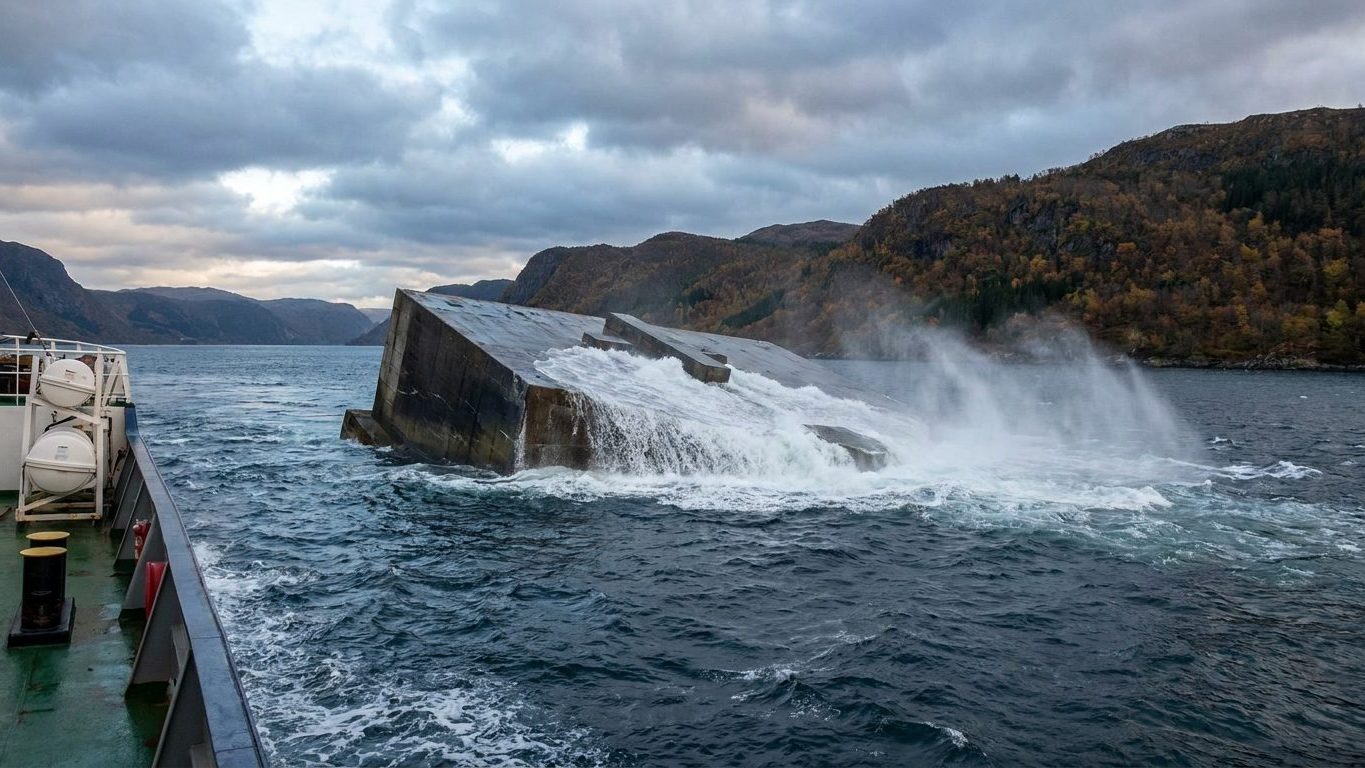
A triangular concrete block, poorly calculated on a simulation software, was enough to send to the bottom of a Norwegian fjord a structure valued at 700 million dollars. On August 23, 1991, at 5:49 a.m., the base of the future Sleipner A gas platform yielded in the Gandsfjord, near Stavanger. In eighteen minutes, the structure disappeared underwater. The cause: a 47% error in a shear-force calculation, coupled with a defect in the anchoring of the reinforcements.
The disaster concerns not a platform in operation, but its concrete base alone, without a bridge or hydrocarbons on board. This base, called a gravity-based structure, belongs to the Condeep family: a type of platform resting on a gravity-based concrete foundation composed of 24 cells, for a total area of 16,000 m². Four of these cells are extended into shafts intended to support the platform’s bridge. This bridge, still on land at the moment of the accident, weighs 57,000 tons by itself and was to accommodate about 200 people once the platform became operational.
- A 47% error in the dimensioning of a concrete tricellule caused Sleipner A to collapse in 18 minutes on August 23, 1991.
- The NASTRAN software underestimated shear forces, making some concrete walls too thin to bear the actual loads.
- A new base was rebuilt in 19 months and the platform began gas production in August 1993, two years after the sinking.
A muffled bang, then water floods in
That morning, the base was undergoing controlled ballast in the Gandsfjord, a routine operation before the bridge’s mooring. The event begins at 5:49 with a loud detonation emanating from inside the structure, followed by two smaller bangs, and a significant leak is immediately detected. The control room does not delay in grasping the magnitude of the problem.
The control station records nearly 1,000 tonnes of water rushing into the drill well, and although ballast pumps are started immediately, the volume entering far exceeds their capacity. Eighteen minutes. That is the time it takes for the structure to sink completely.
The Sleipner A gravity base hits the seabed roughly 18 minutes later, a window of time sufficient to evacuate without injuries the 22 people aboard. The wreck lies at a depth of about 200 meters, the cells would implode under the pressure as they descended. The impact at the fjord bottom is violent enough to register as a seismic event of magnitude 3.0 on the Richter scale, leaving only a jumble of debris in its wake.
The faulty calculation, revealed by the SINTEF investigation
The inquiry is launched without delay. Immediately, Statoil, the platform’s owner, forms an investigative panel, with the SINTEF institute acting as technical advisor. Technicians trace the problem to a single component: the tricell, this triangular concrete junction where several cylindrical cells of 12 meters in diameter converge.
The verdict is a double failure, technical and material. The post-accident investigation retraced the error to an inaccurate finite-element approximation of the linear-elastic model of the tricellule, performed with the NASTRAN software, widely used at the time: shear forces had been underestimated by 47%, leading to an undersized design, some concrete walls not thick enough. A simple misparameterization in a numerical model, echoed in tons of poorly dimensioned reinforced concrete.
The more troubling part would come later. Once the accident happened, engineers recomputed the calculations, this time correctly. A more thorough finite-element analysis, conducted after the accident, predicted that the rupture would occur with this design at a depth of 62 meters, which matches closely the actual event at 65 meters. A three-meter discrepancy between the corrected theory and field reality. The original calculation’s margin of error, by itself, had cost an entire platform.
700 million dollars and a reconstruction in 19 months
The bill is heavy. The investigation estimates the total economic loss at around 700 million dollars, while the value of the destroyed structure itself is estimated at 1.8 billion Norwegian kroner by the operator. Two separate figures, one measuring the overall impact of the disaster, the other the value of the lost structure.
Norwegian Contractors, the company tasked with building the base, does not collapse as a result. According to a widely recounted anecdote, project managers, summoned before Statoil’s board and fearing a harsh sanction, were asked whether they could rebuild a new base faster than planned. Their affirmative reply proved correct in the end.
A new base was constructed in only 19 months. The schedule was kept: the replacement structure left the construction site on June 7, 1993, heading for the gas field. Gas production began on August 24, 1993, almost exactly two years to the day after the original structure’s sinking, even though contractual deliveries were initially slated for October 1 of the same year.
An exemplary case still taught
The Sleipner A accident left a lasting mark on offshore structural engineering. It illustrates a risk inherent in any numerical simulation: a mathematical model is only an approximation of physical reality, and a poorly chosen simplifying assumption—such as the boundary conditions used to model the tricellule—can invalidate months of calculations without anyone noticing until real-world testing.
The University of Minnesota, which documented the case in detail from SINTEF reports, still cites it today as an example in the teaching of finite-element calculation. Sleipner A, the real one, has operated since 1993 without notable incident and even serves as a pioneering site for geological CO2 storage since 1996, a second life that no one would have bet on the morning of August 1991.
Sources: tex.unica.it | members.home.nl
