
The turquoise lagoon born from an engineering error
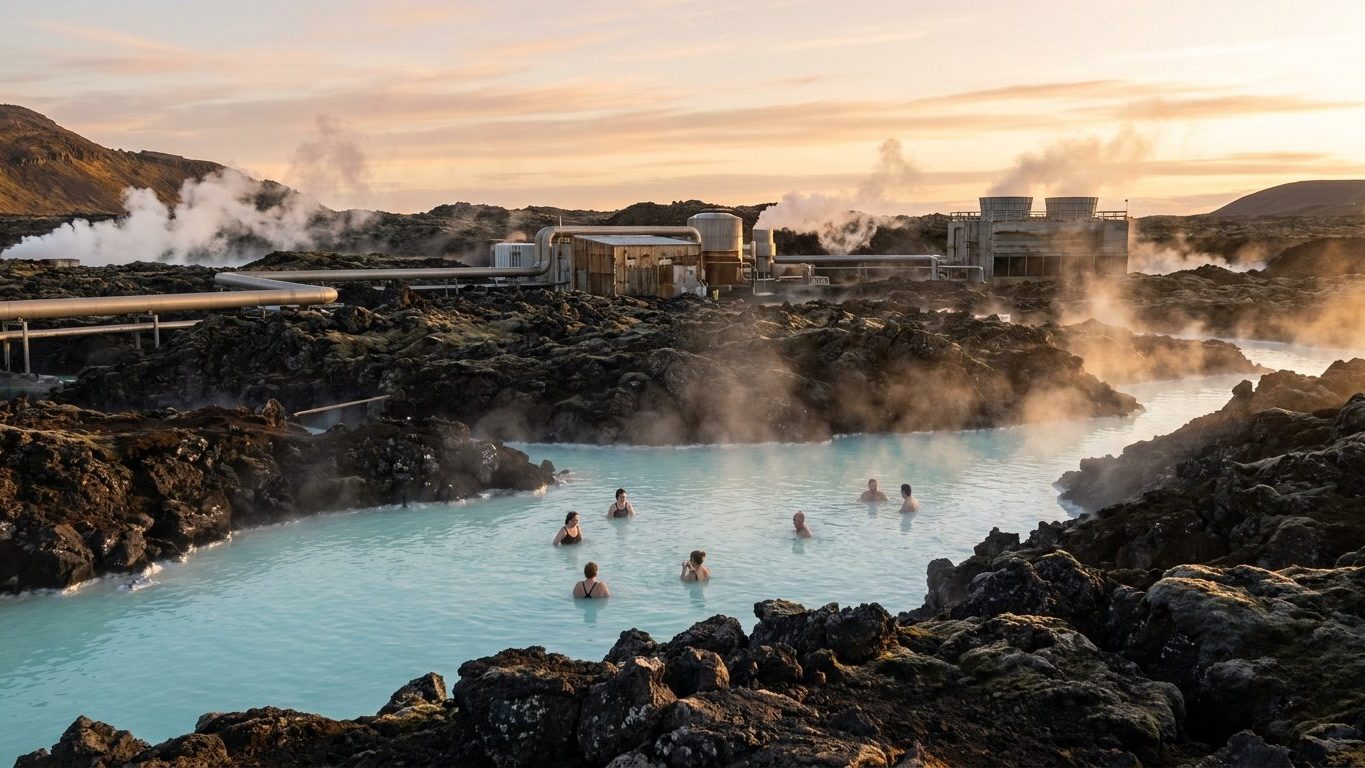
In a field of lava in the southwest of Iceland, a turquoise lagoon has been steaming since 1976, a sight that tourists treat as a natural wonder. Yet no one drew it, dug it, or imagined it. It is the byproduct of a power plant, an industrial accident that became one of the country’s most photographed attractions.
- The Icelandic Blue Lagoon results from an engineering mistake: the geothermal water could not seep into the lava as planned.
- The silica present in the water clogged the rock’s pores and gave birth to this opaque, turquoise basin that did not exist initially.
- The site has drawn about 1.3 million visitors annually since the tourism boom of the 2000s, turning an industrial accident into a global brand.
An engineering error that went wrong—in the right direction
It all began with the commissioning of the Svartsengi geothermal power plant. Construction started in 1976. The installation taps into the heat beneath the Icelandic crust to produce electricity and hot water, a resource plentiful on this island perched along the Mid-Atlantic Ridge.
The plant then discharged its surplus geothermal water into a nearby lava field. The original plan was simple: let the water seep into the porous rock and disappear. Nothing more.
But the rock did not cooperate. The milky tint of the water came from its high silica content, which reflects sunlight in a distinctive way. That same silica, depositing day after day, gradually clogged the lava’s pores. The drainage that the engineers had anticipated never occurred. The water began to stagnate, then spread across the black rock, eventually forming this opaque, blue basin that had never been meant to exist.
The first swimmer hardly believed it
The locals watched this water body grow with skepticism. It was spoken of as the plant’s wastewater, not exactly an invitation to swim. The surrounding residents treated the blue water as what it officially was: a byproduct of a power station, and they avoided taking a dip.
One man changed the course of events. In 1981, a plant employee named Valur Margeirsson, who suffered from psoriasis, asked for permission to bathe in the hot water discharged, hoping the mineral-rich water might ease his skin. The risk was considerable. It turned out to be a fortunate risk.
The following days saw others follow his lead. In the early 1980s, several psoriasis patients from the area, including Valur Margeirsson and Gísli Kristjánsson, began swimming in the water and reported relief from their symptoms. Word-of-mouth did the rest.
From a hole in the lava to a company employing hundreds
The bathing facilities opened in 1987, and by 1992 the Blue Lagoon company had been established. What had been a mud pool tolerated by a handful of stubborn bathers evolved into a properly organized operation, complete with changing rooms and staff.
Science followed public interest rather than preceding it. Studies conducted in the 1990s confirmed that the lagoon had a beneficial effect on psoriasis, and a clinic dedicated to this skin condition opened in 1994, before the company began marketing in 1995 skincare products featuring silica, algae, and salt. The industrial accident had transformed into a brand, with its own cosmetic line drawn directly from the mud that had blocked the basin.
Visitor numbers rose along an almost vertical curve. The site remained relatively obscure until the 2000s, after which Iceland’s tourism boom propelled it to must-see status. The lagoon logged 1.3 million visitors in 2017, up from 919,000 in 2015. Two years later, the influx had swelled by nearly 400,000 bathers—a staggering rise in a country with a population just over 300,000.
A power plant still in operation, right beside the bathers
The most striking detail for visitors is the unvarnished proximity of spa and industry. The Svartsengi plant continues to operate right beside the lagoon, surrounded by fresh lava flows, and visitors can observe how this improbable pairing of science and nature gave birth to one of Iceland’s best-known attractions. There is no staging, no artificial backdrop: the pipes and technical structures are visible from the pool.
The water renewal follows an industrial tempo more than a natural one. The basin never remains stagnant for long; it is continually fed by the discharges of the neighboring plant, which also explains why its hue remains stable across seasons despite tens of thousands of bathers rotating through each month.
That is what makes the Blue Lagoon story so remarkable in the panorama of global tourism. It is neither a protected site nor a geological phenomenon preserved for millennia, but the outcome of an engineer’s miscalculation that went right. The next time a place seems almost too perfect to be natural, it may be worth asking: what if it is indeed exactly that?
Sources: scandinaviastandard.com | perlan.is
