
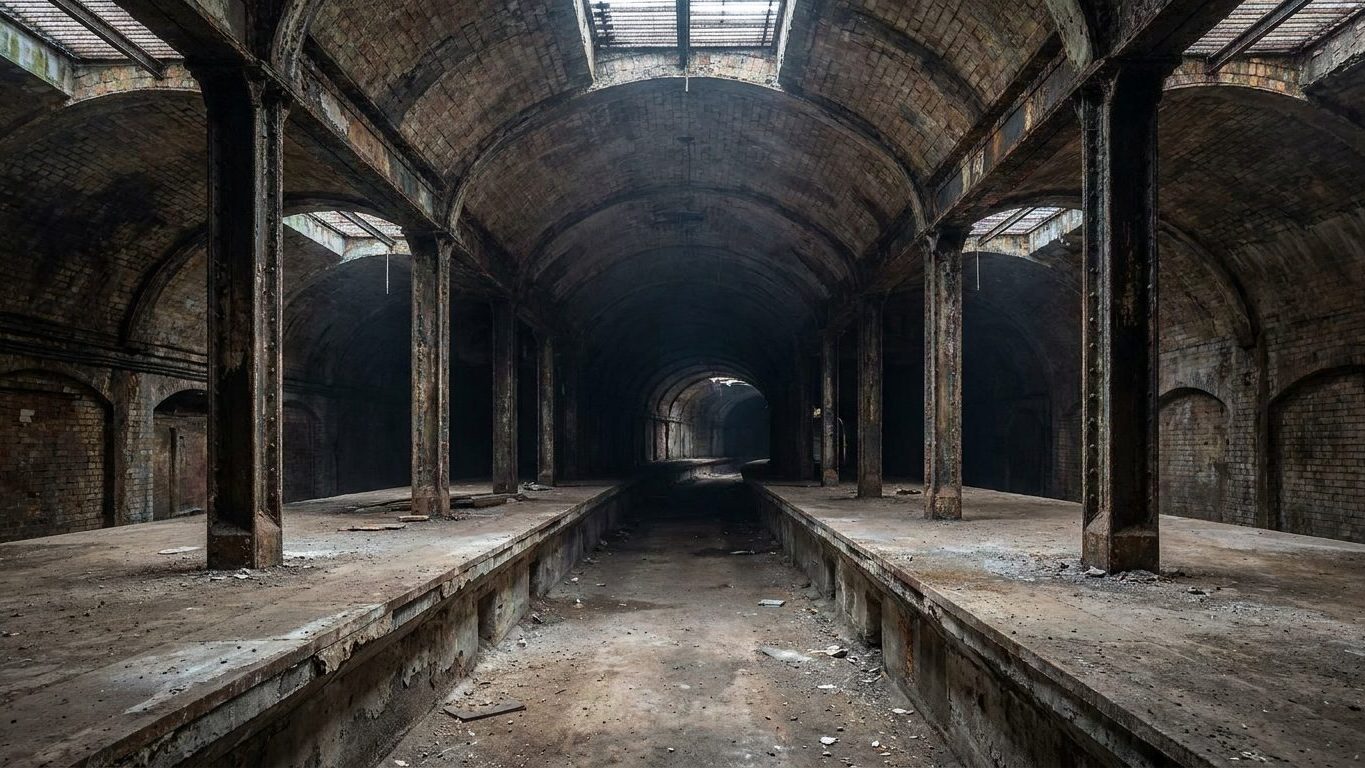
Under a broad avenue in the American Midwest, traffic never stops. Cars, buses, and trucks rush above an emptiness they ignore. For just below, a few meters from the pavement, subway platforms have waited since 1928 for travelers who will never come. The stations are clean, almost untouched, frozen in a mineral silence that only the muffled hum of the pipes disturbs.
The story begins with a canal. This waterway, built in the 19th century to carry goods and passengers, had fallen into obsolescence with the rise of the railway. It had become a stagnant, foul-smelling trench slicing through the city’s heart, offering no service at all. The municipal authorities then saw an extraordinary opportunity: why not drain this abandoned canal and, in its bed itself, dig the tunnels of a modern subway?
- A complete metro was dug beneath an American avenue between 1920 and 1928 in the former canal bed.
- Lack of funding and the economic crisis stopped the project before the rails and rolling stock could be installed.
- The tunnels and stations remain intact beneath the avenue and today house water mains and electrical cabling.
An avenue built to conceal a canal, then a subway
The idea won broad support from the public, who approved the project by referendum. The logic seemed flawless: reuse an existing path through the city center, without expropriating entire neighborhoods, while offering the city a fast transport system to relieve its congested streets. Work began in the early 1920s, during a decade still buoyed by the belief in perpetual expansion.
Miles of galleries were dug in the canal’s former bed. Entire stations were plastered in with their platforms, their staircases, their brick vaults carefully matched. The construction progressed methodically, section by section, under the gaze of a city convinced it had finally found a solution to urban congestion.
Then the money ran out.
The funding drought that halted it all
The initial budget, already cut back due to postwar inflation, proved insufficient to complete the entire planned route. The underground tunnels were finished, but the overhead sections and the railway equipment—rails, rolling stock, signaling—never followed. The decade ended with a halfway project: neither fully finished nor completely abandoned.
Political context offered little help. The quarrels between the city and the project’s oversight bodies slowed every decision and every new funding. Then the late-1920s economic crisis delivered the coup de grâce. There was no longer the will or the means to resume work, and the subway remained frozen in the state in which the money had left it.
The city finally covered it all. A broad avenue was laid out exactly above the underground route, using the footprint already freed by the canal works and then the subway works. On the surface, nothing betrayed what slept beneath.
Galleries turned into technical corridors
Today, these tunnels and stations have not disappeared. They are still there, beneath the avenue, in a preservation state that often astonishes those who manage to descend into them. The platforms remain, the rail supports are still fixed to the floor, and the stations seem frozen, as if still waiting for passengers who will never come.
Their current use is not spectacular, but it justifies their minimal maintenance. The tunnels today host water mains and electrical cabling, a purely technical role that explains why the city never had to choose between filling in the galleries or destroying them. They serve, modestly, as an underground conduit for networks that would have to be housed somewhere anyway.
The refrain of redevelopment proposals
Regularly, the idea resurges. Transform these galleries into a museum, a cultural space, an underground bike path, or even relaunch a genuine public transport project: proposals have never been in short supply for decades. Redeployment attempts have swung from storage to civil defense, from mushroom cultivation to film shoots, with none taking root sustainably.
Each study rekindles hope, each time without a lasting outcome. Every few years, new plans for these tunnels surface again, carried by elected officials or residents’ groups convinced that this underground heritage deserves more than a simple piping job. Yet the cost of a full restoration and the lack of consensus on the preferred use inevitably push the file back to a standstill.
What remains striking, at bottom, is the persistence of the built environment beneath a city that has changed its face several times in a century. Cars roll by, shops change their signs, residents come and go without knowing what lies beneath their feet. And the platforms, in the dark, keep waiting for a train that will never have the chance to enter the station.
