
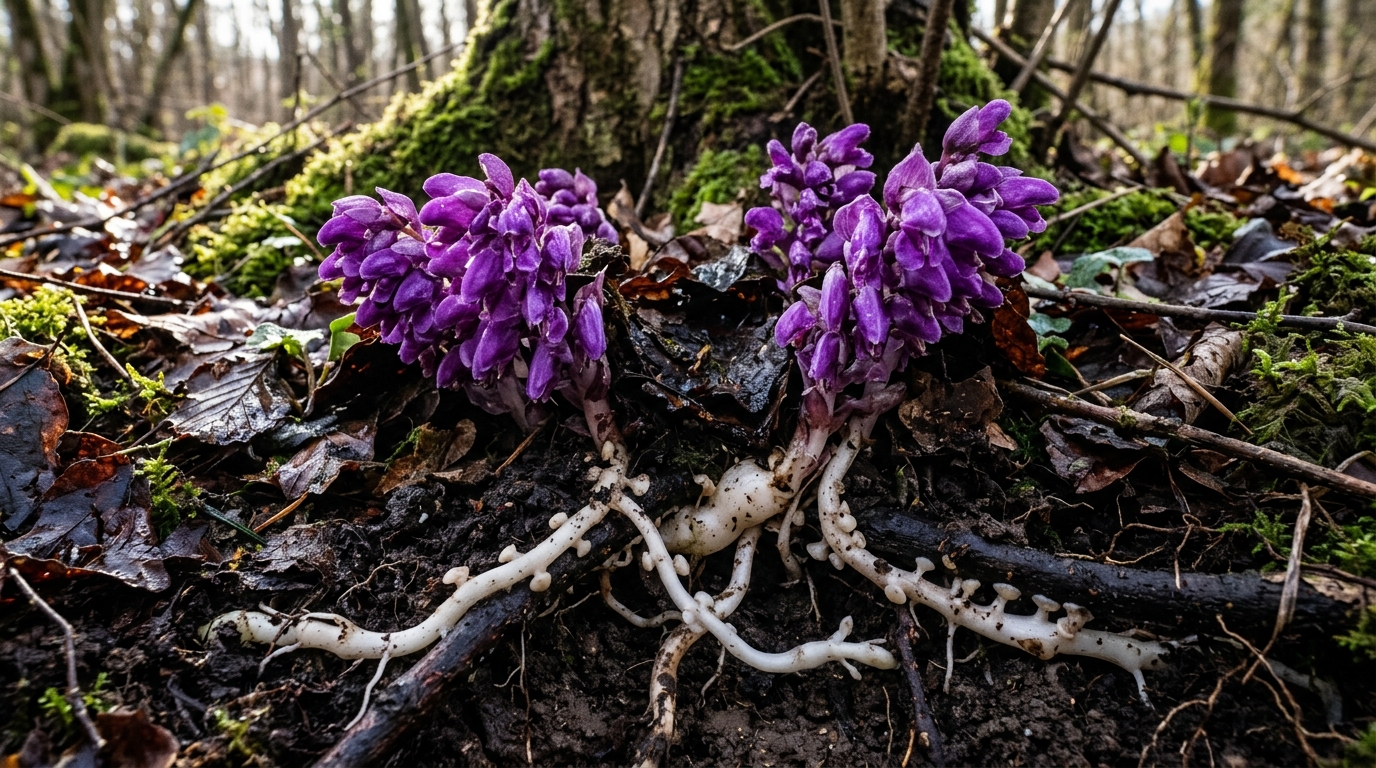
Imagine a plant capable of living for years on end without ever seeing daylight, without a single green leaf, without the slightest trace of chlorophyll in its cells. A plant that literally makes nothing on its own and must borrow everything from its neighbors. This scenario, worthy of a science-fiction episode of botany, is actually unfolding beneath our French forests, at the foot of hazels, alders and hornbeams. Its name: the Lathraea clandestina, or scale-leaved lathraea depending on the region. At the tail end of the summer, as nature begins to slow down, this strange vegetal creature already slumbers underground, invisible, waiting patiently for the next spring to reveal its discreet bloom. Here is the fascinating story of a plant that chose to bend the elementary rules of botany.
- The clandestine lathraea is a chlorophyll-free plant that feeds exclusively through haustoria implanted in the roots of trees such as hazel, alder or hornbeam
- It flowers only between April and May with violet flowers, then disappears entirely from the surface while surviving thanks to a vast underground rhizome
- This parasitism remains harmless to the host trees, which continue to grow normally despite the limited sap extraction.
- A plant that never photosynthesizes and steals from its neighbors
- A flower that only emerges from the ground once a year
- The underground network it diverts for its own gain
- Why hazel trees never die from this relationship
- What this ghost plant reveals about forest ecosystems
A plant that never photosynthesizes and steals from its neighbors
Most vegetation draws its energy from the sun through photosynthesis, a chemical process that turns light into nourishing sugars. The clandestine lathraea has, quite simply, given up this strategy. Lacking chlorophyll and true leaves, it has no means of producing its own organic matter. Its solution is radical: it hooks directly into the roots of nearby trees—primarily the hazel, willows, poplars, alders and oaks—to steal water and nutrients.
This connection is made through very particular organs called haustoria, or suckers. These structures insinuate themselves into the host tree’s root tissues, a bit like a blood transfusion cannula drawing from a vein. The result is total and permanent parasitism, unique in the country’s flora, where a plant can survive without ever catching a single ray of sunshine.
A flower that only emerges from the ground once a year
While the clandestine lathraea spends most of its life buried underground, it reserves a brief visible appearance each year, precisely when the trees’ sap begins to circulate vigorously again. The bloom occurs between April and May, a narrow window during which flowers of a deep violet-purple, and on rarer occasions pink or white, finally pierce the soil’s surface. It is literally the only part of the plant that is seen above ground.
From the end of May, the spectacle ends as quickly as it began: the aerial portion vanishes, as if swallowed by the earth. But rest assured, the plant is not dead. It simply retreats into its vast underground network, ready to resurface in the very same spot the following year. A discreet cycle that explains why the clandestine lathraea remains so little known, even to the most attentive walkers.
The underground network it diverts for its own gain
What is never seen, and yet constitutes the essential biomass of this plant, is its subterranean apparatus. Formed of branched white stems, covered with scaly, fleshy bracts, this assembly can reach several kilograms, a considerable weight for an organism lacking leaves. It is this dense and hidden network that ensures the plant’s survival from one year to the next, remaining connected to the host roots long after the flowers have disappeared.
Even more remarkable is that this underground system is not spatially fixed. Rhizome fragments can be ripped away by river floods and redeposited further downstream, allowing the plant to colonize new territories as the water carries it along. This is why the clandestine lathraea is found mainly in moist, humid woods along riverbanks, in the southwest, the Massif Central and the western part of France. An almost aquatic mode of dispersal, quite unusual among terrestrial plants.
Why hazel trees never die from this relationship
One might think such an organized theft of resources would eventually exhaust the host trees. Yet this is not the case. Field observations show that the sap withdrawal performed by the clandestine lathraea remains limited and sporadic. Hazel, alders or hornbeams that are parasitized continue to grow normally, with no visible signs of weakness or decline. The relationship resembles a discreet tax levied on a budget that remains more than ample, rather than a deadly siphoning.
This tolerance likely stems from the fact that the lathraea only targets a tiny portion of the host’s root system, while the tree generally possesses a much larger network than what the parasite can exploit. An intriguing detail that even fascinates botanists: some propose that the lathraea may possess a partially carnivorous facet, with tiny insects getting trapped in small glandular cavities located on its underground stem. A supplement to its already singular diet.
What this ghost plant reveals about forest ecosystems
Beyond its extraordinary lifestyle, the clandestine lathraea illustrates how French forests cradle underground relationships of surprising complexity. The plant’s seeds take several years, sometimes even a decade according to certain observations, before their rhizomes grow enough to produce a first flowering. This underscores how patience is the guiding principle of an existence entirely built beneath our feet, far from prying eyes.
This plant also reminds us that the forest is not limited to what can be observed on the surface. Beneath the humus, an invisible network of roots, fungi and parasitic organisms weaves connections that condition the balance of an entire ecosystem. The clandestine lathraea, with its discreet lifestyle and apparent fragility, remains a truly functioning cog in this forest machinery, as silent as it is essential.
Next time you walk in spring along a shaded stream, beneath hazel branches, take a moment to scan the ground at your feet. Perhaps you will glimpse those small purple flowers, the sole visible sign of a vast underground organism that has thrived for years without ever producing a speck of its own nourishment. A humbling lesson from the subsoil, inviting us to rethink what it really means to live in balance with one’s environment.
