
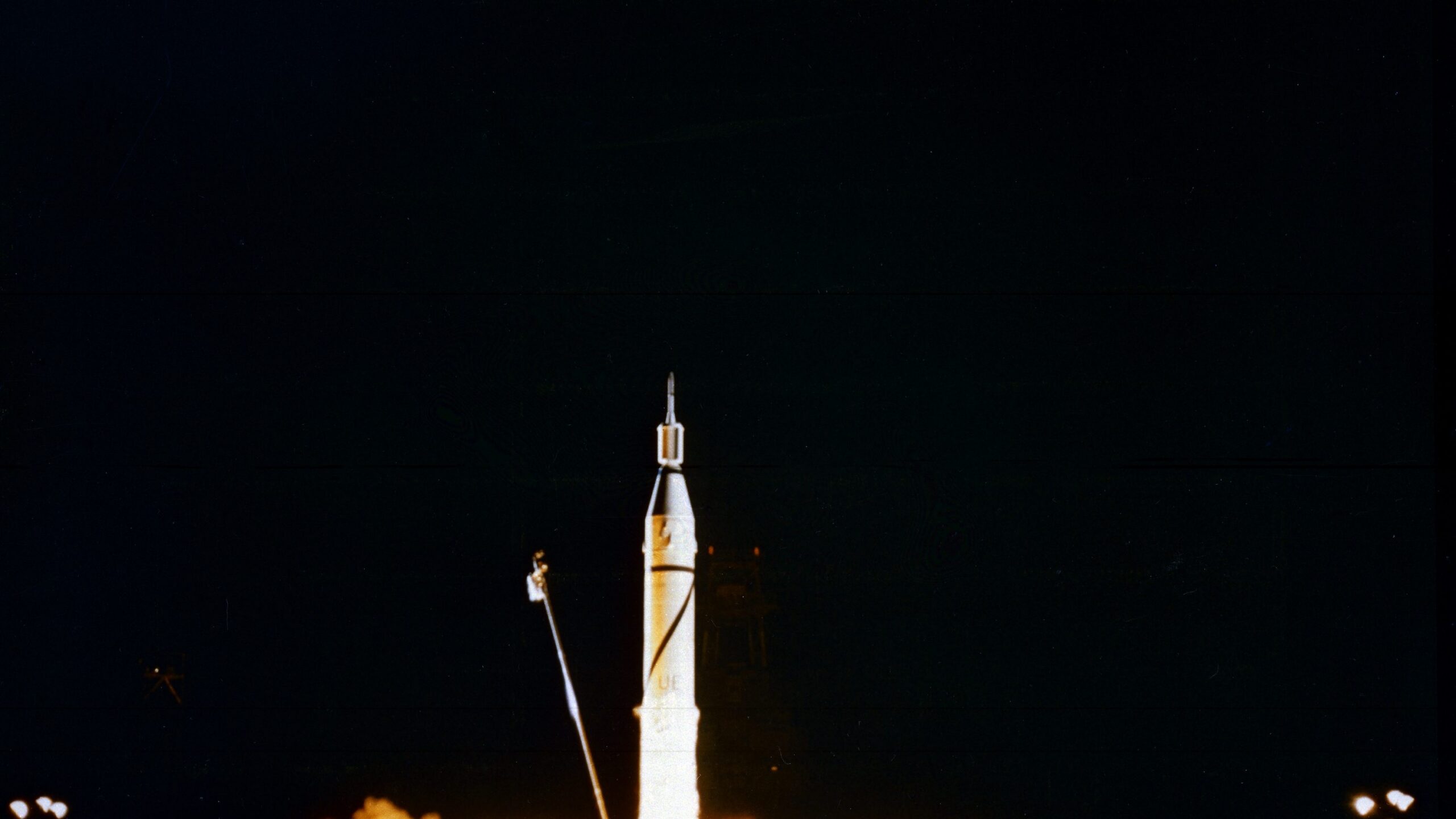
An object the size of a grapefruit continues to orbit the Earth, sixty-eight years after its launch. Vanguard 1 was sent by the United States on March 17, 1958, during the space race against the Soviet Union. Nobody has spoken to it since 1964. And yet, catalogs of orbital objects keep tracking it with the precision of a post-sale service department that would never close.
Vanguard 1 is an American satellite, the fourth artificial Earth satellite to be launched successfully, after Sputnik 1, Sputnik 2 and Explorer 1, launched on March 17, 1958. Its size fits in a hand. It measured only 16.3 centimeters in diameter and about 1.5 kilograms, and despite its six slender antennas that made it seem more imposing, the craft itself was grapefruit-sized. The nickname actually came directly from Moscow: Soviet Premier Nikita Khrushchev had derisively dubbed it a “grapefruit satellite.”
Its small size hid a major innovation. Vanguard 1 was the very first satellite to feature a solar electrical power supply. A technical choice that changed everything for its longevity of operation.
- Vanguard 1, launched in 1958, is the oldest artificial object still in orbit after 68 years
- The silent satellite since 1964 should remain in orbit about 240 years, until the 22nd century
- Its revolutionary solar cells and its high orbit allowed it to survive while its predecessors burned up in the atmosphere
Why it keeps flying when others have fallen
Sputnik 1, Sputnik 2, Explorer 1. All Vanguard 1’s predecessors have long since fallen back into the atmosphere, one in a few months, another in about a dozen years. Vanguard 1, by contrast, has held on. Although communications with the satellite were lost in 1964, it remains the oldest artificial object still in orbit, together with the upper stage of its launch vehicle.
The explanation lies in its altitude. The third stage of the rocket placed Vanguard 1 on an orbit of 654 by 3,969 kilometers, with a period of 134.27 minutes and an inclination of 34.25 degrees. An orbit so high that most of the satellite’s journey unfolds far from the atmospheric drag that would have eventually pulled it down, unlike its predecessors that stayed much lower.
Its batteries offered only three weeks of autonomy. That’s where its solar cells took over, a feat for the era. The signal powered by the batteries lasted 20 days, while the solar-powered signal held for six years. The last signal from the satellite came from a tracking station in Quito, Ecuador, in May 1964. Since then, total radio silence, but a continuous physical presence.
A trajectory that redefined the shape of the Earth
The silent object has nonetheless continued to speak to scientists, in its own way. By observing the deviations of its trajectory from theoretical predictions, researchers uncovered a major insight about the true shape of our planet.
The pear-shaped Earth theory was born from data received from Vanguard 1 in 1958, whose orbit varied with a long periodicity, revealing a stronger gravitational pull in the southern hemisphere, indicating a flattening at the South Pole and a corresponding bulge at the North Pole. A geodesy breakthrough that no one expected from a device originally designed for testing a simple three-stage rocket.
Still in the catalog, despite radio silence
The NASA catalog dedicated to Vanguard 1 preserves the mission file and its orbital parameters under its international designation, 1958-002B, the modern continuation of a tracking effort started when the satellite was among the few objects in orbit. It also carries a SATCAT number, 00005, proof that it ranks among the earliest objects ever cataloged.
How long will it keep turning? Estimates vary, but they remain impressive on a human timescale. NASA has published an orbital lifetime of about 240 years since launch, which would place its re-entry toward the end of the 22nd century. A projection to be treated with the caution warranted by calculations spanning two centuries, but it gives a sense of the order of magnitude.
Some even dream of bringing it down voluntarily. Experts mention the possibility of returning Vanguard 1 to Earth, a feat that would once again write history. For now, no official decision has been made. The small metallic grapefruit continues, unfazed, its millionth silent lap above our heads.
Sources: spacedaily.com | astronomy.com
