
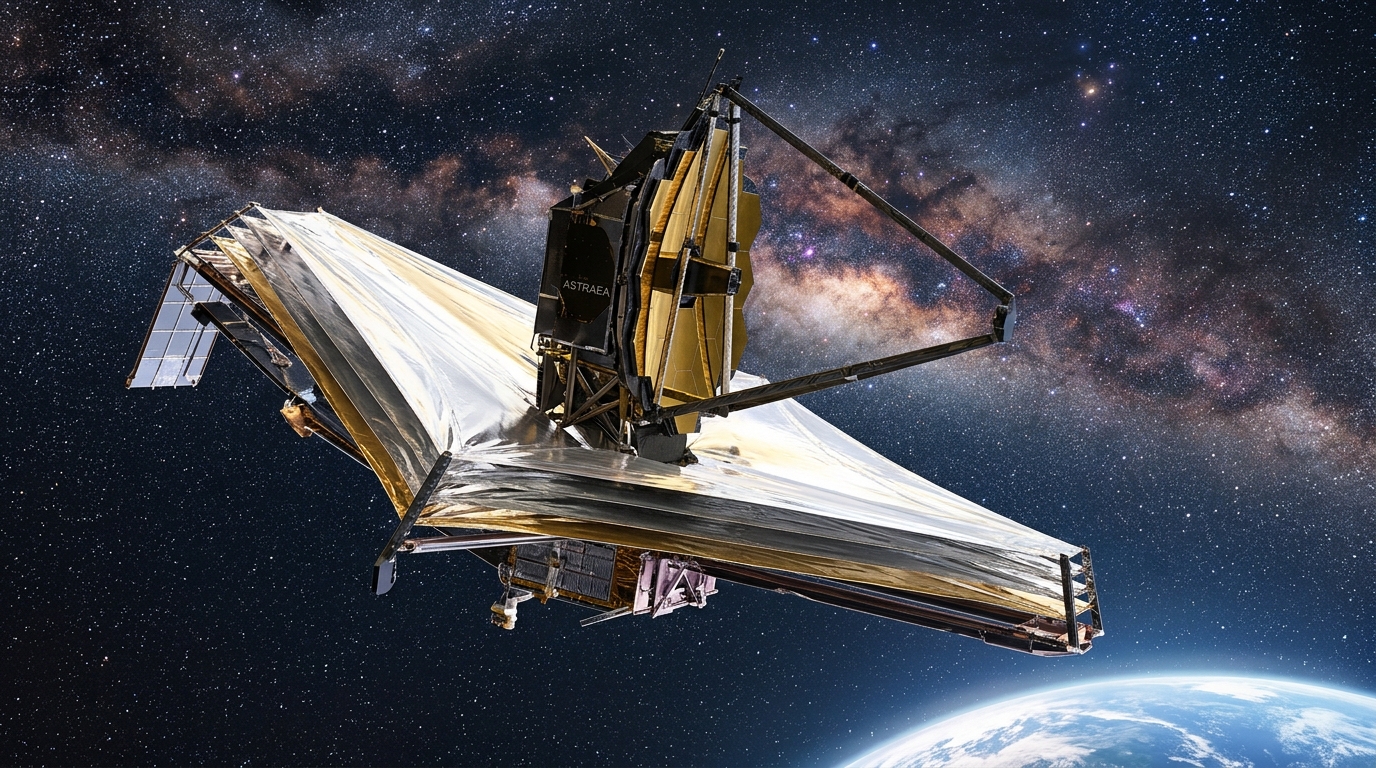
On one side, an engineering feat scrutinized by thousands of scientists over more than twenty years of development. On the other, a centerpiece so fragile and so vast that no laboratory on Earth had ever witnessed its full deployment before launch. This paradox alone sums up one of the boldest bets in recent space history. For when the James Webb Space Telescope departed from French Guiana, it carried with it a thermal shield as large as a tennis court, whose behavior in zero gravity relied solely on calculations and simulations, never on a complete rehearsal. A technological vertigo that we invite you to dissect.
- The James Webb thermal shield, tennis-court-sized, could never be tested fully deployed on Earth due to gravity.
- Its final deployment in space involved 139 actuators and 8 engines that had to operate without any fault, with no possibility for human repair.
- On January 4, the deployment of the thermal shield succeeded without major incident, validating years of calculations never tested in real conditions.
- The James Webb Space Telescope took off with a bold bet
- A thermal shield engineered for the impossible
- Why Earth could not serve as a laboratory
- One hundred seventy-eight mechanisms that must not fail
- A technological wager that ultimately paid off
The James Webb Space Telescope took off with a bold bet
Launched on December 25 by an Ariane 5 rocket from the Guiana Space Centre in Kourou, the James Webb Space Telescope was not merely a successor to Hubble. It carried a component so large that it could not fit into any existing rocket fairing without folding onto itself, in a fashion reminiscent of a vast metal-and-fabric origami. This technical constraint dictated a dizzying scenario: carefully folding the instrument on the ground, then fully unfolding it only once in the vacuum of space, far from any possible human intervention.
NASA therefore had no choice but to trust calculations rather than direct experience. It was impossible to reproduce on Earth the exact microgravity conditions for such a delicate structure. The bet was to believe that thousands of hours of computer modeling would be enough to guarantee the success of a maneuver never tested in full.
A thermal shield engineered for the impossible
This famous shield, composed of five layers of Kapton, an extremely thin plastic material, measures about 21 meters by 14, the exact area of a tennis court. Its mission is crucial: to protect the ultra-sensitive scientific instruments from the Sun’s heat, maintaining a striking temperature gap between the exposed side and the sheltered side. The thickest layer does not exceed 0.05 millimeters, the others being even thinner still.
Such fragility made any full deployment on Earth simply unthinkable. NASA itself labeled this step as the most perilous moment of the entire mission, as the margin for error was razor-thin. A tear, an abnormal rub, and the entire scientific program could have collapsed before it even began.
Why Earth could not serve as a laboratory
On our planet, gravity would have exerted an excessively strong constraint on these ultra-light sails. Therefore, deploying the shield in full without risking irreparable damage was out of the question. Engineers at NASA and Northrop Grumman had to improvise: testing specific sections, working with scaled models, and using complex systems of pulleys, counterweights, and rails to artificially simulate microgravity during mechanical tests.
Result: Webb’s thermal shield was never deployed in full under Earth’s gravity before launch. A dizzying reality, almost counter-intuitive, for one of the most expensive and eagerly awaited scientific instruments of our era. Everything rested on the conviction that the vacuum of space would behave exactly as the models had predicted.
One hundred seventy-eight mechanisms that must not fail
The final deployment, carried out over two consecutive days, involved a machinery of formidable complexity. The first three layers were stretched on Monday, the last two on the following Tuesday, each from the four corners of a diamond-shaped structure. In total, 139 actuators and 8 engines, connected to hundreds of pulleys and meters of cables, had to operate without a single fault for every sail to tension perfectly.
The telescope sat at the L2 Lagrange point, about 1.5 million kilometers from Earth, roughly four times the distance to the Moon, making any repair mission unthinkable in case of failure. Unlike Hubble, which benefited from five maintenance missions by astronauts, James Webb could not rely on any human intervention for rescue. A single speck of dust in this mechanism would have been enough to doom the entire mission.
A technological wager that ultimately paid off
Directed from the Baltimore control center, the entire operation ultimately proceeded without major incident, despite the palpable tension among observers at launch. On January 4, the thermal shield deployed successfully in space, validating in real conditions years of calculations and simulations never tested in reality. A technical achievement hailed as historic, for it rested on a level of confidence rarely achieved in the history of space exploration.
This success opened the way to observations that have since transformed our understanding of the universe, from the earliest galaxies to the atmospheres of distant exoplanets. Yet this deployment milestone remains, to this day, one of the most striking examples of what modern engineering can achieve when direct experimentation is simply no longer possible.
Reflecting on this extraordinary technical gamble, one realizes how contemporary space exploration rests as much on the audacity of engineers as on the power of the calculations that precede them. While other next-generation telescopes are already in development, a question remains: how far can we push the boundaries of what we dare to test on paper before actually launching it into the emptiness of space?
