
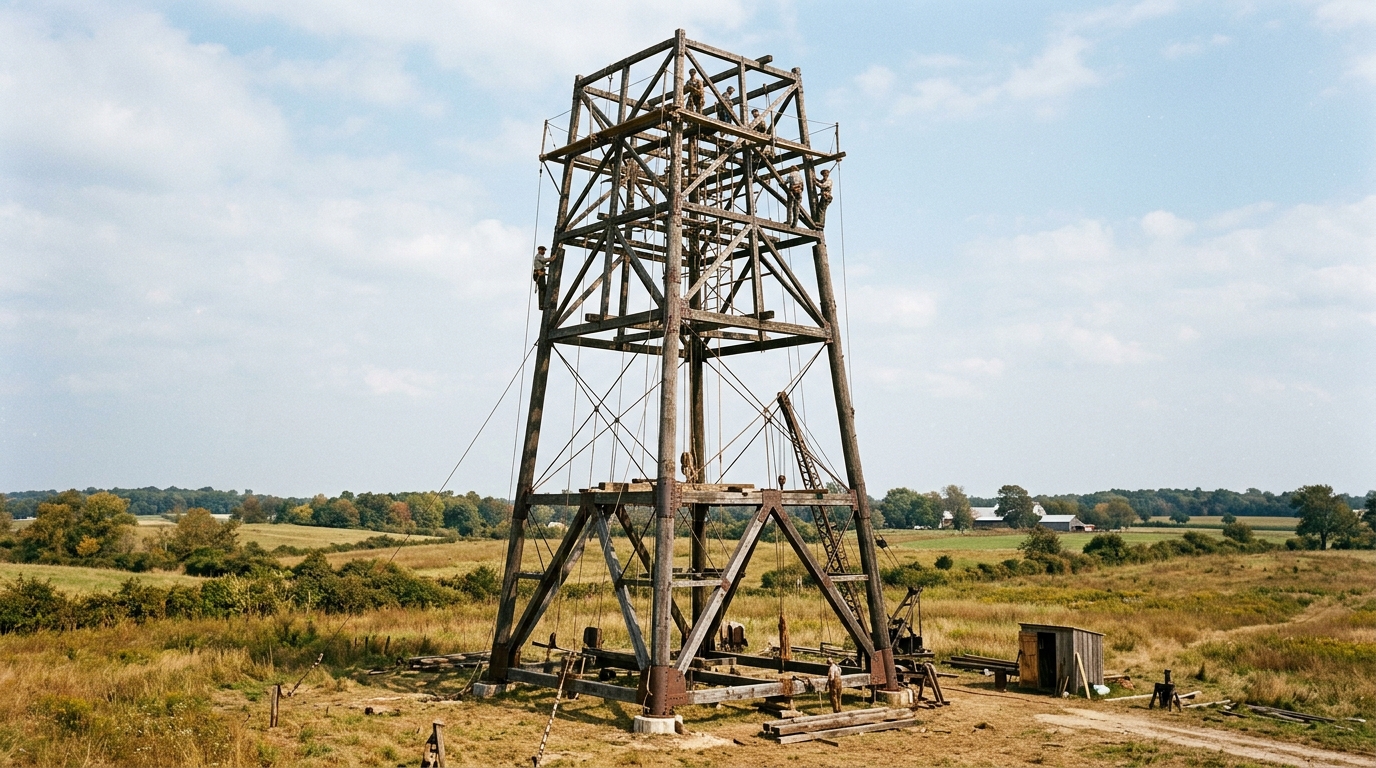
Imagine a 57‑meter‑tall tower, topped with a 55‑ton copper dome, planted in the middle of Long Island’s fields. Its stated objective at the time: to transmit electrical energy without any cables, to ships at sea or offices in London. We are in 1902, and the man behind this crazy project is Nikola Tesla. Three years later, the machines stop, the site empties, and the tower ultimately disappears. What toppled this visionary engineer’s dream wasn’t an explosion, nor a war, nor even a scientific dead end. It was a far more prosaic decision, taken in a New York office, far from coils and artificial lightning.
- In 1901, J.P. Morgan invested $150,000 in the project, persuaded by the promise of transatlantic wireless communication.
- With Tesla shifting the project toward large‑scale wireless energy transmission, Morgan refused any further funding between 1904 and 1905, deeming the initial agreement betrayed.
- Lacking funds, the site was abandoned as early as 1906 and the tower was ultimately dynamited in 1917 to sell the materials and repay Tesla’s debts.
- When Tesla Wanted to Electrify the Planet Without a Single Cable
- Morgan’s Money, the Real Wardenclyffe Switch
- A Phantom Tower Demolished for Its Materials, Not Its Ideas
- What Wardenclyffe’s History Reveals About Sacrificed Innovation
When Tesla Wanted to Electrify the Planet Without a Single Cable
At the very start of the twentieth century, Nikola Tesla did not simply dream: he bought a 200‑acre plot at Shoreham, on Long Island, and launched the construction of what would become the Wardenclyffe Tower. The building, designed with the help of architect Stanford White, rises 187 feet, about 57 meters, and stands out for its impressive metal dome. But behind this feat of architecture lies an ambition even more staggering: to transmit electrical energy through the Earth’s atmosphere, without a single wire, to power devices thousands of miles away.
To finance this technological madness, Tesla convinced in March 1901 one of the era’s most powerful bankers, J.P. Morgan, to invest $150,000, an amount today equivalent to more than $4 million. Tesla’s blockbuster argument? The possibility of sending and receiving messages from London, but also from ships at sea, at a time when wireless communication was barely getting off the ground. Morgan saw a commercial opportunity in it, not necessarily a revolution in energy available to humanity for free.
Morgan’s Money, the Real Wardenclyffe Switch
That is where the story takes a decisive turn, and one that is often overlooked. Tesla, along the way, alters his original design: it is no longer merely about challenging Guglielmo Marconi’s wireless telegraph system, but about transmitting electricity itself, on a grand scale, to light and power the whole world. A grand project, but one that diverges considerably from the terms of the initial contract signed with Morgan.
When Tesla returned to ask for additional funds to actualize this expanded vision, Morgan’s answer was blunt and final: he would not be willing to make further advances at that time. The banker believed the inventor had breached the agreement between them, and he refused to dig deeper. This withdrawal of financing, occurring between 1904 and 1905, sealed Wardenclyffe’s fate. Without fresh money, there was no way to finish the installations, much less to bring them online.
By 1905, the project slowed to a crawl, then ground to a complete halt. In 1906, most of the staff were dismissed and the laboratory, once buzzing with activity, stood virtually deserted. Cornered, Tesla took out a first mortgage on the property in 1904, then a second in 1908, in a final effort to keep the site afloat. But by that date, Wardenclyffe already looked like an empty shell.
A Phantom Tower Demolished for Its Materials, Not Its Ideas
The project was officially abandoned in 1906, never having transmitted a single watt of wireless energy. The tower remained upright, silent, like a relic of thwarted ambition. Its final fate was not glorious: in 1917, it was dynamited and demolished, not because it posed a threat or an established scientific failure, but simply because the landowner at the time sought to recoup money to pay off Tesla’s debts. The structure was dismantled to sell the materials, a nearly ordinary ending for a project that claimed to be revolutionary.
This downfall had nothing to do with any technical impossibility nor with the geopolitical upheavals of the era. It was the funding question, and the loss of confidence by a single man, that precipitated the end of the venture. Today, the site houses the Tesla Science Centre, a memorial dedicated to the inventor’s life and work, turning this place of failure into a symbol of his visionary genius.
What Wardenclyffe’s History Reveals About Sacrificed Innovation
The Wardenclyffe episode illustrates a reality that runs through the entire history of major innovations: technique alone never suffices to bring a bold project to fruition. It is also necessary to persuade, reassure, and sometimes bend to the economic logic of those who hold the purse strings. Tesla, a brilliant engineer but a poor negotiator, paid the price of a vision too generous for his time, one that offered energy accessible to all without an immediate financial return for its investors.
More than a century later, this story still resonates as a warning for anyone interested in technological breakthroughs. How many promising ideas have been abandoned not because they didn’t work, but because funding dried up at the wrong moment? Wardenclyffe remains, in this sense, a fascinating case study where science and finance collided with irreversible consequences.
Reflecting on this vanished tower, one measures how innovation rarely depends on a single factor. Would Wardenclyffe have changed our relationship with energy if Morgan had kept his support? Impossible to say for sure, but the history reminds us that a brilliant idea, no matter how solid on paper, always rests on the confidence of those financing its realization.
