
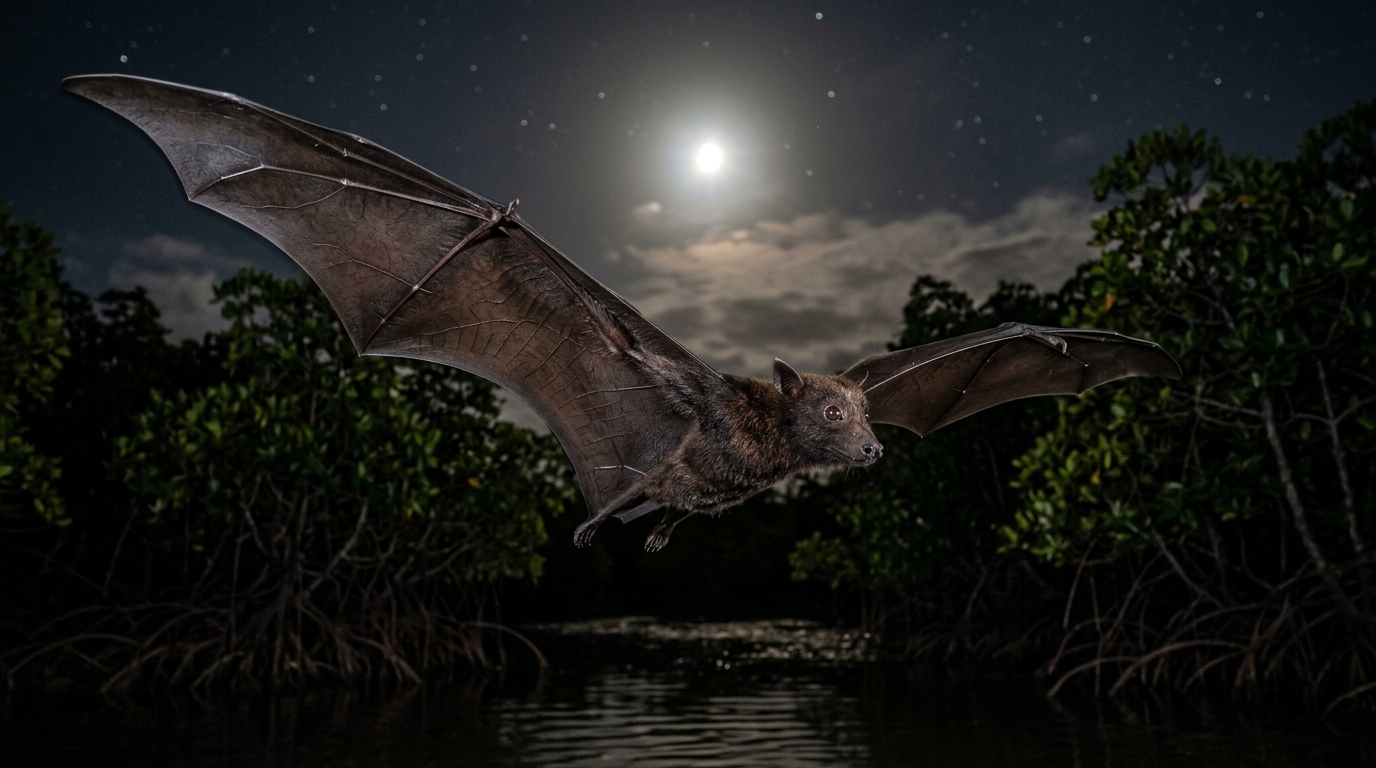
On Mayotte, as the sun sinks behind the tannes and the mangroves, a silent ballet begins to move above the mangroves. This is not a bird, nor even an ordinary bat: it is the Comoros flying fox, a flying mammal capable of spreading a wingspan of almost 1.30 meters. On this small overseas territory in the Indian Ocean, this discreet and little-known animal holds between its wings the future of several emblematic tree species, starting with the baobab. A role so specific that nothing in the local ecosystem seems able to replace it.
- The Comoros flying fox, an endemic bat reaching a wingspan of up to 1.30 meters, pollinates the nocturnal flowers of the baobab and the kapok tree while dispersing their seeds
- Protected since 2000 and strengthened in 2013, and listed on CITES Appendix II, it remains locally hunted for its meat or in response to damage to fruit crops
- Its population, estimated at 900 to 1,200 individuals across the Comoros archipelago, is deemed concerning because no other local pollinator can fulfill its irreplaceable ecological role
- A wingspan of 1.30 m gliding above the mangroves
- The discreet giant no one can replace
- Why Mayotte’s baobabs depend on it to survive
- Protected since 2013, but still threatened every night
- What Mayotte would lose without its giant bat
A Wingspan of 1.30 m Soaring Above the Mangroves
Every night, above Mayotte’s mangroves, a creature of impressive proportions takes to the air. Measuring 30 centimeters in length, 700 grams in weight, and with a wingspan approaching 1.30 meters, the Mayotte flying fox is nothing like your usual bat. Nicknamed ndrema in Shimaoré or the flying fox, it belongs to an endemic Comoros subspecies, Pteropus seychellensis comorensis, a close relative of a species native to the Seychelles.
The Discreet Giant No One Replaces
Unlike most bats, often strictly nocturnal and stealthy, the Mayotte flying fox displays a rather atypical behavior. It is particularly active at dawn and in the late afternoon, making it a relatively diurnal species. It is found gathered in colonies of 5 to 50 individuals, perched in large trees where it spends the day resting before heading out to forage. Its diet is wide-ranging: mangoes, papayas, badames, figs, breadfruit, and kapok tree flowers make up the core of its menu.
What makes this species so special is that it occupies a unique ecological niche that almost no other animal on the archipelago can fulfill. Its size, its ability to fly long distances between forested massifs, and its regular visits to nocturnal flowers make it an irreplaceable link in Mayotte’s ecological chain. An older estimate placed its population at 900 to 1,200 individuals across the Comoros archipelago, a figure that, given the size of Mayotte, remains troubling.
Why Mayotte’s Baobabs Depend on It for Survival
The link between the flying fox and the baobab rests on true coevolution. Baobab flowers, whether Adansonia digitata or Adansonia madagascariensis, have adopted a nocturnal blooming strategy: they open at dusk, hang at the end of a long stalk to ease aerial access, and emit a sharp, powerful scent that guides the bat to them in the dark. By feeding on their nectar, the flying fox picks up pollen on its wings and fur, ensuring cross-pollination essential to the reproduction of these ancient trees that can live for centuries.
This role does not stop at the baobab. The bat also contributes to the pollination of the kapok tree, another emblematic species of Mayotte’s landscapes. By consuming fruits and flowers and then dispersing seeds through its droppings during its nocturnal travels, it acts as a true engine of regeneration for the forests that fringe the mangroves. Without it, a whole swath of the island’s plant biodiversity would lose its principal agent of natural reproduction.
Protected Since 2013, But Still Threatened Every Night
Aware of the species’ fragility, the administration established an initial protection framework in 2000, with a prefectural decree prohibiting at all times and across the entire territory of Mayotte the destruction, capture, removal, domestication, transport, sale, or purchase of the flying fox. This local regime was later strengthened by an expanded protection status in 2013, consolidating the species’ safeguarding in law. The flying fox also enjoys international recognition, as it is listed on Appendix II of the CITES convention, which means that any international trade involving it requires an export permit or a re-export certificate.
Despite this legal arsenal, field reality remains more nuanced. The flying fox is still occasionally hunted by certain local populations, sometimes for its meat, sometimes in response to the damage it causes to crops. A big fan of papayas, guavas, and mangos, it regularly invades orchards and gardens, causing real economic losses for Mayotte’s farmers. This conflict between preserving an essential species and protecting harvests illustrates the difficulty of coexisting human activity and the natural balance on a territory as densely populated as Mayotte.
What Mayotte Would Lose Without Its Giant Bat
Imagining Mayotte without its giant flying fox is to imagine baobabs no longer flowering for nothing, mangrove forests deprived of their main seed-disperser, and a whole swath of the island’s natural heritage silently collapsing. This bat is not merely an impressive creature by size: it is the invisible link that ties the nocturnal flowering of giant trees to the ongoing regeneration of the island’s forest ecosystems. No other local pollinator possesses both the wingspan, mobility, and diet required to deliver this ecological service on such a scale.
As tensions between agriculture and biodiversity preservation persist across the archipelago, the Mayotte flying fox continues, night after night, its quiet work as a flying gardener. Perhaps it is time to view this immense silhouette crossing Mayotte’s twilight sky differently, not as a nuisance to orchards, but as one of the island’s last guardians of an balance that nothing today seems able to reproduce.
