
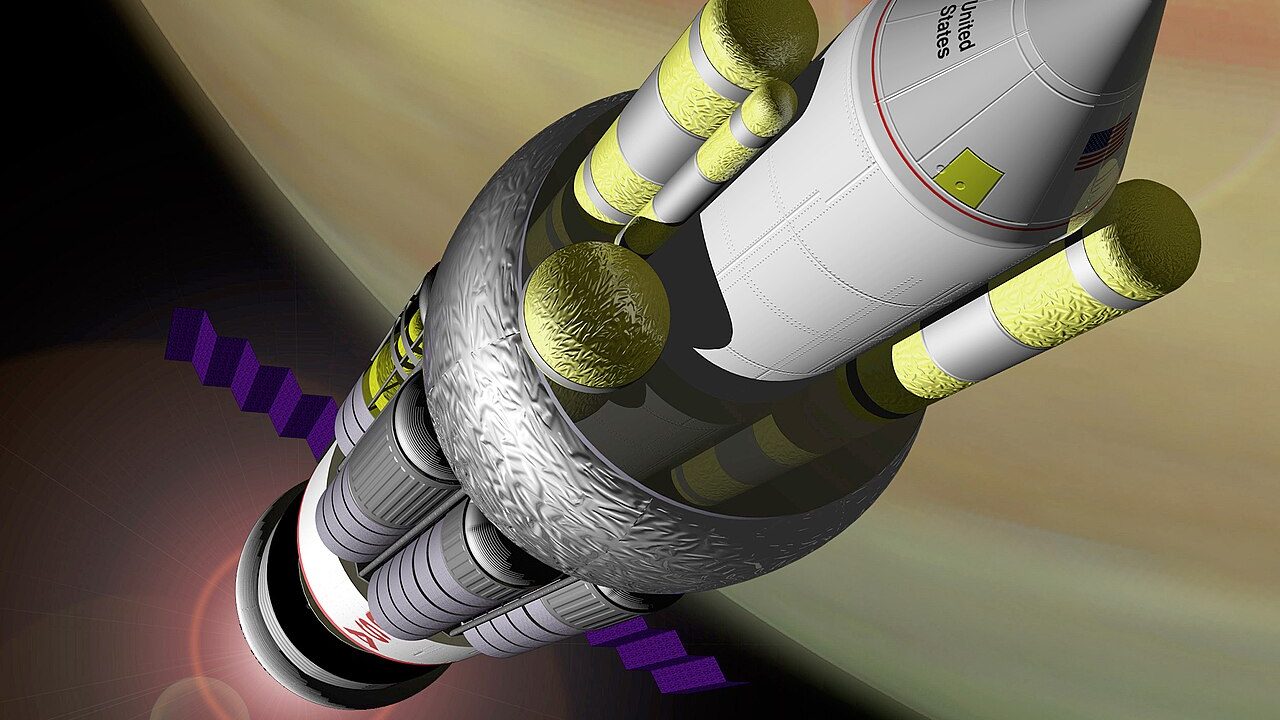
Hidden within the United States’ declassified archives lies a project that nearly sent humans to Mars in the 1960s: Orion. Conceived in the late 1950s by the General Atomics teams, this spacecraft was not intended to fly thanks to reactors or traditional rocket engines, but by ejecting bombs behind it and riding the blast. The feasibility study, led by Ted Taylor and physicist Freeman Dyson between 1958 and 1963, envisioned a craft propelled directly by a sequence of nuclear explosions unleashed behind the vehicle. The concept was examined in earnest, backed by engineering calculations and physical tests.
Technically, nothing at the time barred Orion from taking off.
- The Orion project relied on controlled nuclear explosions as a propulsion system to launch multi-thousand-tonne vessels into orbit.
- Successful tests in 1959 on scale models confirmed the stability of flight through successive impulses, validating the concept.
- The 1963 Partial Nuclear Test Ban Treaty rendered the project illegal by prohibiting nuclear explosions in the atmosphere and space.
A spacecraft propelled by bombs, literally
Atomic bombs would be jettisoned from the rocket’s rear and detonated at a distance, transforming a propellant such as water or wax into a high-energy plasma that would rebound off a thrust plate at the back of the vessel to push it forward. The principle, as brutal as it sounds, rested on a logic akin to that of a conventional internal combustion engine: a succession of controlled detonations, but at a scale where each impulse equaled several kilotons. The project was led by Theodore Taylor, a veteran of the Los Alamos weapons programs, who convinced Freeman Dyson to leave Princeton to join the effort in San Diego. The team did not tinker in a garage: they boasted America’s top minds in nuclear explosive physics.
The typical designs envisioned payloads of several hundred metric tons, without requiring sophisticated environmental cleanup systems or ultralight structures. The most ambitious studies targeted ships of several thousand tonnes, a scale entirely out of reach for chemical rockets of the era, and even today.
Eight hundred bombs, one per second, would be enough to put it into orbit.
Real tests, but with construction-site explosives
No one detonated an atomic bomb to test Orion on American soil. A scaled-down model nicknamed “putt-putt,” using conventional RDX explosives, completed a 23-second flight at an altitude of 55 meters over Point Loma. It was enough to validate a crucial aspect of the concept: the stability of flight achieved through successive impulses.
The project saw meaningful technical progress, culminating in a successful 1959 flight test on a reduced-scale model powered by conventional explosives, which demonstrated the principle of a stable impulsive flight. The damper design could be tested at full scale on Earth using chemical explosives, proving that the famed thrust plate would withstand the shock without disintegrating. The General Atomics engineers thus knew that the mechanics worked. What remained was to make the nuclear portion function, which by definition could not be quietly tested in the Californian desert.
A treaty, not a technical problem, that stopped it all
The decisive blow did not come from physics.
The final stroke arrived in 1963 with the signing of the Partial Nuclear Test Ban Treaty, an act of international diplomacy aimed at slowing the arms race, whose prohibition of any nuclear explosion in the atmosphere or in space rendered Orion illegal, with funding cut in 1965. The treaty, which bans nuclear testing in the atmosphere, space, and underwater, did not target any single spacecraft: it targeted the arms race between Washington and Moscow. But Orion, whose very premise required detonating nuclear charges outside of any underground confinement, found itself legally outlawed by the instrument meant to curb militarization.
No commission judged the concept as unrealistic or dangerous in its operation. It was an international agreement on arms tests that, by indirect consequence, condemned a space program that had never intended to wage war.
In October 1964, Freeman Dyson secured permission to publish descriptions of the earliest versions of the vehicle, even before funding was finally halted. Part of these documents still rests in the American declassified archives today, among engineering plans and calculation notes, witnesses to a craft that physics allowed and diplomacy prohibited.
Sources: large.stanford.edu | synchronicite.blog4ever.com | techno-science.net
