
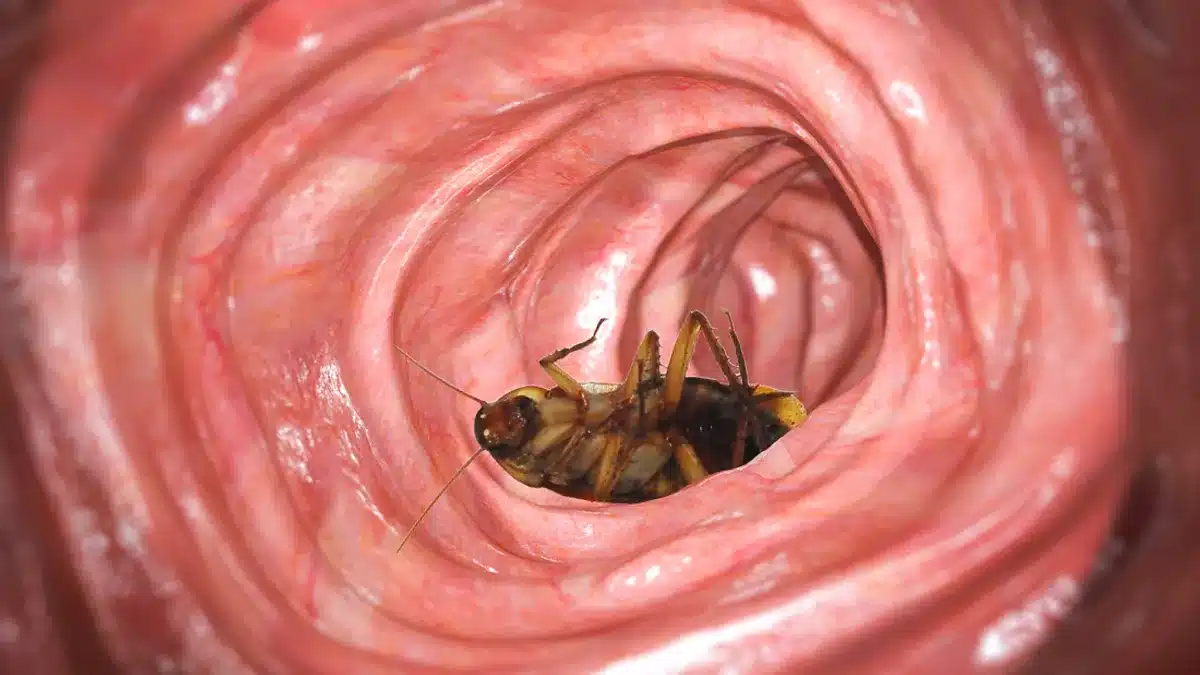
During a routine colonoscopy, Mexican physicians uncovered an intact cockroach lodged inside the colon of a 38-year-old patient. The case, published in the Mexican Journal of Gastroenterology, raises a question as simple as it is uncomfortable: how did it get there? The most probable answer is the most mundane—yet the hardest for the patient to accept.
What you will learn
- How a cockroach ended up intact in the large intestine of a perfectly awake patient
- Why the bowel preparation before a colonoscopy paradoxically explains the insect’s good preservation
- What this case reveals about the frequency, ultimately not so exceptional, of such discoveries
A colonoscopy, a camera, and a bad surprise
A colonoscopy is a routine examination. A flexible camera is inserted through the rectum to inspect the inside of the colon, to detect polyps, tumors, or inflammatory foci. The patient is under sedation. The doctors watch the screen. They advance the scope.
When they reach the ileocecal valve—the sphincter that links the small intestine to the large intestine—something catches their eye on the pinkish mucosa. An insect. Intact. Stuck to the intestinal wall.
After being retrieved with a surgical retrieval basket, the identification leaves no doubt: it is a cockroach. Remarkably well preserved.
How the insect survived transit
The answer lies in a peculiarity of the procedure itself. Before any colonoscopy, patients ingest an intestinal preparatory solution that empties the colon completely. This process dramatically speeds up transit—which means that anything present in the digestive tract at the time of ingestion is evacuated rapidly, without the usual window for enzymatic and bacterial degradation.
The cockroach, swallowed at an undetermined moment, benefited from this accelerated transit. Rather than being gradually digested, it was carried forward and preserved under conditions close to food deprivation.
The patient’s reaction: astonishment
When the patient woke up from the sedation, the doctors informed him of their discovery. His reaction, as reported in the article, was one word: astonishment. He could not understand how this could have happened.
The most plausible hypothesis remains unconscious ingestion during sleep. Contrary to the popular belief that we regularly swallow spiders at night—a myth well documented—accidentally swallowing a cockroach of that size during sleep remains plausible, though rare.
The other theoretically possible entry route, the author notes with commendable scientific sobriety by mentioning earwigs, which are the only insects actually known to treat certain bodily cavities as entry points. This is not the case for cockroaches.
Not as exceptional as it seems
What is even more surprising than the discovery itself is that it is not unique. Medical literature contains other cases of insects found during colonoscopies — including a ladybug found in the colon of a 59-year-old man. These discoveries are rare, but they do occur.
The study’s authors draw a conclusion that any gastroenterologist will appreciate: during a colonoscopy, one must be prepared for any eventuality.
