
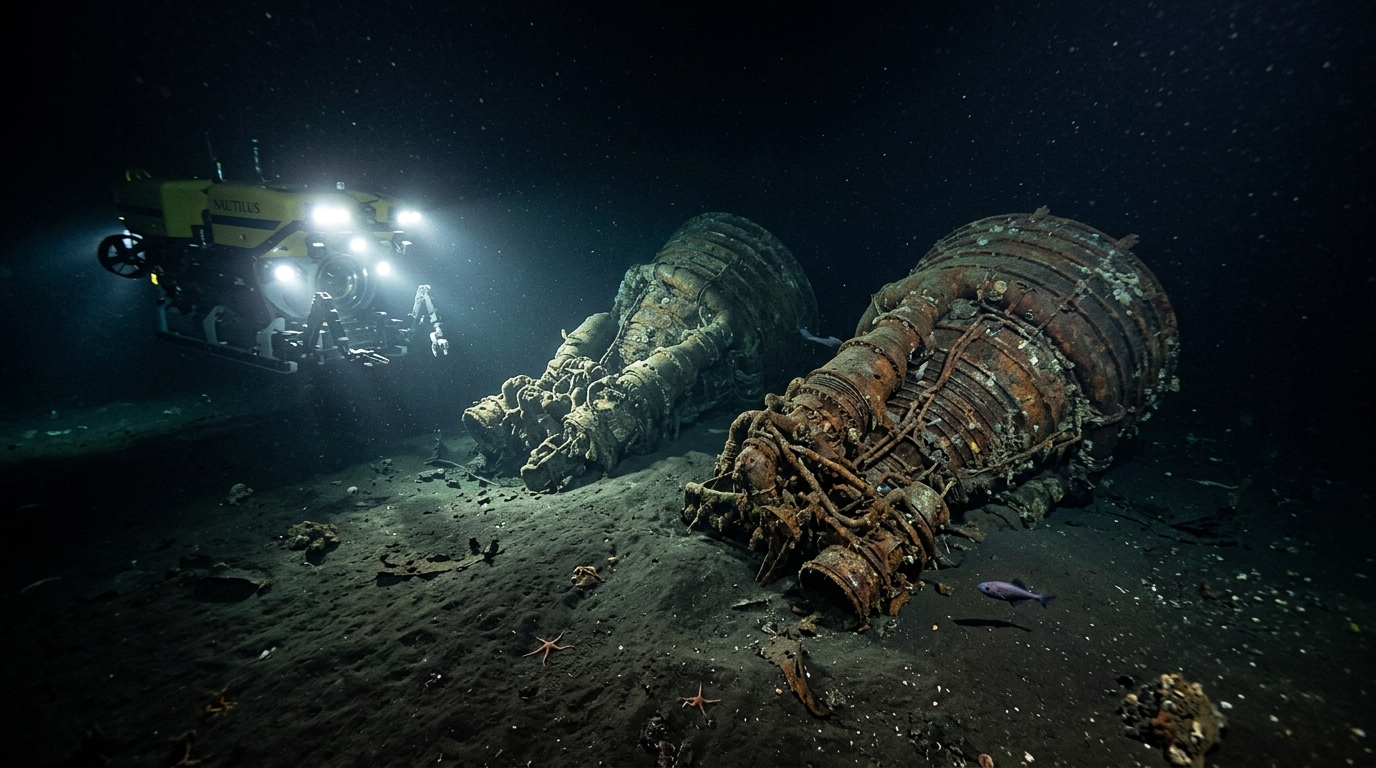
How do you lose two rocket engines as massive as a bus, capable of delivering hundreds of tons of thrust? The answer lies in a single word: gravity. Once their mission was accomplished, these behemoths of steel and aluminum had only one possible trajectory left, a free-fall toward the Atlantic Ocean. This is precisely what happened to the F-1 engines of the Saturn V rocket that propelled Apollo 11 toward the Moon in 1969. After their use, no one at NASA deemed it useful to recover them from 4,300 meters down. For more than forty years, these relics of the lunar saga lay there, forgotten by all, until a well-known businessman decided, with his own money, to go search for them.
- The Saturn V F-1 engines, having fallen into the Atlantic after their use in 1969, were located at a depth of 4,300 meters thanks to a sonar funded by Jeff Bezos in 2012.
- The March 2013 expedition, entirely financed by Bezos, succeeded in recovering 11,300 kilograms of components, identified thanks to a serial number etched on one of the pieces.
- Although funded with private money, the pieces remain the property of the United States government and were distributed between the Smithsonian and the Museum of Flight in Seattle.
- A rocket engine, does it get lost like a common bolt?
- Bezos shells out millions for an underwater treasure hunt
- Recovering 1969 debris, a NASA-worthy technical feat
- What this story reveals about billionaires’ space obsession
A rocket engine, does it get lost like a common bolt?
To grasp why these engines ended up at the bottom of the ocean, one must first understand how a rocket like the Saturn V operates. The launcher consisted of several stages that detached successively once their fuel was spent, much like a firework shedding parts as it climbs. The first stage, equipped with five F-1 engines, fired for only about 150 seconds, the time needed to wrench the vehicle free from Earth’s gravity and send it on its way toward the space pad. Once this colossal task was accomplished, that stage detached and began its descent toward the Atlantic, just like the ones before it.
Contrary to what one might imagine, NASA never planned to recover these debris. In the 1960s, the priority was to achieve lunar conquest, not to recycle space hardware. These engines, once they fell into the ocean, were simply considered lost. They have thus lain since July 16, 1969 at the bottom of the sea, in total darkness, under crushing pressure, with no one really worrying about their fate for more than four decades.
Bezos shells out millions for an underwater treasure hunt
The story takes a turn in 2012. Jeff Bezos, the founder of Amazon and already known for his space ambitions through his company Blue Origin, announced that he had located the engines thanks to a deep-sea sonar. He said he was “excited to report that, thanks to a cutting-edge sonar, the team has found the Apollo 11 engines resting 14,000 feet beneath the surface,” roughly 4,300 meters deep off the Florida coast. A technological feat in itself, given the vastness of the Atlantic Ocean makes such a search akin to finding a needle in a haystack, only in its abyssal counterpart.
After this discovery, nearly a year of preparation was required to organize a real expedition. In March 2013, fully funded with Bezos’s personal money, the expedition finally managed to retrieve components belonging to several F-1 engines. The businessman described the underwater scene as “an incredible garden of sculptures, made of twisted F-1 engines, telling the story of a brutal and fiery end”. A striking image that gives a fairly clear idea of the state in which these relics found themselves after so many years submerged.
Recovering 1969 debris, a NASA-worthy technical feat
Finding the engines was one thing, but formally identifying them was another. It would require waiting until July 2013 for an almost invisible inscription, hidden beneath a thick layer of corrosion, to confirm the origin of one of the pieces. The number “2044,” etched into the metal, was enough to establish beyond any doubt that this engine indeed came from Apollo 11’s Saturn V. A tiny detail that settled a decades-old mystery.
The expedition recovered a total of 11,300 kilograms of components, later sent to the Kansas Cosmosphere and Space Center for processing. The impact of splashdown at high speeds, combined with more than forty years of immersion, had literally shredded these massive structures. Conservators’ work is not aimed at reconstructing the engines in their original state: their mission is to halt corrosion and stabilize the artifacts for display, without attempting to reassemble them.
One point to emphasize: although the operation was entirely privately funded, ownership of the pieces has never been questioned. The F-1 engines remain the property of the U.S. government. NASA thus planned to allocate these relics among several museum institutions, with one set of parts to be donated to the Smithsonian for the National Air and Space Museum in Washington, while the components of a second engine were entrusted to the Museum of Flight in Seattle.
What this story reveals about billionaires’ space obsession
This expedition, as spectacular as it is, fits into a broader trend observed in recent years. Several tech magnates have developed a voracious appetite for space exploration, whether funding crewed missions, developing reusable launchers, or, as here, pursuing sunken relics. Behind this fascination lies often a sincere attachment to the history of space exploration, the chapter when humanity first set foot on the Moon.
Beyond the purely patrimonial aspect, this operation also illustrates a more pragmatic reality: when financial resources meet genuine passion, projects once deemed impossible or merely unnecessary can finally come to life. NASA, absorbed by its own budgetary priorities, would probably never have marshaled such resources to retrieve old rusted engines. It took the curiosity and purse of an individual to revive this forgotten chapter of lunar conquest.
This underwater adventure ultimately reminds us that space history is not limited to stars and astronauts in white suits. It can also hide in the deepest depths of our oceans, patiently awaiting someone, however unlikely, to decide to dig it up. And if other technological treasures of this scale remain, somewhere, awaiting rediscovery?
