
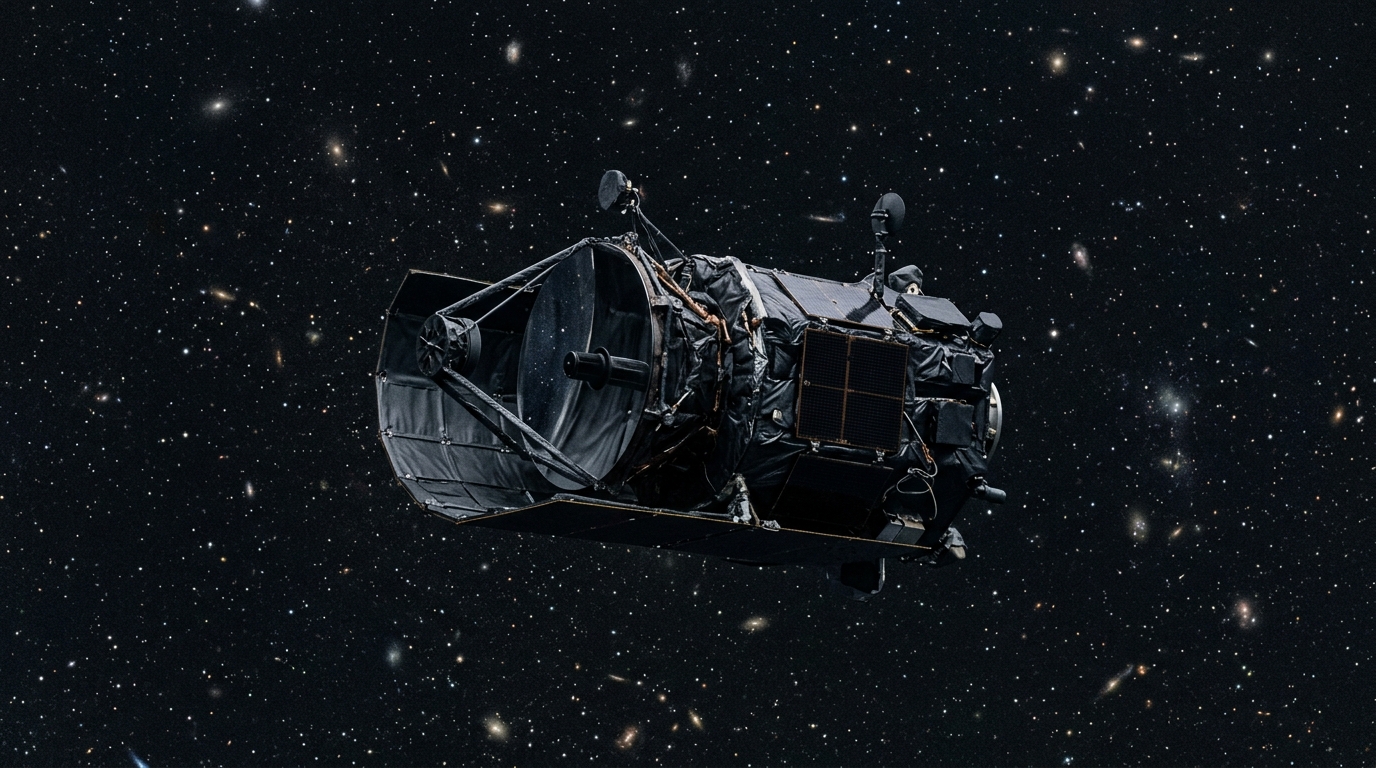
No, no one will ever be able to switch it back on. Somewhere on an orbit close to Earth’s, a spacecraft weighing over a ton continues its quiet march around the Sun, unable to send the slightest signal or receive any command. This space phantom is Kepler, one of the most productive telescopes in the history of astronomy, whose technical agony began in 2018 and which, eight years later, continues its eternal drift far from our planet. A story that blends scientific prowess and mechanical futility, and one that deserves attention at the start of autumn, as space exploration continues to fascinate people of all ages.
- Launched in 2009, the Kepler space telescope discovered more than 2,680 exoplanets in nine years using the transit method.
- Deprived of fuel for its pointing, Kepler sent its final images on October 11, 2018 before NASA definitively shut it down on October 30, 2018.
- On its heliocentric orbit, the spacecraft weighing more than a ton drifts indefinitely around the Sun, with no possibility of recovery, maneuvering, or deorbiting.
- A technological ghost lost in the Solar System
- Kepler, the world-hunter who changed our view of the universe
- The fuel failure that sealed its fate
- A silent drift millions of kilometers away, with no return possible
- The scientific legacy that survives the powered-off machine
A technological ghost lost in the Solar System
Imagine an object the size of a small car, weighing 1,039 kilograms, gliding silently tens of millions of kilometers from us, never again exchanging a single byte of information with Earth. This is precisely Kepler’s situation today. The space telescope did not disintegrate, it did not explode, it was not struck by debris: it simply shut down, like a lamp with no power, and no one will ever be able to press the switch again.
Placed on a heliocentric orbit—that is, it orbits the Sun rather than our planet—Kepler trails behind Earth at a distance, a bit like a road companion that gradually falls behind the pack. Without propulsion, without energy to reorient itself, it is entirely left to its own devices, condemned to drift indefinitely in the vacuum of space.
Kepler, the world-hunter who changed our view of the universe
Before becoming this silent wreck, Kepler enjoyed a moment of glory. Launched in March 2009 from Cape Canaveral by NASA, this instrument had a very clear mission: to hunt exoplanets, those worlds located beyond our solar system, using the transit method. The principle is astonishingly elegant: when a planet passes in front of its star, it causes a tiny dip in brightness, barely perceptible but detectable by a sufficiently sensitive instrument.
To accomplish this colossal task, Kepler carried a Schmidt camera equipped with a frontal corrector of 0.95 meters, powering a 1.4-meter-diameter primary mirror. Its sensor mosaic, measuring roughly 30 centimeters by 30 centimeters, offered an impressive 95 megapixel resolution, enabling it to monitor hundreds of thousands of stars simultaneously. The results exceeded all expectations: in nine years of operation, the telescope helped uncover more than 2,680 exoplanets, including about 550 rocky candidates and 21 potentially habitable ones. A tally that literally redrawed our understanding of Earth’s place in the universe.
The fuel failure that sealed its fate
But no machine lasts forever, especially millions of kilometers from any repair workshop. As early as 2014, and again in 2017, two of its detection modules failed, one during an engineering test, the other several years later. Despite these malfunctions, the eighteen remaining modules carried on bravely, until the inevitable happened: the fuel used to correct the telescope’s pointing ran dry.
On October 11, 2018, while about 170 million kilometers from Earth, Kepler transmitted its last images. A few days later, on October 23, operators attempted a final reorientation maneuver, without success: the device automatically entered a standby mode, its fuel reserves completely exhausted. NASA then had only one choice: on October 30, 2018, the agency definitively cut the radio transmitter and officially retired the telescope after nine and a half years of exceptional service.
A silent drift millions of kilometers away, with no return possible
Since that pivotal date, Kepler has drifted in total isolation on its heliocentric orbit. Unlike certain satellites in Earth orbit that can be deliberately deorbited to burn up in the atmosphere, there is no such option for a craft placed so far away, around the Sun. Without fuel, without energy, without any possible communication, Kepler is neither recoverable, nor steerable, nor even precisely observable from Earth.
It will continue thus, indefinitely, to trace its path around our star, like a ghost ship sailing on a cosmic sea that never lands. A nearly poetic image for an object that nonetheless enabled humanity to take a substantial leap in its understanding of the universe.
The scientific legacy that survives the powered-off machine
If Kepler’s metallic body has fallen silent, its scientific spirit endures through the thousands of data gathered during its mission. Researchers around the world still mine the information transmitted by this telescope to refine models, compare new observations, or deepen the study of exoplanets already cataloged. This is, in fact, one of the most fascinating traits of space exploration: a instrument can cease functioning while continuing to fuel research for decades.
Kepler thus opened the door to subsequent missions, proving that it is possible to detect rocky worlds potentially habitable far beyond our solar system. A feat that continues to inspire engineers and astrophysicists, long after the last radio signal ceased to resonate in the void.
Eight years after its extinction, Kepler remains a paradoxical symbol: a dead machine that nevertheless helped give rise to a multitude of living questions about the existence of other habitable worlds. As new telescopes take over today to pursue this quest, one question persists: how many other technological wrecks will drift, someday, in silence, through the corners of our solar system, mute witnesses to our dreams of exploration?
