
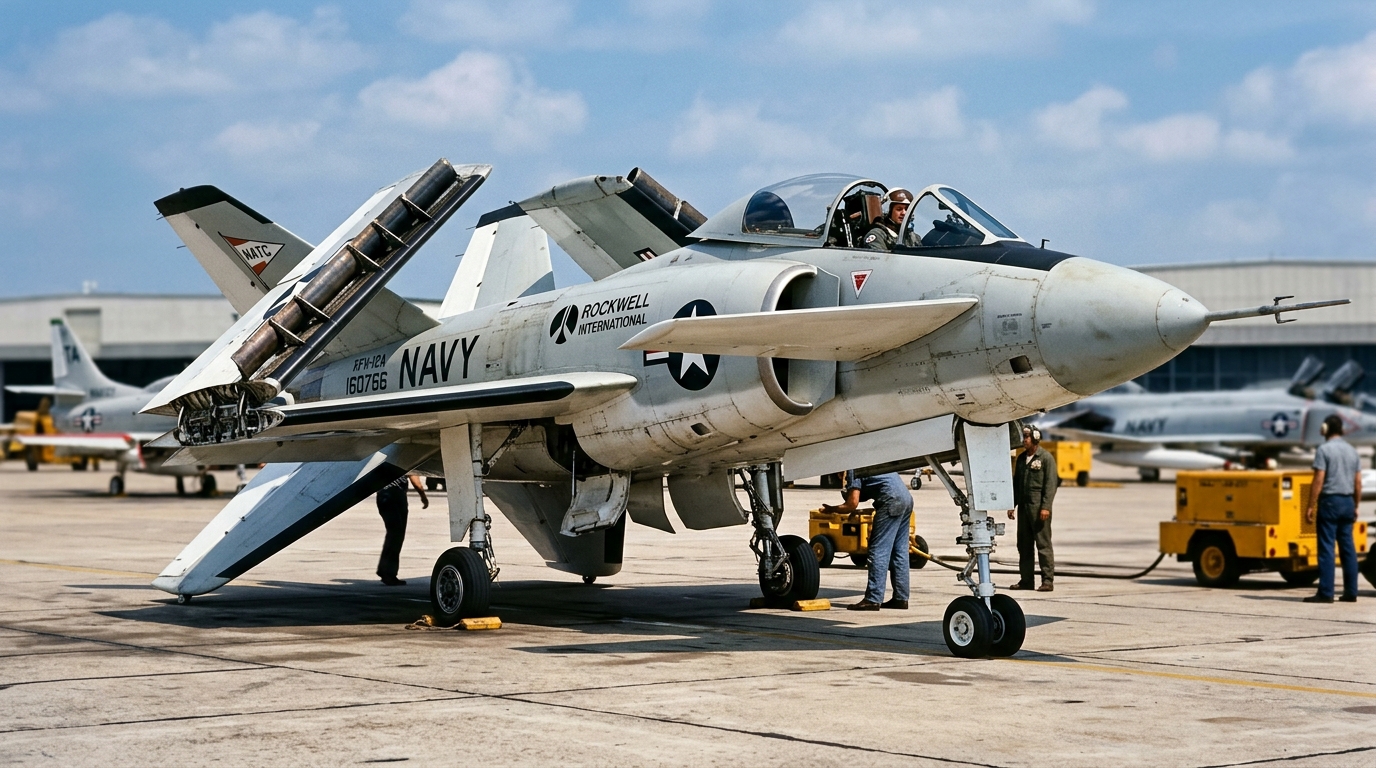
An aircraft capable of lifting off like a rocket, flying like a supersonic fighter, and then landing gently on the deck of a small vessel: that was the somewhat audacious bet the United States Navy aimed to pursue in the late 1970s. The result was named the Rockwell XFV-12A, and on paper it seemed to have everything needed to revolutionize military aviation. Mach 2 speed, armament comparable to the famous F-4 Phantom II, vertical takeoff without a runway: enough to make any admiral green with envy. Except that at the moment of truth, the aircraft stayed grounded, literally unable to rise even a few centimeters. And contrary to what one might imagine, it wasn’t an engine failure nor a lack of funding that sealed its fate. The real culprit lay in a far more discreet corner of the airframe.
- The Rockwell XFV-12A used a blown-flap system rather than an engine that could tilt like the Harrier, yet delivered only 75% of the thrust required for a vertical takeoff.
- Despite a secured test stand, the aircraft never managed to take off, even when tethered, leading to the cancellation of the program in 1981.
- The United States ultimately turned to the licensed British Harrier, while the XFV-12A cockpit was restored by high school students starting in 2012.
- The crazy tail-sitter bet: take off like a rocket, fly like a fighter
- The invisible trap hidden in the XFV-12A’s blown-flap system
- What the XFV-12A’s failure really changed in military aviation
The crazy tail-sitter bet: take off like a rocket, fly like a fighter
Everything began in 1972, when the Navy issued a call for a supersonic fighter equipped with vertical takeoff and landing capability, what specialists call VTOL. The objective was clear: equip the small aircraft carriers of the American fleet with a machine capable of rivaling the best fighters of the era, without needing the long runways of the large carriers. At that time, only the British Harrier mastered this feat, but it remained hampered by subsonic speed. Rockwell saw there a golden opportunity to offer something better, much better.
To move quickly and keep development costs down, Rockwell engineers showed a pragmatism almost artisanal. They grafted the nose of an A-4 Skyhawk, the air intakes of an F-4 Phantom, and assembled them around a single Pratt & Whitney engine. This approach to aeronautical recycling, a bit like building a race car from parts of several existing models, allowed the project timeline to accelerate. On paper, the XFV-12A indeed seemed to hold all its promises: a top speed of Mach 2, armament comparable to the Phantom, and this famous ability to take off without a runway. Enough to potentially outperform the Harrier, at least in theory.
The invisible trap hidden in the XFV-12A’s blown-flap system
This is where the story takes a turn. The XFV-12A did not rely on a swiveling engine like the Harrier, but on a more complex principle called blown-flap lift. The idea was to redirect the engine’s exhaust through an internal network of ducts to the wings and canards at the front of the aircraft, in order to generate the lift necessary for vertical takeoff. On paper, once again, the concept appealed for its ingenuity.
But reality proved far harsher. The long internal ducts intended to channel the thrust from the Pratt & Whitney F401-PW-400 engine proved to be energy sinks. A large portion of the thrust generated by the engine dissipated along the way, swallowed by the system’s complexity before reaching the flaps. The figure was blunt: only 75% of the required thrust could actually be delivered. In other words, the aircraft suffered a severe lack of thrust at the crucial moment, a bit like a runner who loses a quarter of energy before the starting pistol.
When the moment finally came to test this technological feat at full scale, the engineers had to suspend the aircraft on a test stand for safety. The result was as simple as it was disastrous: the VTOL fighter most advanced ever designed by the United States could never take off, even when tethered. It never rose from the ground without external assistance, despite several attempts conducted under extremely constrained conditions.
What the XFV-12A’s failure really changed in military aviation
Faced with these unequivocal results, the U.S. Navy was forced to put an end to the project. Development costs continued to rise even as the aircraft failed to meet the performance criteria set from the outset. In 1981, the verdict arrived: the program was officially canceled. Only a single example, the XFV-12A, would be built, never accomplishing the mission for which it had been designed.
Ironically, the United States eventually turned to the very Harrier under license that they had hoped to surpass a few years earlier. The subsonic aircraft, less ambitious but more reliable, would enter the American armed forces under license, proving that in military aviation, technological prudence sometimes pays more than reckless bravado.
As for the XFV-12A’s wreckage, its fate reads almost like a novel. Dismantled after the program’s abandonment, the cockpit ended up stored at NASA’s Plum Brook Station in Sandusky, Ohio. It would take until 2012 for a group of aviation-enthusiast high school students to undertake its restoration, aiming to showcase it in a museum. A second life for this emblem of unfinished technological ambition.
The story of the XFV-12A carries a valuable lesson, one that goes beyond aviation: the success of a complex project never hinges on a single key piece, but on the harmony among all its elements. A powerful engine, a hefty budget, and a brilliant idea are worthless if one fails to master a detail that seems secondary at first glance. While current research into vertical-takeoff fighters continues with machines like the F-35B, one cannot help but rethink this 1970s prototype, left on the ground despite all its promises. A question remains: how many other promising innovations today fail because of a detail that no one saw coming?
