
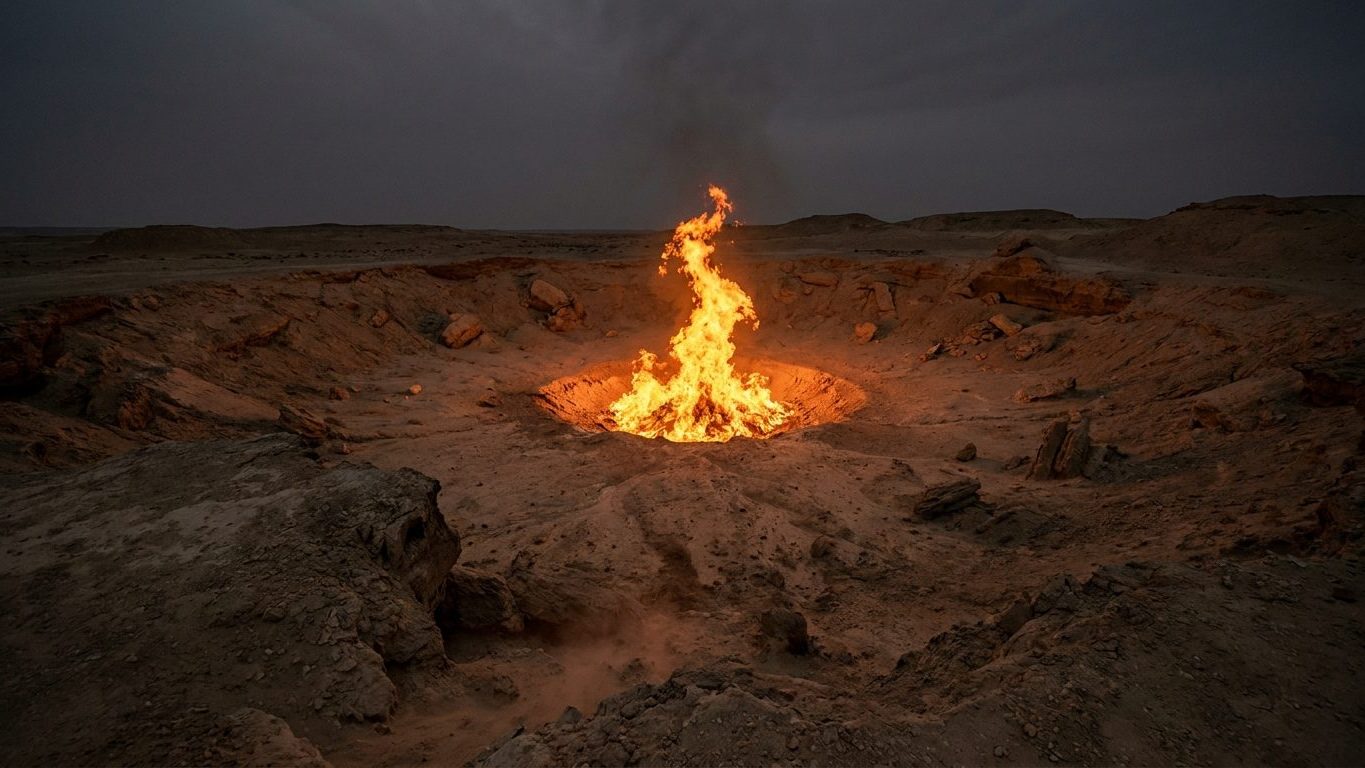
A crater sixty metres in diameter spews flames day and night across the Karakum Desert, located 260 kilometres north of Ashgabat. At 260 km north of Ashgabat, the capital of Turkmenistan, lies one of the world’s most intimidating tourist attractions: a gaping, fire-belching hole around 70 metres across, where gas has burned continuously for decades. This chasm, nicknamed the Gates of Hell or the Darvaza crater, has burned without interruption for more than half a century. What keeps the blaze going is not oil or coal, but an invisible gas seeping constantly from below the surface: methane.
The fire, for its part, has never waned.
- The Darvaza crater has burned continuously since 1971, following the collapse of a natural gas pocket during a Soviet drilling operation.
- Methane rises consistently from a vast underground reservoir, feeding flames that can reach as high as 15 metres.
- The flames have diminished by about two-thirds since 2024 thanks to relief wells drilled by Turkmenistan in partnership with the UN.
A Soviet drilling accident that went wrong
The story begins in 1971, when Soviet teams drill the desert in search of natural gas. Its exact origin cannot be verified with absolute certainty, but it is believed that Soviet drillers tapping a natural gas pocket hit a major methane reserve. The ground gives way under the weight of the operation, exposing a vast natural gas pocket that had gone unsuspected until then.
Faced with the risk of toxic leaks affecting nearby villages, geologists made a radical choice. They lit the escaping gas at the opening. The plan was straightforward on paper: burn off the pocket in a matter of weeks, allowing the pressure to drop. The fire was not supposed to last more than a few weeks, but it has burned ever since, almost five decades later.
The calculation proved completely false.
What truly fuels the flames
Contrary to a widespread belief, there is no buried oil field or coal vein that is burning beneath Darvaza. The fire is fed by natural gas deposits rich in the region, one of the world’s largest gas reserves. Methane steadily ascends from a subterranean reservoir far larger than the visible crater surface.
The flames can reach up to 15 metres in height, and the temperatures inside the crater climb to as high as 1,000 degrees Celsius. This makes a nighttime visit an almost surreal spectacle.
Despite its accidental origins, the site has become a standout tourist destination. The crater is a popular tourist attraction: in the last five years, 50,000 visitors have come. A Canadian adventurer, George Kourounis, even became the first to explore the crater floor in 2013, after more than a year of careful preparation. On site, there are hardly any barriers guarding visitors: no grille or protection stops visitors from a possible collapse, since the sandy ground can give way at any moment.
Extinction attempts that confront field realities
The Turkmen authorities did not resign themselves to watching this resource burn away indefinitely. The initial calls to extinguish the Darvaza blaze date back to 2010, spurred by President at the time, Gurbanguly Berdimuhamedov. The official reasoning combines two arguments: the economic loss from burning gas and the pollution it emits.
The most decisive decision came in January 2022.
B Berdimuhamedow announced his intention to extinguish the crater, citing its harmful effects on local health, the environment and the gas industry; a commission was tasked with identifying the most suitable method. The options ranged from filling it with earth to drilling relief wells. Despite this presidential declaration, the crater remains open and continues to burn.
Recent scientific measurements show progress. In March 2024, Turkmenistan teamed up with the United Nations Environment Programme to address methane emissions, employing advanced monitoring technologies and leak-management strategies in the country’s energy sector. The same year, the Turkmen government succeeded in drilling a relief well near the crater, substantially reducing emissions. At the TESC scientific conference held in Ashgabat in June 2025, researchers from the state-backed Turkmengaz presented data indicating that the flames had shrunk to roughly one-third of their original size, and are now only visible up close, whereas they were once visible from miles away.
Measurements taken in October 2025 confirm that the site continues to emit gas. That month, methane emissions reached 1,960 kilograms per hour, placing Turkmenistan among the countries with the highest global methane emission rates according to the International Energy Agency. By the end of December 2025, Turkmengaz announced the drilling of a new well aimed at diverting gas away from the crater’s source. The stated objective is to “eliminate completely uncontrolled gas emissions into the atmosphere”. The question remains whether this latest effort will succeed where all prior attempts have failed for more than a decade.
Sources: futura-sciences.com | franceinfo.fr | neozone.org
