
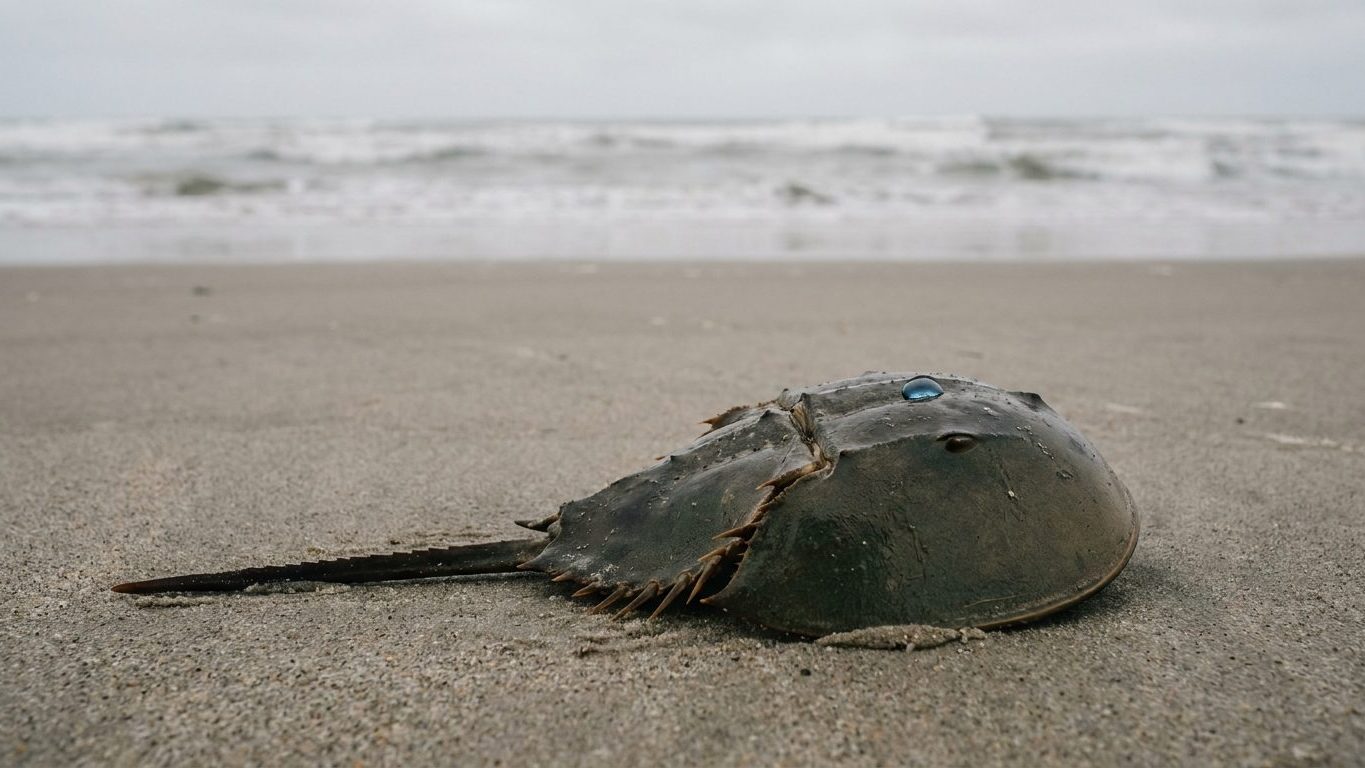
A vial of flu vaccine, an IV bag, a hip prosthesis: before they end up inside a human body, these objects have all crossed the blood of an animal that looks like a prehistoric warrior’s helmet washed up on a shore. The horseshoe crab, often nicknamed “crab with a horseshoe,” has since the 1970s provided the reagent that verifies the absence of toxic bacteria in everything that is injected or implanted into the body. Used worldwide, this test is remarkably effective at uncovering traces of potentially deadly bacterial endotoxins in anything that must be injected or placed inside the human body. Few vaccinated patients are aware of it, and for good reason: nothing on the label mentions this marine supplier.
The test is called LAL, for Limulus Amebocyte Lysate. This method was officially approved in 1977, after more than a decade of research. Since then, it has become the global reference for ensuring the safety of medicines, vaccines, and devices that come into contact with human blood. No vaccine batch, no dialysis bag, no surgical implant leaves the factory without undergoing this test.
- The LAL test, using horseshoe crab blue blood, checks for the absence of bacterial toxins in every vaccine since 1977
- About 500,000 horseshoe crabs are harvested annually along the U.S. East Coast to extract 30% of their blood
- The Asian species Tachypleus tridentatus is listed as endangered by the IUCN due to overfishing and the pharmaceutical industry
- Recombinant Factor C offers a synthetic alternative for more than five years, approved in Europe since 2021 and in the United States in 2024
Blue Blood, an Animal 450 Million Years Old
The horseshoe crab is not a crustacean. Genetically, it is closer to spiders and scorpions than to crabs, and its body shape has hardly evolved during its 450 million years of existence—a true living fossil. It has ten eyes spread across its carapace, five pairs of legs around the mouth, and a pointed tail that acts as a rudder in the sand.
Its blood doesn’t owe its color to hemoglobin. The blue hue comes from copper. The horseshoe crab’s blood, its blue tint arising from copper in hemocyanin, a protein that carries oxygen much like hemoglobin, has been used for decades to test the safety of various vaccines, intravenous fluids, and medical instruments. When exposed to air, this translucent liquid turns a deep, electric blue.
Its peculiarity lies in a remarkably precise chemical reaction. Thanks to the proteins in its cells, the horseshoe crab blood clots instantly when it contacts endotoxins from pathogens such as Escherichia coli or Salmonella; this is what is known as the “LAL test.” A simple gel visible to the naked eye provides proof that a batch is contaminated.
Hundreds of Thousands of Creatures Bled Each Year
The industrial chain starts on the beaches of the American East Coast, where horseshoe crabs come to spawn by the millions in spring. Teams collect them by hand, transport them to laboratories, extract their haemolymph directly from the heart region, then release the survivors back into the water. Estimates vary by source, but the scale remains constant: nearly 500,000 horseshoe crabs are legally harvested each year along the U.S. East Coast, and in labs, about 30% of their blood is drawn from the cardiac area, after which the living crabs are returned to the sea.
Mortality following this extraction divides studies. Some assessments, often cited by animal advocates, estimate a mortality rate of at least 30%. Other studies, notably those reported by Radio-Canada with marine researchers, propose a lower figure: about 15% die, with survivors released back into the sea. A MIT researcher quoted in a related report goes further, claiming the industry behind the LAL test probably kills twice as many horseshoe crabs as it admits. Between these bounds, one certainty remains: surviving females lay fewer eggs afterward, weakening long-term population renewal.
Prices for this raw material have surged. The trade of haemolymph for the biomedical sector has reached record levels, with the liter valued at around 11,000 euros in 2016. A similar figure is circulating on the Canadian side, where the precious horseshoe crab blood sells for nearly 15,000 dollars per liter. Two price ranges, two currencies, but one conclusion: this blue liquid is literally worth more than gold per liter.
The Asian Species, Itself, Is in Danger
On the American Atlantic coast, Limulus polyphemus remains classified as vulnerable, but not at immediate risk of extinction. In Asia, the situation is far more serious. Tachypleus tridentatus, the species used for the equivalent test in China, Japan, or Taiwan, is listed as endangered by the IUCN, and according to available data, it is today the most threatened horseshoe crab species in the world. Overfishing for food in several Asian countries and the destruction of coastal habitats heighten a pressure already heavy from the pharmaceutical industry.
Recombinant Factor C, a Possible Yet Slow Path Forward
There has been an alternative for years. It is called recombinant Factor C, or rFC: a synthetic version of the active molecule in horseshoe crab blood, produced in a laboratory without any harvesting. Advances in genetics have enabled the identification of the gene in the horseshoe crab responsible for producing the chemical factor contained in amebocytes, and biomedical companies like the French company bioMérieux now use it to produce this synthetic test.
Europe paved the way first. The endotoxin testing method using recombinant Factor C, published in the European Pharmacopoeia, came into effect on July 1, 2021. This new chapter allows manufacturers to use rFC as an alternative to traditional LAL-based methods. The United States took much longer to follow: long hindered by regulations, rFC was officially recognized by the American Pharmacopoeia in 2024, after earlier adoption in Europe.
This slowness is partly due to industry habits and patent questions. Some laboratories have nonetheless taken the plunge: laboratories like Eli Lilly have already adopted it. A former Lonza executive, a company specialized in this synthetic test, bluntly summarizes the stakes: horseshoe crabs are a limited resource with potentially unlimited demand, and these two realities exclude one another.
The rFC has not yet fully replaced the traditional LAL. Some regulatory monographs still require the use of the animal reagent, and switching to recombinant is regarded, in European texts, as a method change requiring product-specific validation. The solution has been on laboratory shelves for more than five years, but every pharmaceutical plant must still, product by product, demonstrate that it can do without the blue blood.
Sources: biomerieux.com | ici.radio-canada.ca | ncbi.nlm.nih.gov
