
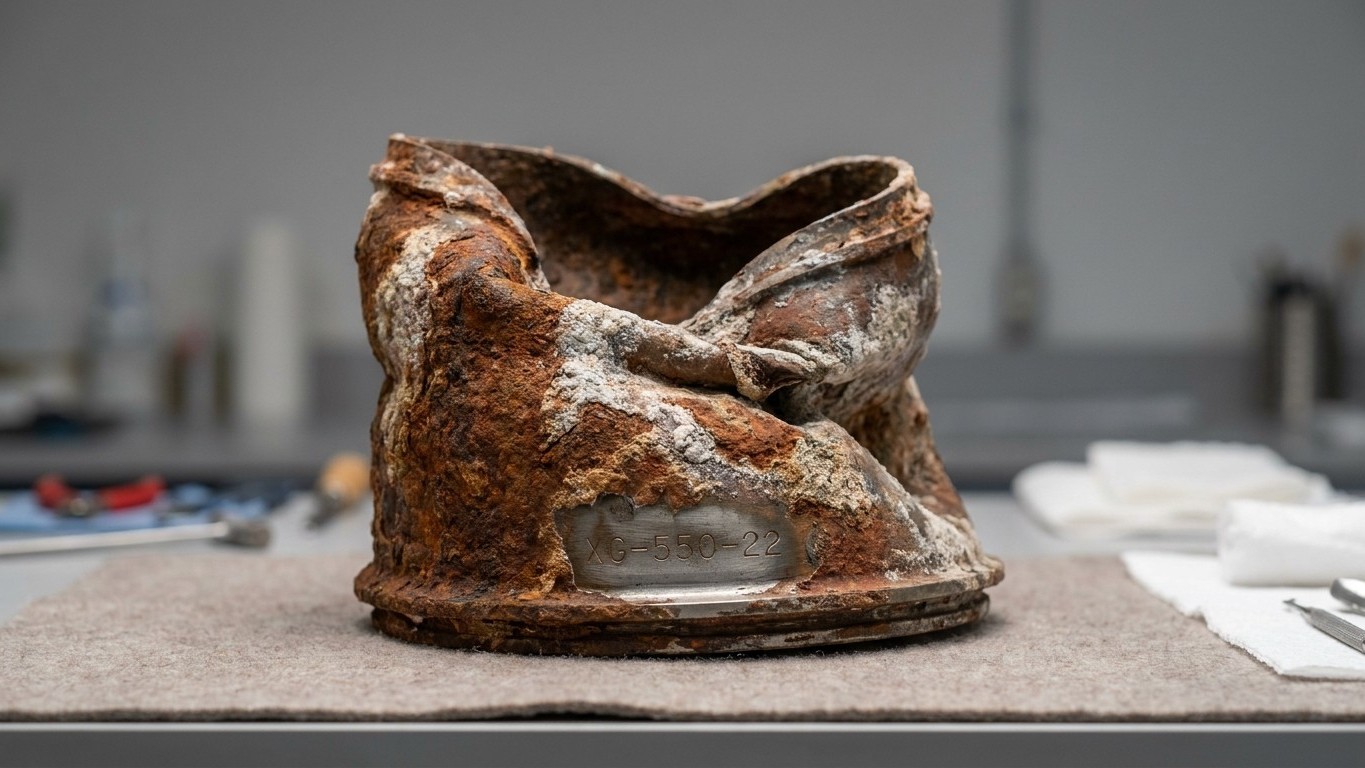
A number half-erased by four decades of saltwater was enough to cut through a space mystery 44 years old. In July 2013, the teams funded by Jeff Bezos confirmed that one of the F-1 engines recovered from the Atlantic a few months earlier indeed came from the Saturn V rocket of Apollo 11, the mission that landed Neil Armstrong and Buzz Aldrin on the Moon. The proof lay in an inscription almost invisible, found beneath a layer of corrosion: “2044.”
Key takeaways
- Rocket debris recovered at a depth of 4,270 meters kept a closely guarded secret
- A conservation technique is revolutionizing our understanding of heavily corroded artifacts
- The timing of this discovery was more than a mere coincidence
A Mystery Submerged at 4,270 Meters Depth
Back in March 2013. After years of scouting, the Bezos Expeditions team located and retrieved debris from F-1 engines lying on the sea floor since 1969. The engines were roughly 14,000 feet, or 4,270 meters, beneath the Atlantic surface off Florida, where they had rested since July 16, 1969, when they were fired for about 150 seconds to push the Saturn V of Apollo 11 off the launch pad. These engines were never designed to survive: they were part of a five-engine supplement that helped propel the Saturn V off Cape Canaveral’s pad, were jettisoned a few minutes after liftoff, and plunged into the Atlantic, where they remained for more than four decades.
The shock of impact with the water at high speeds, followed by the fall to the ocean floor, literally shredded these structures despite their mass. The force of hitting the water and their descent to the seabed at a depth of 4,300 meters had torn these colossal components apart, leaving them almost unrecognizable. On site, explorers described an otherworldly landscape: Bezos himself spoke of “an incredible garden of sculptures, made of twisted F-1 engines, telling the story of a brutal and fiery end.” Problem: at the time, there was no way to determine which mission the debris belonged to. Bezos had revealed in March 2013 that his team had recovered pieces from at least two F-1 engines, without knowing whether they came from Apollo 11 or from another one of the twelve Saturn V missions flown between 1967 and 1973, each equipped with five of these giant engines.
The Number the Corrosion Refused to Reveal
The identification plates had almost vanished. Bezos wrote on his site that there remained one secret the ocean did not yield easily: the mission identification, the abrupt end of the components, and the corrosion accumulated over 43 years underwater that had erased or covered most of the original serial numbers. The recovered pieces, about 11.3 tons of metal, were shipped to the Kansas Cosmosphere and Space Center in Hutchinson for extended conservation work. It was in 2013 that the Bezos Expedition retrieved 11,300 kilograms of F-1 engine components, which were then sent to the Kansas Cosmosphere and Space Center for treatment.
The breakthrough came from a nearly trivial tool in the grand scheme: a black light torch. Scanning one of the torn combustion chambers under that specific illumination, a conservator spotted traces of paint invisible to the naked eye. One conservator, examining the objects with a black light and a special filter, made a discovery: the number “2044,” stencil-painted in black on the side of one of the vast combustion chambers. A finding that, by itself, did not tell much. But continuing the cleaning at the base of that same chamber, a second inscription appeared, etched directly into the metal: “Unit No 2044,” stamped into the surface.
It remained to cross-check this number with NASA archives. Rocketdyne, the engine manufacturer, had originally assigned each F-1 a four-digit serial starting with “2,” before NASA renumbered each engine at completion, with a number starting with “6” for lunar-mission engines. The cross-check was decisive: 2044 is the Rocketdyne serial that corresponds to NASA 6044, the fifth engine of Apollo 11. This twisted fragment pulled from the ocean floor was not anonymous space-program debris: it was indeed one of the five engines that had propelled Apollo 11 from the Earth’s surface, on July 16, 1969. The coincidence also allowed Bezos to announce this confirmation on the eve of the exact anniversary of the Moon landing, a timing he did not fail to highlight.
Twisted Relics Turned into Museum Pieces
The conservation of these relics was far from a simple cleaning operation. The combustion chambers and an exhaust nozzle posed a particular challenge to conservators because they were built from a nickel-based superalloy called Inconel X-750, designed to withstand extreme temperatures. A metal that was almost impervious to heat, yet it ended up corroded after decades of immersion in seawater. The stabilization process, conducted in public view in specially designed basins, lasted more than two years before the pieces were deemed presentable.
The fate of these historical fragments then followed two distinct paths, as the material remained the property of NASA. Some pieces joined the National Air and Space Museum in Washington: this combustion chamber came from an F-1 engine that powered Apollo 11, and after being recovered from the ocean floor in 2013 by Bezos Expeditions, NASA transferred it to the museum in 2016. The other batch went to Seattle. The Apollo permanent exhibit opened on May 20, 2017, at the Museum of Flight in Seattle, featuring a full-scale F-1 engine alongside artifacts recovered in 2013, including the combustion chamber and injector of Apollo 12’s engine number 3, as well as a gas generator from an engine that powered Apollo 16.
A detail worth noting: the “2044” engine was not the only one identified using this method. The teams found, less than 50 meters away, another combustion chamber marked “2050,” this one belonging to an Apollo 12 engine. Two lunar capsules, two feats of engineering, separated on the ocean floor by the length of a football field, and found side by side 44 years later thanks to a flashlight bought at an auto-parts store.
Sources: geekwire.com | geekwire.com
