
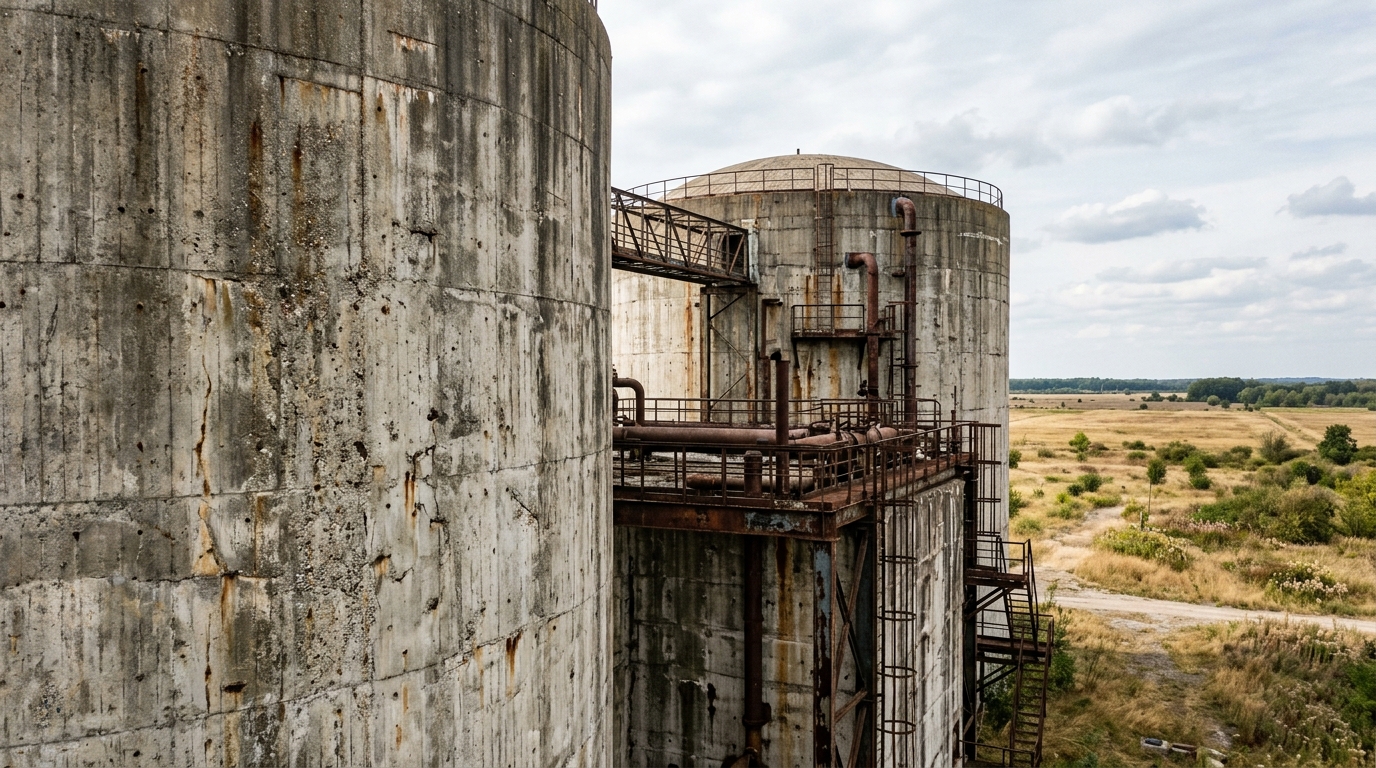
Imagine for a moment you cross the Alsace plain, between the vines and the maize fields that brown at the edge of autumn, and that two imposing concrete silhouettes rise in the distance, motionless for years. Nothing moves, no construction equipment, no sound of metal being cut. And yet these buildings cost the French about 1.5 billion euros. That is the paradox of Fessenheim: a plant shut down for a long time, but a dismantling project that never truly began. How can we account for such a gap between the announcement of closure and the reality of a site frozen in time?
- The two reactors of Fessenheim, stopped in 2020, did not actually shift into the dismantling phase until June 25, 2026, after a government decree and the validation by the ASNR.
- During these six years, EDF carried out pre-dismantling work that remained invisible to the public, reaching 98% completion before the first concrete cuts.
- The project is expected to generate about 405,000 tonnes of materials (with 5% radioactive requiring special handling) and must be completed no later than June 30, 2048, EDF aiming for 2041.
- On the Alsace plain, two multi-billion reactors sleep while not a single worker comes near
- Six years of shutdown, zero bulldozer: the Fessenheim mystery
- EDF, the State, the ASN: the ping-pong that paralyzes the site
- The bill grows every year while nothing moves
- Fuel, radioactivity, calendar: what really blocks the dismantling
- Fessenheim, a mirror of a France that pays without ever acting
On the Alsace plain, two multi‑billion-euro reactors sleep while not a single worker approaches
Located in Haut-Rhin, the Fessenheim plant long symbolized the might of France’s nuclear industry. Its two reactors were definitively shut down in 2020, the first on February 22 and the second on June 30. Since that date, the reactor buildings have stood upright, silent, as if suspended between two eras: the era of electricity production and the era, now underway, of the large dismantling project.
What strikes when one studies this file is the gap between the scale of money invested in the installation and the apparent inertia that followed its shutdown. For years, no worker came to cut a single metal piece, no crane engaged with the structures. The site remained fixed, as if under a glass bell, awaiting an authorization that seemed never to arrive.
Six years of shutdown, zero bulldozer: the Fessenheim mystery
How can we explain that a site closed for such a long time has not yet seen real demolition work? The answer lies in one word: authorizations. Dismantling a nuclear plant is not a matter of simply sending in a team with diggers. Each step must be validated, checked, and framed by precise regulatory texts, because it is first and foremost a matter of guaranteeing the safety of workers and nearby populations.
In this way, for five years EDF carried out what is called pre-dismantling work: draining the circuits, removing certain ancillary equipment, safeguarding the installations. EDF noted in early 2026 that it had already completed 98% of these preparatory tasks. An impressive figure, showing that the apparent inaction actually hid ongoing activity, but invisible to the public due to the lack of the spectacular concrete-cutting typically associated with a demolition site.
EDF, the State, the ASN : the ping-pong game that paralyzes the site
The real kick-off of the dismantling required the alignment of several institutional green lights. The government issued a decree on May 3, 2026 authorizing EDF to proceed with the complete dismantling of the installation. What remained was the technical validation: the ASNR approved on June 19, 2026 the Safety Report and the General Operating Rules, the last piece of the regulatory puzzle before the actual operational phase began.
It was only after this validation that the official switch to the dismantling phase occurred on June 25, 2026, symbolically marking the end of five years of preparation since the reactors were shut down. This mechanism, in which each actor waits for the other’s green light before moving forward, illustrates well the complexity of French administration when it comes to closing a chapter of such a sensitive industrial sector as nuclear.
The bill grows heavier each year while nothing moves
During the years preceding the official switch to dismantling, EDF carried out the pre-dismantling works, having completed 98% of them by early 2026. This period, though less visible to the public, required substantial resources before the concrete operations could finally begin.
Now that the green light has been given, the concrete operations can finally start. The first project involves cutting the three steam generators of Reactor No. 1, gigantic parts weighing more than 300 tonnes and more than 20 metres tall. A second major project will involve the removal of the cells that supported spent fuel within the fuel building, a step that is just as delicate as it is spectacular.
Fuel, radioactivity, calendar: what really blocks the dismantling
The pace of the process is also explained by the nature of the materials to be managed. Unlike a conventional demolition, this is not simply about bringing walls down. The project is expected to generate around 405,000 tonnes of materials, of which 95% are non-radioactive, mainly concrete that will be reused on site as fill. The remaining 5% require specific treatment, with all safeguards tied to residual radioactivity.
The decree governing this dismantling sets a maximum deadline: all operations must be completed no later than June 30, 2048. EDF, however, has a tighter aim, targeting 15 years, which would place the end of the works around 2041. A schedule that measures the long timeline inherent to this type of project, where safety always takes precedence over speed.
Fessenheim, mirror of a France that pays without ever acting
Beyond the technical aspects, Fessenheim tells a broader story about how large public dossiers are handled in our country: decisions announced, sums committed, followed by long years of waiting before any real movement on the ground. This gap between announcement and action often fuels, rightly, the impatience and confusion of citizens who fund these projects without witnessing immediate results.
On this site in particular, the machinery is finally coming back to life: the operations will employ an average of 300 people per year, with nearly 400 people on site according to local estimates for this period. The long‑awaited project is finally taking shape, but it took almost six years between the shutdown of the reactors and the first cutting blow to get there.
Fessenheim thus exemplifies, in its own way, the peculiar administrative tempo of major French industrial projects: slow to start, bounded by multiple validations, yet necessary to ensure that each step proceeds under the safest possible conditions. The question remains broader than this Alsatian case: how many other public works projects still await, in silence, the moment when someone will finally bring them to completion?
