
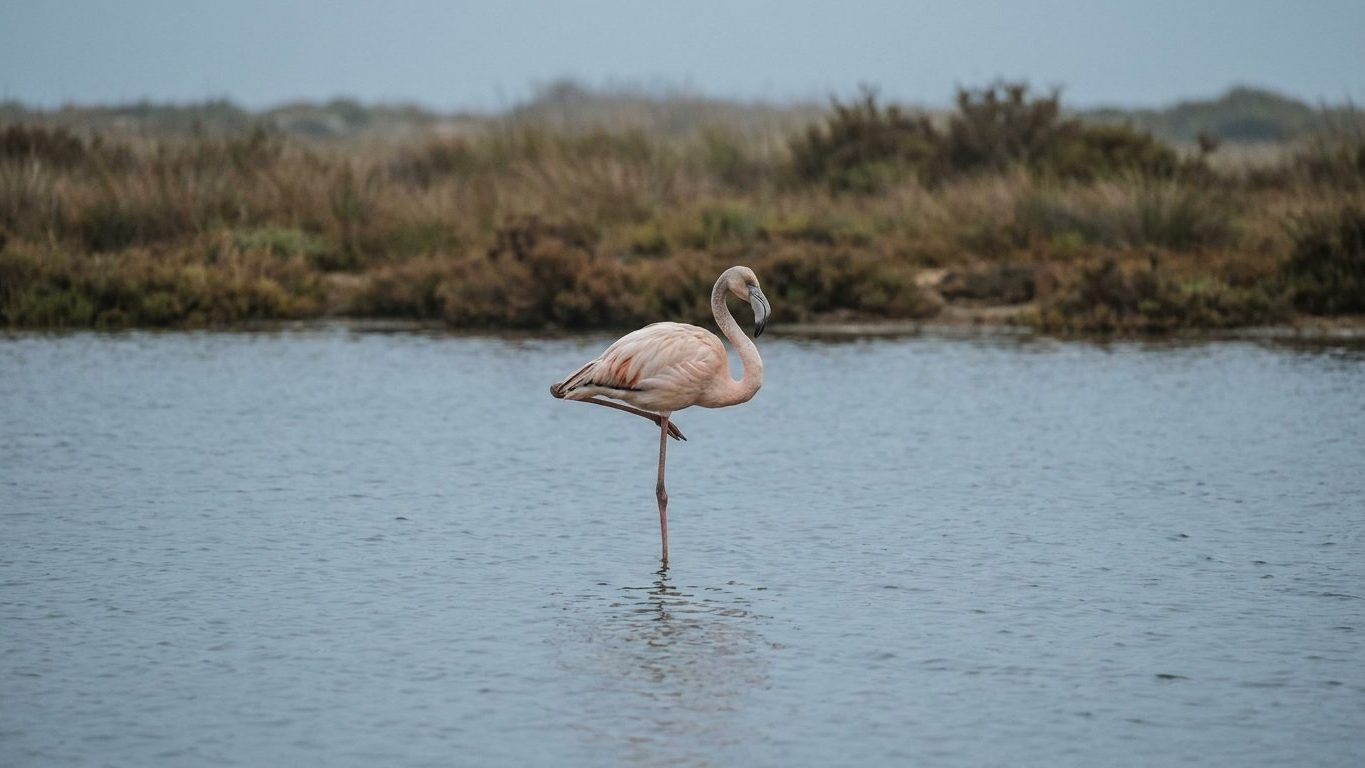
A pink flamingo can remain perched on a single leg for hours, motionless in water close to 10°C, with not a single muscle appearing to strain. The answer lies in two distinct mechanisms that add up rather than oppose each other: a purely mechanical joint lock, and a thermal system that limits heat loss. A 2017 study published in Biology Letters helped settle a two-century-old debate about the contribution of each.
- The knee and hip joints lock mechanically when the body’s center of gravity lies above the foot, with no muscular effort.
- A dead flamingo positioned correctly can stand on one leg, proving that mechanics alone can maintain balance.
- Folding a leg out of the water halves the heat-exchange surface and limits heat loss to the cold water.
The two classical explanations are not sufficient
For a long time, two theories clashed without solid evidence. The first proposed that the flamingo saves energy by using only one leg at a time, the other resting during that period. The second relied entirely on thermodynamics: by folding a leg against the body, the bird would reduce the surface exposed to cold water and limit heat loss.
Neither of these avenues is wrong. They are simply incomplete.
Neither explains a puzzling detail observed by ornithologists: the posture seems almost more stable when the bird is asleep than when it is awake. A mystery that only a direct anatomical experiment could resolve.
A dead flamingo also stands
Researchers Chang and Ting had the idea of handling a dead flamingo in a laboratory to test the pure mechanics of the leg, with no muscular action possible. The result: when placed in the right position, the body remains upright on a single leg, by itself, without contraction or effort. The knee joint and the hip lock as soon as the body’s center of gravity lies exactly above the foot. The bird’s weight does all the work in place of the muscles, like a trestle held up by its geometry alone.
This discovery changed how posture is read. It is not a feat of muscle endurance; it is architectural balance.
The same work also measured another fact: a living flamingo, asleep, wobbles less than the same flamingo awake on its leg. Counterintuitive, but logical once you understand the mechanism. Awake, the bird constantly adjusts its posture with small muscular movements, which introduces micro-oscillations. Asleep, the body relies on passive locking, more stable precisely because nothing disturbs it.
The posture is therefore more reliable when the animal does not actively control it. A joint that works alone tires less than a muscle that works all the time.
The leg, a radiator that can be turned off
The thermal mechanism has not disappeared from the equation; the two facets coexist. A flamingo’s legs submerged in cold water behave like radiators: heat from the blood escapes through this surface in direct contact with the water. To limit this loss, birds possess a counter-current system in the leg’s blood vessels, where the descending artery warms the returning vein before the cold blood reaches the body.
Folding a leg out of the water mechanically halves the heat-exchange surface. Less skin submerged means less heat lost—a simple physical calculation that complements the joint lock without replacing it. The researchers remain cautious about the exact share of each mechanism in field behavior, and no study has yet isolated precisely what the thermal component adds relative to the purely mechanical one.
The two explanations thus advance together, with no clear indication of which dominates.
Pink thanks to shrimp, head inverted to filter
The flamingo’s color has nothing to do with strict genetics. It comes entirely from its diet, rich in carotenoids sourced from shrimp and certain algae in the lagoons it frequents. A flamingo raised in captivity without these pigments loses its pink tint over molts and reverts to white, a well-documented phenomenon in zoos that must enrich their birds’ diets to maintain the species’ iconic color.
That same crustacean-rich habitat explains another peculiarity of the flamingo: it filters its food with the beak inverted, its head literally upside down underwater. The beak, bent for this exact use, acts as a sieve when the bird sweeps the mud with sideways motions, head low and inverted relative to its usual position. A posture almost as distinctive as the one on one leg, and just as tied to an anatomy tailored to its environment.
Sources : royalsocietypublishing.org | vacancescamargue.com
