
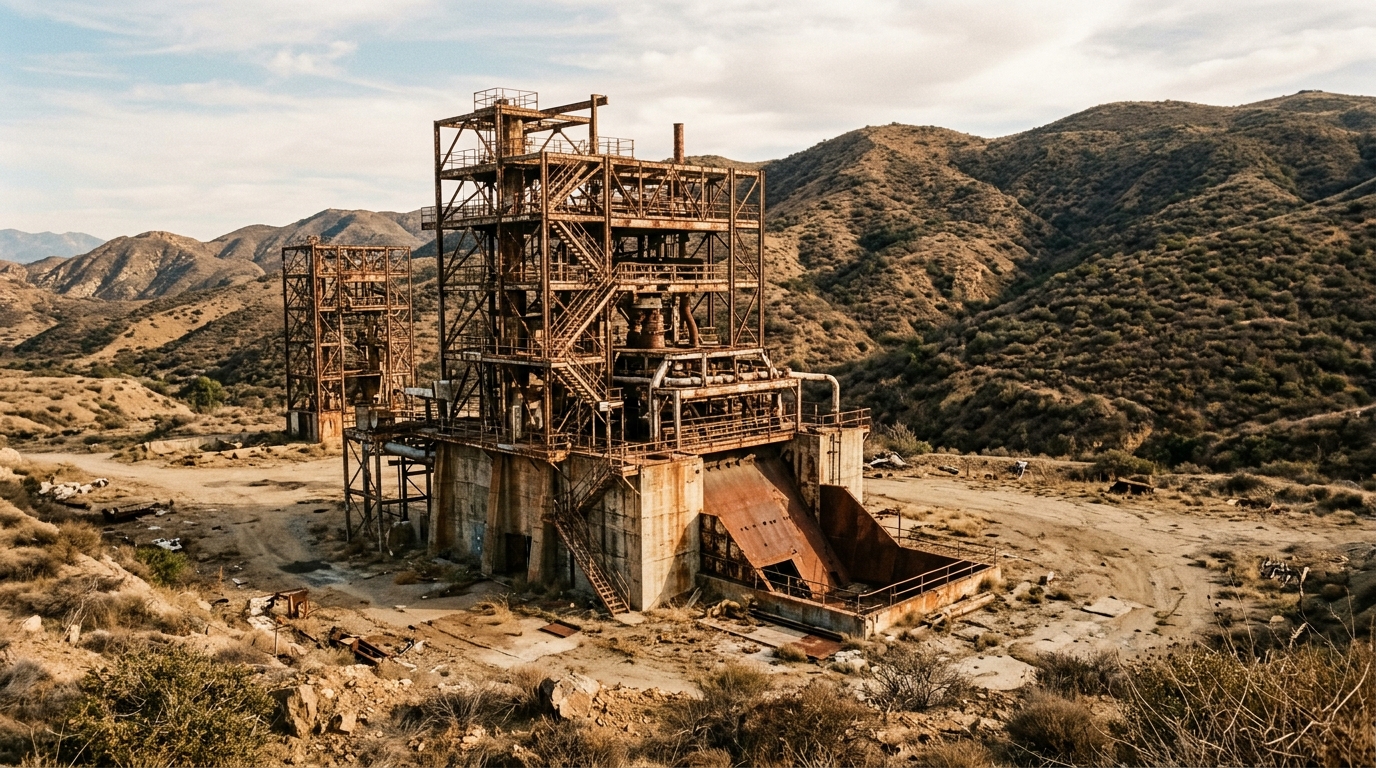
There are landscapes that resemble industrial graveyards, and this one is a perfect example. Nestled in the arid hills north of Los Angeles, rusting metal carcasses have stood silent for nearly twenty years, fenced off and surrounded by warning signs. These structures are far from incidental: they witnessed the birth of the power that propelled humanity toward the Moon. Yet on this soil steeped in spaceflight history, the earth itself remains toxic, as if frozen in time after decades of administrative neglect.
- The Santa Susana Field Laboratory, where Rocketdyne tested the Saturn V F-1 engines, has been shuttered since 2006 without a full cleanup of soil or groundwater.
- The site also experienced in 1959 a partial core meltdown of an experimental nuclear reactor, an incident kept confidential for decades.
- Boeing, NASA, and the Department of Energy share responsibility for the cleanup, but demolitions and promised remediation are running far behind schedule despite commitments made for 2026.
- Rusted ruins where the engines that carried humanity to the Moon slept, abandoned for nearly twenty years on soil still contaminated
- Rocketdyne, the secret factory that shaped Saturn V’s F-1 engines
- 1959, the nuclear accident that no one spoke of for decades
- Why the promised cleanup never truly began
- Simi Valley today, between space memory and persistent contamination
Rusted ruins where the engines that carried humanity to the Moon slept, abandoned for nearly twenty years on soil still contaminated
In Simi Valley, California, lies the Santa Susana Field Laboratory, a sprawling site of almost 2,850 acres, roughly 1,150 hectares. It is here, on test benches now locked in rust, that the giant rocket engines which powered the Apollo missions beyond Earth’s atmosphere were tested. Since 2006, these facilities have been shut down, left to the elements, while the surrounding soil remains marked by chemical and radiological pollution never completely resolved.
The contrast is striking: on one side, a unique technical and historical heritage, witness to the early days of space exploration; on the other, ground still deemed hazardous, where groundwater and certain pockets of soil continue to concentrate unwanted substances, despite decades of intermittent interventions.
Rocketdyne, the secret factory that forged Saturn V’s F-1 engines
Before becoming a symbol of administrative inertia, the site was a premier hub of American aerospace engineering. It was the company Rocketdyne that conducted, in quiet secrecy, the development of the most powerful engines ever built for a crewed launcher: the F-1 engines, which equipped the first stage of the Saturn V rocket. Each test produced a deafening roar, audible in nearby valleys, and left in its wake residues of highly toxic fuels.
For years, the site’s activities remained largely unknown to the general public. Local residents sensed something important was happening there, without knowing exactly what. It was only much later that the scale of the tests, and above all their environmental consequences, began to be documented and taken seriously.
1959, the nuclear accident that nobody talked about for decades
What few people know today is that the Santa Susana Field Laboratory did not exclusively host rocket engine tests. The site also housed an experimental nuclear research center, where various reactors were tested. In 1959, one of them experienced a partial core meltdown, an incident now regarded as one of the most serious in the history of American civilian nuclear power, then kept confidential for many years.
This late revelation changed the site’s perception: it was no longer merely a ground scarred by hydrocarbons and industrial solvents, but a zone potentially affected by radiological contamination. It is this double legacy, chemical and nuclear, that today explains the complexity and the unusually slow pace of remediation efforts.
Why the promised cleanup never really began
Since Boeing acquired the site from Rocketdyne in 1996, Boeing, now the main owner, claims to have removed or treated nearly 45,000 cubic meters of soil and demolished about 300 structures. A figure that seems impressive, but remains far from sufficient given the scale of the site, divided into four administrative zones, each associated with different responsibilities among Boeing, NASA, and the U.S. Department of Energy.
This summer again, Boeing planned to demolish the five remaining buildings it owned in Zone IV, the former Energy Technology Engineering Center site. Yet, according to local press, these works had still not begun by the end of summer 2026, with some projects showing notable delays. Meanwhile, the Department of Energy committed, in a May agreement, to demolish ten buildings still owned by it, including several among the most contaminated on the site. The schedule, however, remains unclear, and resident groups, such as Parents Against Santa Susana Field Lab, continue to denounce a lack of transparency and demand a much stricter cleanup than what is currently planned.
Simi Valley today, between space memory and persistent contamination
At the turn of autumn, with the California DTSC agency still to rule on the fate of the site’s groundwater, the situation remains in a state of limbo between two realities. On one hand, NASA released in January its annual pollution cleanup report, signaling the completion of phase 6 of demolition in the so-called Coca Test Area, an encouraging sign. On the other hand, the final soil cleanup, promised as early as 2026 under an agreement with the DTSC, hesitates to materialize on the ground.
The paradox is striking: this site enabled humanity to set foot on another world, while leaving behind an imprint that the Earth itself still struggles to erase. Between rusting test benches and administrative documents awaiting signatures, Santa Susana embodies that strange moment when technological achievement and environmental neglect walked side by side for a long time without much concern.
It is hard not to wonder, while gazing at these silent ruins perched above Simi Valley, about the true price of humanity’s grand undertakings. If the engines that allowed reaching the Moon lie now in the rust, the question of when, and how, this land will finally be deemed cleansed remains, itself, unresolved.
