
Forty-seven children. A single afternoon of play. One inflatable castle. That was all it took to trigger the largest outbreak of resistant Staphylococcus aureus ever recorded in Ireland. Behind this story that resembles a miniature disaster movie plot lies a far more commonplace reality, and that is precisely what makes it fascinating: a simple children’s party, a damp afternoon, and a bacterium seizing the perfect conditions to spread at a breathtaking pace. A look back at a health episode as spectacular as it is instructive, which questions our relationship with the most ordinary forms of collective leisure.
- In Ireland in autumn 2025, 48 children were infected with the hypervirulent strain t016-ST22-MRSA-IV after a party where an inflatable castle was set up under humid, heat‑favorable conditions for bacteria
- 22 cases were laboratory-confirmed, 26 deemed probable, and 4 children required hospitalization, with no deaths reported
- Health authorities conducted contact tracing and alerted the local school, helping to contain the outbreak to the circle of party participants
- An autumn party that turns into a bacteriological nightmare
- The inflatable castle, the ideal playground for a superbug
- T016-ST22: the hypervirulent strain that should not have been there
- What this Irish outbreak changes for the safety of children’s parties
An autumn party that turns into a bacteriological nightmare
In autumn 2025, an outdoor social gathering organized in Ireland was meant to be a simple, joyful memory for the children who attended. Yet, a few days later it became the starting point of a public health alert of unprecedented scale. It all began when a twelve-year-old boy was hospitalized nine days after attending the party, presenting worrying skin symptoms. This report immediately alerted local health authorities, who quickly contacted all families who took part in the event.
The tally was chilling: 48 children and adolescents developed symptoms, including 22 cases confirmed in the laboratory and 26 probable cases. Pimples, pustules, redness, blisters, sometimes accompanied by fever, nausea, or vomiting: the clinical manifestations were serious enough that four children were hospitalized, fortunately with no severe complications or deaths. The vast majority of young patients showed the first signs one to two days after the party, while a single case took seventeen days to appear.
The inflatable castle, the ideal playground for a superbug
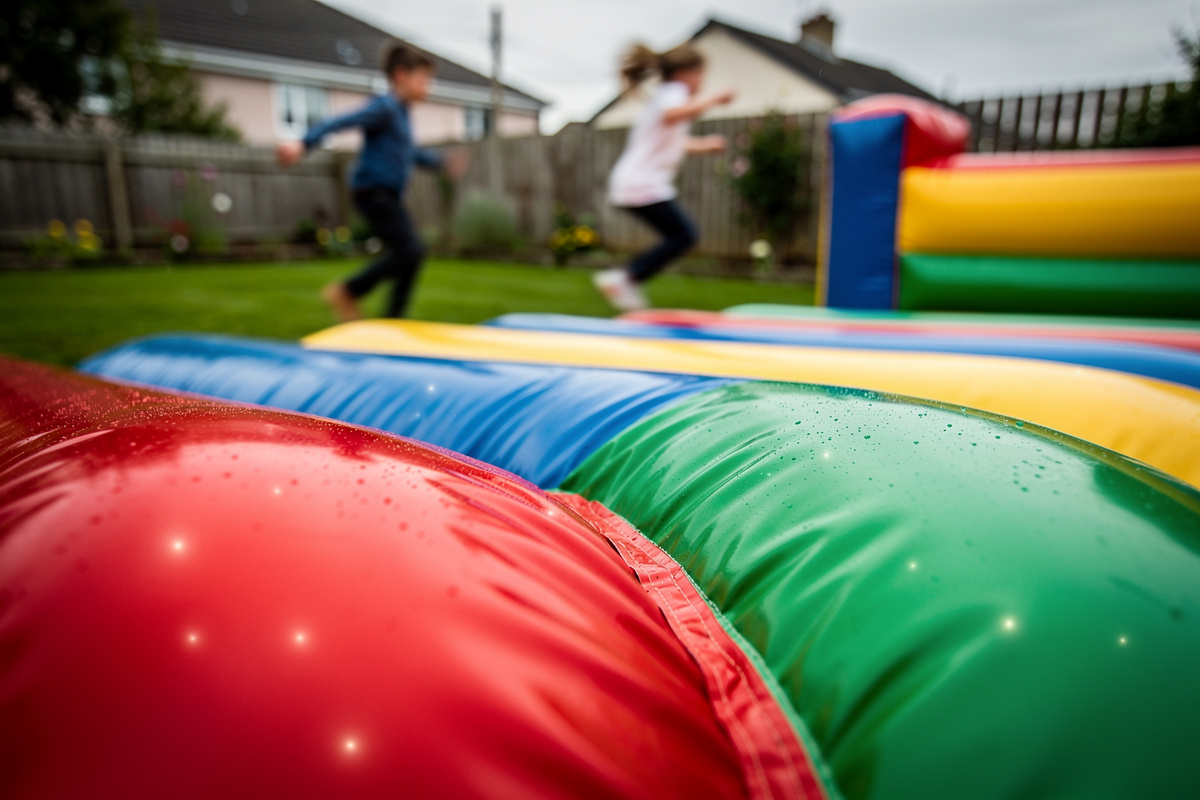
Of the 48 cases recorded, 47 had an obvious common link: they all played in the same inflatable castle during the party. The last case, however, did not directly set foot inside but had close contact with a child who was already infected, confirming the central role of this inflatable structure in transmitting the bacterium. One detail drew particular attention from observers: at least 24 children had played more than three hours in a row inside the castle, a duration that appears to have markedly boosted the risk of contamination.
How can such an effective spread occur on a simple inflatable at a fairground-style setup? The weather conditions that day, described as hot, humid, and rainy, likely played a decisive role. This combination of heat and moisture creates an environment especially favorable for the survival and multiplication of bacteria on surfaces, turning the inflatable castle into a kind of giant culture broth where skin, sweat, and microorganisms mingle for hours. Unfortunately, it was not possible to test the equipment directly for the bacterium, as the time elapsed before the investigation was deemed too long to collect a usable sample. Authorities nevertheless estimate that the structure was very likely contaminated by one or more carriers beforehand, before acting as a transmission vector on a large scale. Notably, the legs, and more specifically the thighs, were the body parts most affected by the infections.
T016-ST22: the hypervirulent strain that should not have been there
Laboratory analysis pinpointed the culprit precisely: a strain named t016-ST22-MRSA-IV, capable of producing the formidable Panton-Valentine leukocidin, a toxin associated with particularly aggressive skin infections. This strain is described as hypervirulent but remains, thankfully, rare in Ireland, which helps explain why its appearance in this epidemic form drew immediate and sustained attention from health authorities and specialized laboratories.
In terms of management, the distribution of cases provides a sense of the episode’s relative severity: 33 children were treated by their general practitioner, while 15 others required care at emergency departments or in a day hospital, including the four hospitalizations mentioned above. No deaths were reported, which remains the most reassuring aspect of this story, despite the troubling reputation of this kind of antibiotic-resistant bacterium.
What this Irish outbreak changes for the safety of children’s parties
In response to the scale of the situation, health authorities established a contact-tracing and case-follow-up system. The local primary school was also notified so that infected children stayed at home, thereby limiting the risk of secondary transmission within the school. This rapid response helped contain the outbreak without it spreading beyond the initial circle of party participants.
This episode, as striking as it is, highlights a point often overlooked: inflatable structures, widely used at birthday parties and family gatherings, can become genuine vectors for bacterial transmission when conditions are right. Prolonged play, heat, humidity, and close contact among many children create a cocktail conducive to the spread of germs that, under different circumstances, would remain much more contained. Rather than panicking, this case invites a rethink of hygiene practices around these leisure devices, especially during periods of high heat or humidity.
This Irish outbreak will likely stand as a textbook case for epidemiologists, illustrating with force how a simple everyday festive object can, under certain circumstances, become the setting for large-scale bacterial spread. So, the next time a inflatable castle graces a yard for a birthday party, it might be worth thinking twice before letting children spend hours inside.
