
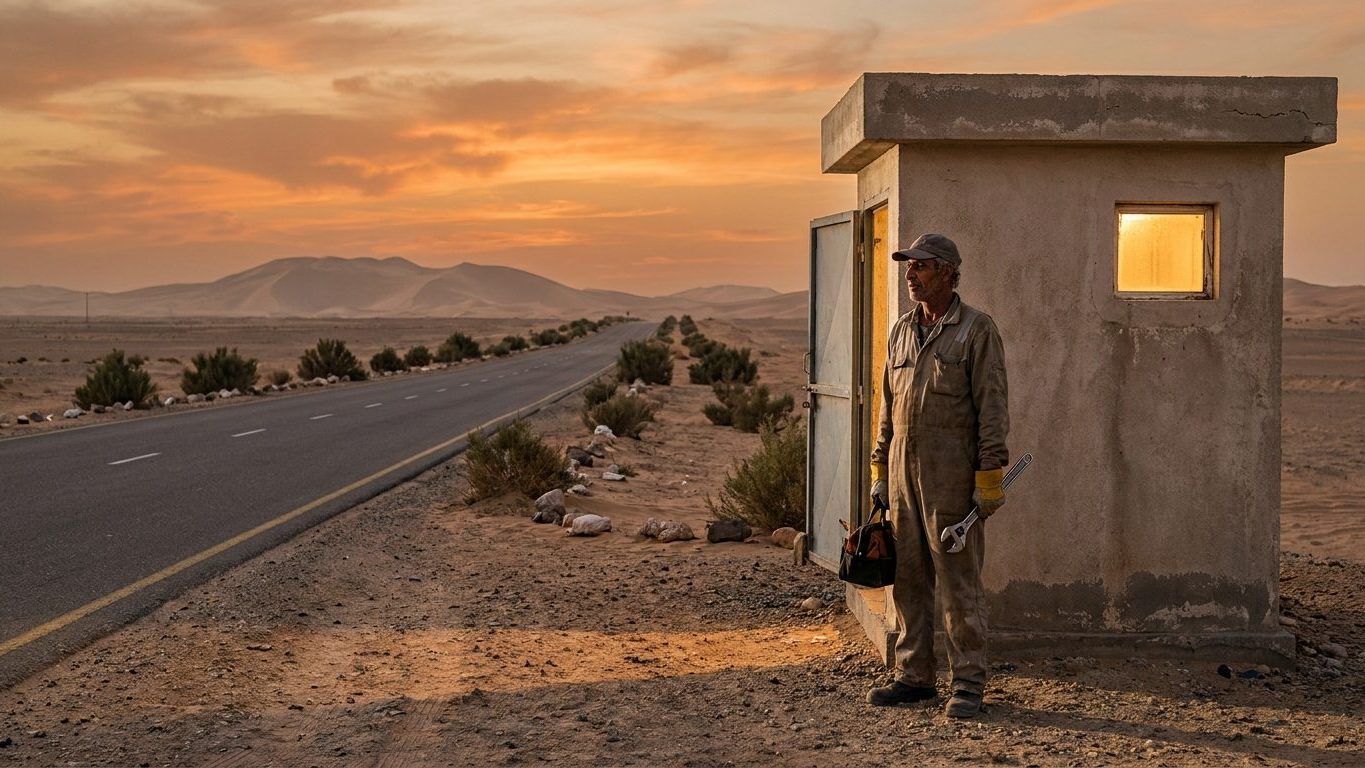
On the map, a straight line cuts through emptiness. On the ground, it is a 552-kilometer road, about 446 kilometers of which cut through the Taklamakan, in the heart of Xinjiang, without a village, a farm, or any natural water source along the entire stretch. It links the towns of Luntai and Minfeng, opened to traffic in 1995 after two years of construction, and it stays upright thanks to a mechanism found nowhere else: guardians housed every four kilometers, charged with preventing the sand from reclaiming what the asphalt has taken.
- A 446-kilometer road crosses the Taklamakan with a guardian every four kilometers since 1995.
- Deep-rooted shrubs irrigated by wells 100 meters deep hold back the dunes on both sides of the pavement.
- 86 solar stations have replaced diesel generators since 2022 to pump water for irrigating 3,100 hectares of green belt.
- The road protects a strategic oil pipeline linking north to south beneath the desert.
A hedge that drinks so the road breathes
The Taklamakan is not a desert of flat sand. It consists of shifting dunes, some reaching 20 meters in height, driven by the wind and swallowing anything that stays put. To hold back this mass, engineers planted rows of shrubs on both sides of the road for almost the entire desert stretch, choosing species with deep roots, such as the saxaul or certain tamaris varieties.
These plants would not survive a season without aid. A vast irrigation system draws water from underground reservoirs through wells drilled about 100 meters deep, fed by rivers descending from the surrounding mountains that encircle the Tarim basin. Water comes from wells 100 meters deep in an aquifer beneath the desert, itself fed by the rivers from the surrounding mountains.
Without this water, the hedge would die within weeks.
A house every four kilometers, and nothing else
That is where the road becomes truly extraordinary. Every four kilometers, a maintenance house keeps an irrigated strip of shrubs along the road, protecting the pavement from the moving sand. These buildings house a pump, equipment, and the people responsible for monitoring the irrigation day after day. Outside the workers assigned to operate the pumping stations, the region is entirely uninhabited.
No farm, no hamlet, no spontaneous fuel stop for hundreds of kilometers. Hundreds of workers were employed, housed every four kilometers along the road, to tend to the little roses of the sands, the saxaul and the sea buckthorn, and to ensure they did not die. In the scale of the desert, these houses look like tiny dots. Yet they are the only thing that prevents the dune from completely burying the pavement.
The calculation is dizzying: 446 kilometers of dunes opposed by a chain of refuges spaced every four kilometers, each occupied so that the neighboring hedge does not dry out.
The energy that changed, the vigilance that did not move
For a long time, these pumps ran on diesel, delivered by trucks to the heart of the desert. This system has been replaced: since 2022, all the road’s pumping stations have shifted to solar energy, a conversion led by a PetroChina subsidiary in charge of the Tarim oil field. About 86 solar stations with a capacity of 3.5 megawatts have been built along the road, replacing the diesel generators necessary to pump water for daily use and irrigation.
These installations generate around 3.6 million kilowatt-hours of electricity per year and irrigate more than 3,100 hectares of green belt. A figure that would dazzle when compared to a private garden. But the principle remains the same as in 1995: without continuous human presence to monitor flows and repair leaks, the system collapses in a matter of weeks.
The buried oil pipeline beneath this stretch of desert explains the scale of the investment. The road was built in 1995 to serve a crucial north–south oil pipeline beneath the Taklamakan, where China’s largest oil and gas field lies. Without this economic stake, one might hardly justify dozens of isolated dwellings in the middle of an erg to water a hedge.
What happens when a pump stops
The system is neither automatic nor foolproof. A pump breaks down, a well becomes clogged with salt from saline aquifers, and an entire stretch of shrubs begins to wither within days in the desert heat. Without living roots to anchor them, the dunes resume their natural movement and seal the road once more, exactly as in 1993.
This is the paradox of the road: it exists because dozens of people agree to live alone, at regular intervals, in the middle of nowhere, to water a hedge every day. The desert needs little to reclaim its rights. Just one pipe becomes clogged, and a kilometer of sand resumes advancing.
Sources: gowesternchina.com | chinatravelplaces.com
