
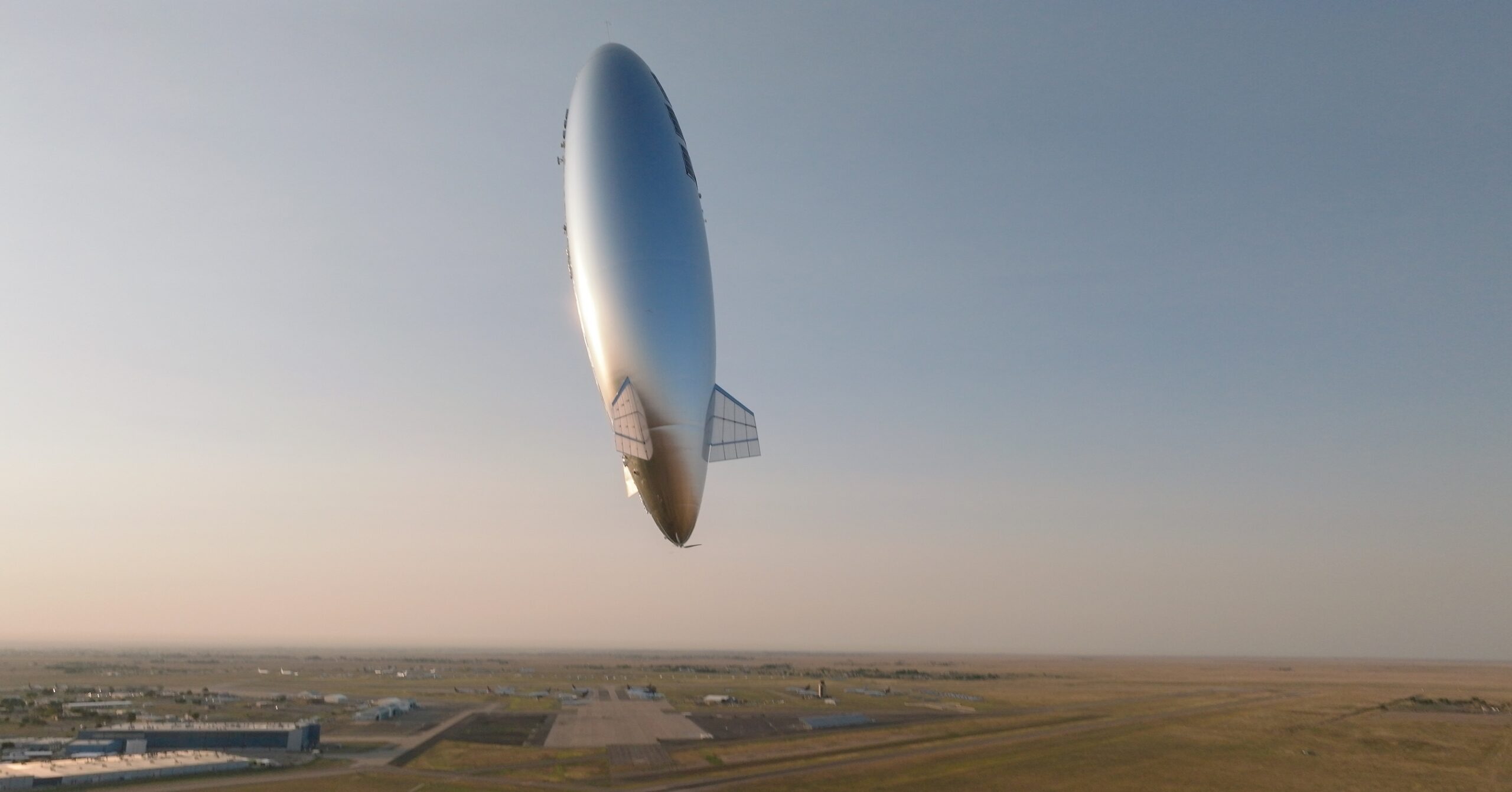
Imagine a sleek, silver craft drifting silently through the stratosphere above the Pacific Ocean, with no pilot on board, yet capable of making your phone function as if it were picking up signals from a conventional cell tower. This sci‑fi scenario has now become reality. In the fall of 2026, the American company Sceye completed a stratospheric flight of unprecedented scale, linking New Mexico to Japan and then returning, all within a month and over roughly 30,000 kilometers. Behind this technical feat lies a far broader ambition: to redefine how our mobile networks could operate tomorrow, without stacking countless towers across our landscapes.
- Sceye accomplished a 30,000 km uncrewed stratospheric flight in one month, linking New Mexico to Japan and back, as part of the Service Test 1 mission
- The SceyeCELL platform delivered broadband mobile connectivity to standard smartphones via SoftBank’s network, equivalent to around 500 terrestrial base stations
- Thanks to onboard edge computing, the measured round-trip latency reached 68 milliseconds, a more than 40% reduction compared with traditional cloud processing, a world first for a HAPS
- A pilotless balloon crossing the Pacific there and back
- Why a single platform replaces 500 base stations
- 68 milliseconds: latency beating the classic cloud
- The stratosphere, a future highway for 6G and 3D networks
Everything begins in Moriarty, New Mexico, home base of Sceye, where the company’s stratospheric platform rises into the sky to begin its mission named Service Test 1 (ST1). This test flight is far from a routine technical trial: it marks Sceye’s first journey toward Asia, a symbolic milestone for a company specializing in High Altitude Platform Systems, the so‑called HAPS that operate well above commercial air traffic.
Thirteen days after liftoff, the craft enters Japanese airspace, where it will operate for a week in collaboration with SoftBank Corp. Then comes the lengthy return path, until the platform re-enters American airspace near its starting point. In total, the expedition lasts thirty days and spans about 30,000 kilometers, a true tour de force for what remains technically a free, unmanned balloon. No pilot at the controls, yet a payload of remarkable sophistication that transformed this flight into a full‑scale demonstration.
Why a single platform replaces 500 base stations
At the heart of the mission lies a device named SceyeCELL, literally a cell tower installed in the sky. In practice, once deployed at full scale, a single Sceye HAPS could cover an area equivalent to about 500 terrestrial base stations. In other words, where hundreds of pylons would be needed to ensure broad mobile coverage over a vast region, a lone platform suspended in the stratosphere would do the job.
During tests above Japan, the device demonstrated its ability to provide broadband mobile connectivity to standard, unmodified smartphones, leveraging SoftBank’s core network. This point is crucial: it is not a gimmick requiring special equipment, but a technology compatible with the devices we already use in daily life. Sceye also validated emergency calls via a disaster-alert system, a use case that resonates when imagining disaster zones lacking terrestrial infrastructure.
68 milliseconds: latency that beats the classic cloud
Beyond mere coverage, the ST1 mission enabled testing a notably groundbreaking innovation: data processing directly aboard the platform, via an edge computing system integrated into the device itself. The result is that data does not need to travel back and forth to a distant server on Earth for analysis and return; everything happens in the stratosphere.
The numbers speak for themselves: the average round‑trip latency measured stood at 68 milliseconds, representing a latency reduction of over 40% compared with traditional cloud processing. This achievement is a world first, since it marks the first time a mobile core network and a web server are installed simultaneously on a HAPS, with processing entirely onboard before sending results back to the smartphones on the ground. A feat that, in a sense, brings computing closer to the end user, even when that user is on the ground below the device.
The stratosphere, a future highway for 6G and 3D networks
Sceye isn’t stopping at simple mobile connectivity. The mission also validated communications between the stratospheric platform and drones, a key step toward building what the company calls a 3D communication network, a mesh that no longer is confined to ground level but stretches vertically across different altitudes.
According to Mikkel Vestergaard Frandsen, founder and CEO of Sceye, these stratospheric platforms operate similarly to geostationary satellites in some respects, but with a major advantage: they sit roughly 1,800 times closer to Earth, dramatically reducing costs while boosting performance. That intermediate position, between ground-based antennas and satellites in orbit, makes the stratosphere a privileged testing ground for future mobile generations, including the 6G, still in its early stages but whose contours are beginning to emerge thanks to experiments like this.
This transpacific flight, as discreet as it is ambitious, illustrates how the future of telecommunications could be decided well above our heads rather than atop our towers. Between broad coverage, reduced latency, and drone connectivity, Sceye lays down a serious pathway to rethink our digital infrastructure. It remains to be seen whether this still‑experimental technology will scale to wide deployment or stay confined to spectacular demonstrations like this one.
