
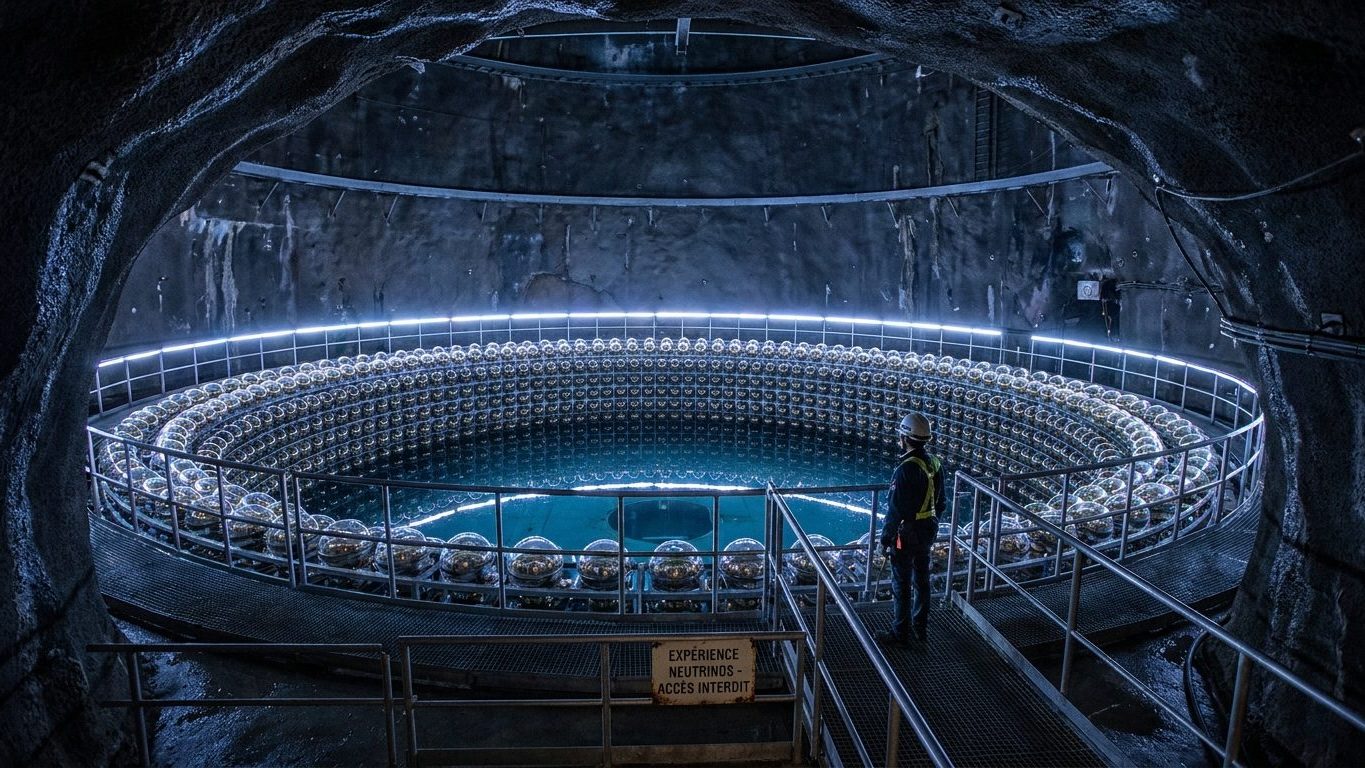
Twenty-four particles. That is all humanity has ever captured from a star dying in the act of death. On February 23, 1987, at 168,000 light-years from Earth, a blue supergiant named Sanduleak −69 202 collapsed in on itself in the Large Magellanic Cloud. It became SN 1987A, the nearest supernova observed since the invention of the telescope, and above all the only one for which neutrinos have ever been detected.
Three detectors, buried under mountains thousands of kilometers apart, recorded on that day a signal within a matter of seconds. Kamiokande-II in Japan captured eleven events, IMB in Ohio detected eight, Baksan in the Caucasus observed five. Twenty-four in total, by the most widely accepted tally. About twelve seconds of data, and nothing since.
- Twenty-four neutrinos were detected during SN 1987A on February 23, 1987 by three underground detectors around the world
- The neutrinos arrived roughly two hours before the first visible-light observation of the supernova
- The neutron star born from this explosion remained hidden for 37 years before being detected by the Webb telescope in February 2024
- The international alert system SNEWS, created in 1998, has awaited a nearby galactic supernova for more than 25 years
Three hours ahead of the light
What makes this event unique isn’t merely the number of particles detected. It is the sequence in which they arrived. Roughly two hours before the first visible-light sighting of SN 1987A, three observatories across the globe detected a volley of neutrinos lasting only a few seconds. The neutrinos escaped the collapsing core almost instantly, while the light had to traverse the entire stellar envelope before escaping.
That race between particles and photons is far from incidental. It confirmed a theoretical mechanism that had never before been observed directly: the gravitational collapse of the core of a massive star releasing most of its energy in the form of neutrinos, not light. It is estimated that the explosion emitted on the order of 10^58 neutrinos, representing about 99% of the total energy discharged by the catastrophe. The light, spectacular as it is, is only a visible byproduct of a phenomenon unfolding elsewhere, in a flood of particles that are nearly undetectable.
Calendar timing also mattered. SN 1987A was the first supernova visible to the naked eye since Kepler’s observation in 1604. Before modern telescopes, no one could have seen it so distinctly. Without underground neutrino detectors shielding from cosmic noise, no one would have captured its invisible signal.
An alert network waiting since 1998
Since then, the scientific community has not rested on that sole observation. An international system named SNEWS was established to never miss such an event again. This network arose in 1998 during a workshop that brought together neutrino experimenters, supernova theorists, and astronomers, aiming to exploit the capabilities of existing detectors to catch the early neutrino signal from a core-collapse galactic supernova.
The principle is simple on paper. A coincidence server waits for signals sent by each experiment, and if it finds a coincidence within a ten-second window, it dispatches an alert to the SNEWS mailing list. The system has operated automatically since 2005 and now links experiments as diverse as Super-Kamiokande, IceCube, and Borexino.
And yet, nothing. No real alert in almost three decades of watching. The fact that a nearby core-collapse supernova has not occurred since 1987 makes this list—now with about 7,000 subscribers—the Internet’s perhaps least-trafficked mailing list. Thousands of scientists await a message that never arrives.
The rarity of the event explains the long wait. Neutrino experiments are sensitive only to relatively nearby core-collapse supernovae within the Milky Way, estimated to occur 1.63 times per century, with a margin of error of 0.46. Statistically, decades more could pass. Or the sky could light up tonight.
Thirty-seven years to locate the dead star
One question remained after the explosion: what became of the core that emitted these 24 particles before vanishing beneath tons of debris? Astronomers knew that a compact object—either a neutron star or a black hole—must have formed from the collapse. Yet no convincing sign of such a newborn object had ever been observed in any supernova, until the Webb telescope finally offered direct evidence of emission triggered by the compact object, most likely a neutron star.
The announcement came in February 2024, published in Science. The neutron star had remained hidden for 37 years, concealed within the wreckage of the stellar explosion. Thirty-seven years spent searching for an object whose probable existence had been known precisely thanks to those neutrinos captured in 1987.
A member of the team summarized the significance of the discovery in simple terms. Mike Barlow, of University College London, stated that the mystery over whether a neutron star lay in the dust had endured for more than three decades and that it was exciting to have it finally resolved. What the 24 neutrinos announced in a few seconds would require nearly four decades of observations to confirm visually.
This story speaks to something dizzying about our relationship with the universe. We heard a star die before we could see its light, thanks to almost ghostly particles that pass through matter with hardly any interaction. And it took one of the most sophisticated telescopes ever built to confirm, almost forty years later, what that fleeting signal had already foretold. Somewhere in our galaxy, another massive star may be drawing near its last breath as we speak, and the underground tanks buried in rock continue to listen.
Sources: sciencedaily.com | nasaspaceflight.com
