
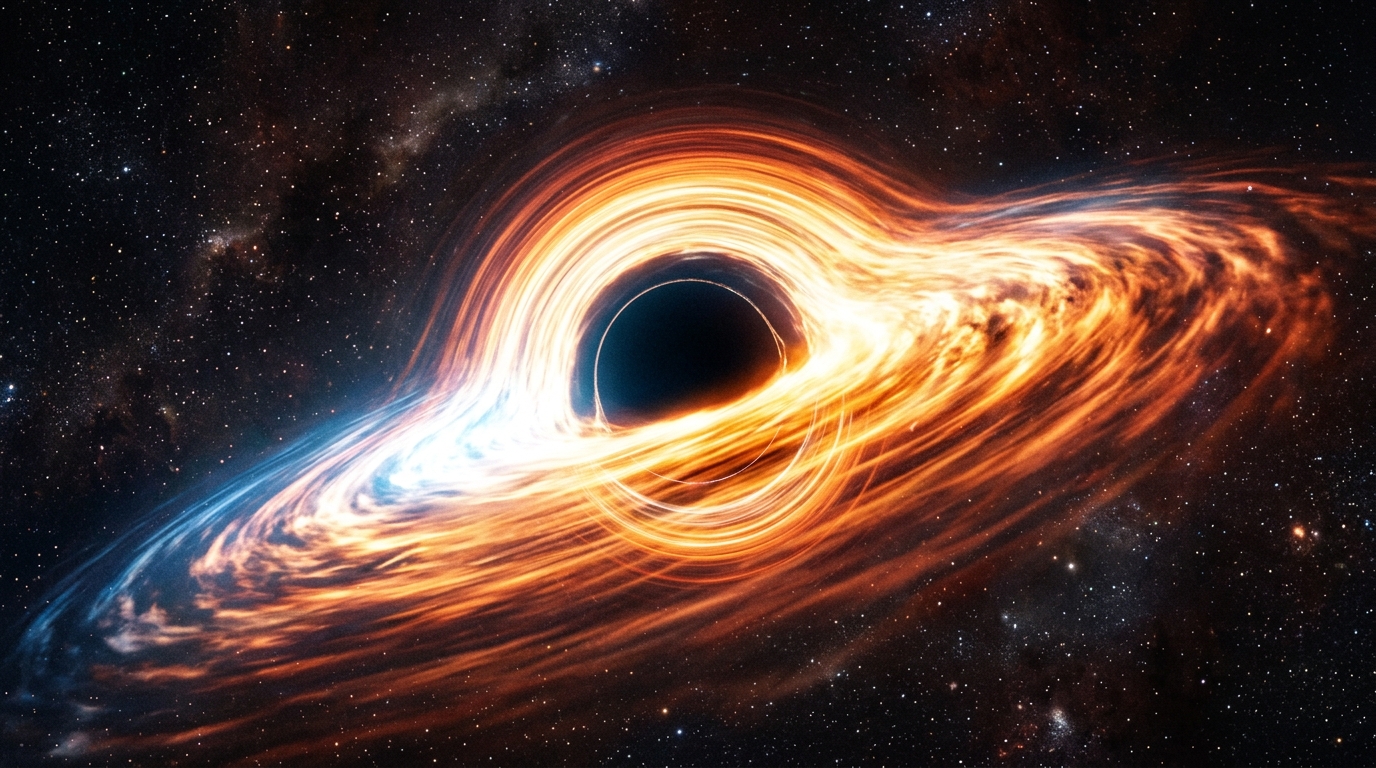
An invisible point in the Cygnus constellation, and yet one of the most extreme objects ever measured by astronomers. Cygnus X-1 isn’t just any star: it is a black hole born from the collapse of a massive star, discovered in the 1960s thanks to its intense X-ray emission. For decades, scientists thought they roughly knew its identity. Then a new set of measurements arrived that completely overturned the picture, revealing a mass and a rotation speed that place this celestial body at the top of the galaxy’s cosmic monsters.
- Cygnus X-1, located at 7,200 light-years from Earth, has its mass recalculated to 21 solar masses thanks to a more precise distance measurement through radio astrometry
- Its spin exceeds 0.95 (with recent studies suggesting up to 0.983), causing its event horizon to rotate at more than 800 revolutions per second, a value approaching the theoretical maximum
- This exceptional mass forces astrophysicists to revise downward the mass-loss rates of massive stars in their stellar evolution models
- A black hole too massive to exist in its own neighborhood
- When rotation nears the absolute limit set by Einstein
- Why this discovery forces rewriting stellar models
- What Cygnus X-1 reveals about the future of blue giants in our galaxy
Located at about 7,200 light-years from Earth, this black hole spins so rapidly that it approaches a limit that physics itself considers insurmountable. This could turn an object already fascinating into a genuine puzzle for specialists in stellar evolution.
A black hole too massive to exist in its own neighborhood
For a long time, the mass of Cygnus X-1’s black hole was estimated at around 15 solar masses, a figure already impressive but still compatible with the theoretical models of the era. Everything changed thanks to a refinement in the distance measurement of the system, obtained via radio astrometry, a technique that locates a celestial object with remarkable precision. Result: the actual distance of the system turned out to be larger than previously thought, which mechanically pushed up the black hole’s mass estimate to 21 solar masses.
This revision makes Cygnus X-1 the most massive stellar object of its kind detected without resorting to gravitational waves, a distinction with significant implications. Its companion star, a particularly luminous blue giant, also saw its mass revised upward, to about 41 solar masses. In other words, the duo forms a binary of exceptional power, where two extraordinarily massive objects dance around each other at a dizzying pace.
When rotation nears the absolute limit set by Einstein
If the mass is impressive, it is the rotation speed of this black hole that truly leaves one speechless. Its spin, i.e., its angular momentum expressed on a theoretical scale from 0 to 1, has been measured at more than 0.95, a value approaching the maximal limit according to the laws of general relativity. In practical terms, this means that Cygnus X-1’s event horizon is rotating at more than 800 revolutions per second, a velocity that nearly matches the speed of light.
To give a more intuitive image, imagine a top spinning so fast that it edges toward the theoretical maximum speed allowed by physics, never quite reaching it. That is precisely the situation of this black hole, which spins faster than any other black hole known to date. More recent observational work has even tightened this estimate to a spin exceeding 0.983, corroborating the extreme rotation obtained by different observational methods, including the analysis of the accretion disk and the iron reflection line that surrounds it.
Why this discovery forces rewriting stellar models
A black hole this massive should not exist so readily, in theory. Classic models of stellar formation predict that very massive stars lose a large portion of their matter over their lifetimes through powerful stellar winds that blow off their surfaces. The more mass a star loses before it collapses, the smaller the black hole it leaves behind.
Yet, for a stellar remnant to reach 21 solar masses, it is necessary to revise downward those very mass-loss rates. This conclusion, simple as it might seem on paper, compels astrophysicists to rethink part of the equations that describe the final stages of the life of giant stars. A detail that isn’t minor, since these models also underpin predictions for the formation of other extreme phenomena, such as black hole mergers detected by gravitational-wave observatories.
What Cygnus X-1 reveals about the future of blue giants in our galaxy
Beyond the record for mass and spin, Cygnus X-1 acts as a true natural laboratory. Its companion star, this blue giant weighing in at 41 solar masses, is itself destined for a similar fate: in a few million years, on cosmic timescales, it could collapse and give birth to a second black hole. Studying such a binary system therefore allows us to observe, almost in real time, the different stages leading to the formation of these ultra-dense objects.
These new data also provide a valuable point of comparison for all stellar-mass black holes cataloged in our galaxy. They demonstrate that there is a much larger margin for the maximum mass such objects can reach than previously anticipated, a finding that could influence how astronomers interpret future detections.
From Cygnus X-1 to the next monsters yet to be discovered, one thing is now certain: our galaxy continues to hide extremes capable of overturning theories that were once considered well established. The question remains how many other isolated black holes await discovery, somewhere in the sky, to reveal their own secret as well.
