
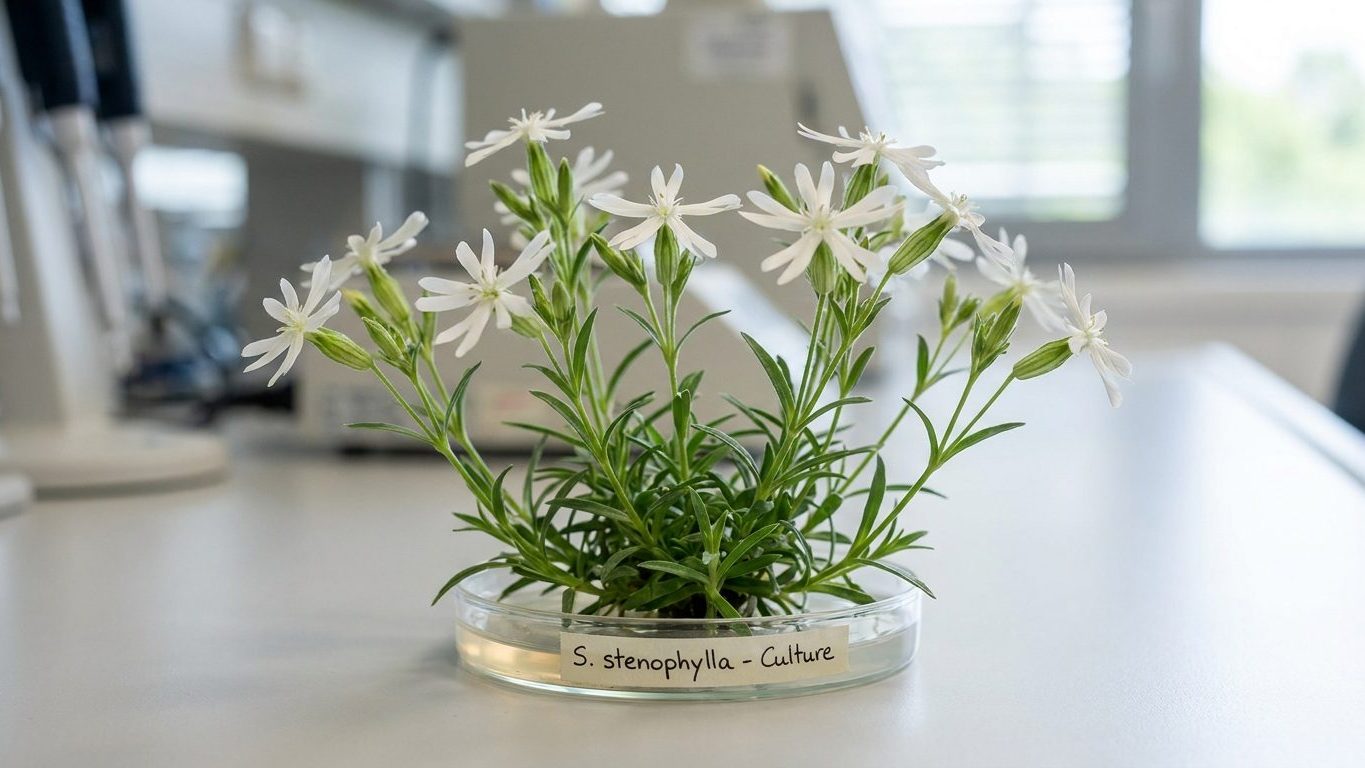
Thirty-eight meters beneath the frozen surface of eastern Siberia, a ground squirrel burrow yielded in 2012 one of the Pleistocene’s best-kept secrets. Inside, immature fruits of Silene stenophylla, a small white-flowered plant in the carnation family, had slept for 31,800 years (with a margin of 300 years) according to radiocarbon dating performed by accelerator mass spectrometry. A team from the Russian Academy of Sciences, led by Svetlana Yashina and David Gilichinsky, managed to extract living tissues and coax them to grow into complete, flowering, fertile plants. Published in the Proceedings of the National Academy of Sciences, these studies made this silene the oldest living multicellular organism ever regenerated.
- Silene stenophylla fruits dated to 31,800 years were found 38 meters deep in a Siberian ground squirrel burrow.
- The immature placenta, less damaged by radiation than mature seeds, enabled the cultivation of 36 living and fertile plants.
- The regenerated plants displayed longer petals and seeds with a germination rate of 100%, exceeding modern specimens.
A pantry frozen by ice
The site sits along the banks of the Kolyma River, in upper-Pleistocene loess and ice deposits, at the site known as Duvanny Yar. A team of Russian, Hungarian, and American researchers explored roughly 70 ancient hibernation burrows of ground squirrels, tucked within the permanently frozen sediments. These rodents served as stores for seeds and fruits to weather the winter, somewhat like a larder before the deep cold.
The burying burrow that yielded the decisive material, labeled P-1075, lay exactly 38 meters below the surface. Several immature fruits were found within a seed-rich conglomerate, in excellent morphological condition, and radiocarbon dating placed them at 31,800 years ago, plus or minus 300 years. Because the squirrels’ winter pantry was pressed against ice and frozen sediments, it was rapidly frozen and preserved without ever thawing. It is the undisturbed sediment layers themselves, never disturbed since, that guarantee the authenticity of this dating.
A flow of ice sealed the burrow almost immediately after its abandonment.
Cold protects, but is not enough
A consistently subfreezing temperature nearly halts enzymatic degradation and microbial activity, which would, in air, reduce any plant tissue to dust within a few years. The burrows had been dug into loess and ice deposits that remained permanently frozen until today. This biological stasis explains why the fruits retained an almost intact appearance after tens of thousands of years.
But freezing does not block everything. The researchers calculated that the total gamma- radiation dose accumulated by the fruits over all that time reached 0.07 kilogray, the highest dose known to render tissues nonviable and seeds ungerminable. The natural radiation emitted by the soil itself—unseen and constant—gradually fragments DNA. It is this physical limit, more than biological decay, that constrains how long an ancient tissue remains usable.
The logical outcome of this radioactive wear-and-tear: mature seeds had likely sustained damage, perhaps by the squirrel itself to prevent germination inside the burrow, while some immature seeds still harbored viable plant material. The researchers even tested the most obvious route first and found it wanting.
The placenta rather than the seed
The Russian team initially tried using mature seeds from the fruit pods, but these seeds could not yield any plant. The failure was not wholly surprising: mature seeds had endured too much damage over such a long period to remain functional. A tissue less exposed or better able to repair its own lesions was needed.
The solution came from the placenta—the tissue inside the immature fruit that connects the developing seeds and remains rich in cells capable of redifferentiation. The researchers noticed that seeds taken from immature fruits often retained a funiculus, the stalk linking them to the placenta, and this tissue showed growth in vitro, which led them to focus on tissues from ancient immature fruits. By extracting this placenta and placing it in a sugar-and-vitamin-rich medium, the team succeeded in growing a root network and then a few shoots. Two years later, these shoots flowered, and after cross-pollination, produced fruits and seeds in turn.
Using in vitro culture and clonally propagated microcuttings, the team grew 36 ancient plants from fragments of placental tissue taken from three intact immature fruits. Three fruits, thirty-six plants: a yield that would impress any horticulturist.
A plant almost identical, but not quite
The regenerated Silene stenophylla still grows in the wild in Siberia today, allowing a direct comparison between the Pleistocene version and the present-day one. The plants from the burrow resembled modern specimens right up to flowering, at which point their petals appeared longer and more widely spaced than those of the current counterpart. A subtle difference, invisible until the flower opened.
Another difference, more surprising: the seeds produced by these regenerated plants germinated with 100% success, versus about 90% for contemporary plants of the same species. The scientists themselves admit they cannot explain these discrepancies. Thirty-two thousand years of genetic distance, and yet a higher germination vigor: fuel for further studies on the microevolution of the species.
Permafrost, a seed bank that melts
This natural preservation of plant tissue for tens of thousands of years shows that permafrost can function as a repository for ancient genetic material, potentially representing life that may be missing from the surface of the planet today. Permafrost denotes soil in which the temperature remains below 0°C for at least two consecutive years, and it now covers about 20% of the world’s surface. This frozen reserve potentially houses other tissues elsewhere on the globe.
Seeds and fruits have also been found in ground squirrel burrows in northeastern Siberia, and in Alaska and the Yukon of Canada. Each intact permafrost pocket thus represents a potential biological archive, provided it remains frozen. Warming at high latitudes is accelerating the thaw of these soils, exposing their contents to air, moisture, and microorganisms that they have kept at bay for millennia. What cold managed to preserve for thirty-two thousand years can degrade in just a few seasons once the soil becomes active again.
Sources: letemps.ch | futura-sciences.com
