
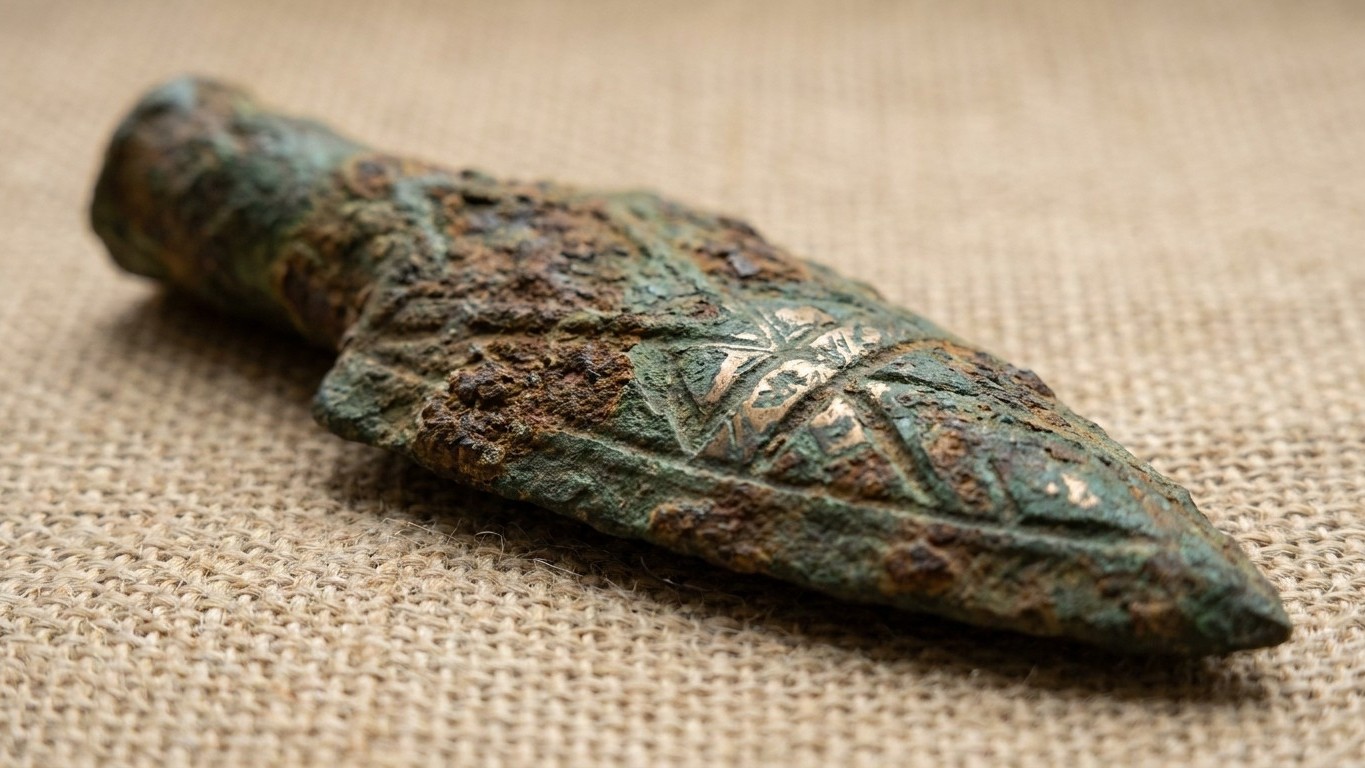
A shard of rusted metal, wedged near the shoulder blade of a 50-ton bowhead whale, has reopened a chapter long believed closed: the industrial whaling of the 19th century. In 2007, Inupiat hunters from Barrow, in northern Alaska, uncovered, within the fat of a male bowhead, a fragment identified as originating from a model patented by Ebenezer Pierce in 1879, a technology that had fallen into disuse by about 1885 in the face of newer innovations. The animal they had just killed bore, for more than a century, the mark of a failed shot, fired by hunters long dead.
Key takeaways
- A mysterious shard of metal buried for over 120 years resurfaces in an Alaska whale
- Experts determine the fragment comes from a revolutionary weapon that fell out of use more than a century ago
- The discovery reshapes scientific understanding of bowhead whale longevity
A routine discovery that turns into a historical enigma
Everything begins in spring 2007, during a subsistence hunt overseen by authorities. The fragment was found by the crew of Captain Arnold Brower Sr. as they flensed a whale captured in May 2007 near Barrow, Alaska. The animal, a male, measured about 49 feet in length and weighed roughly 50 tons, revealing a metal shard buried deep in the fat near the shoulder blade. At first glance, the discovery did not seem extraordinary: finding old iron fittings inside the body of an Arctic whale is not unusual for Inupiat crews, who have long practiced this tradition.
What changes the story is the precision of identification. The fragment, lodged in a bone between the neck and shoulder blade, was probably produced in New Bedford, once the world’s hub of whaling. It was sent to the whaling museum of that Massachusetts city, where historian John Bockstoce could compare the piece with his reference collection. His verdict, unequivocal: “We examined the piece and found that it was a model manufactured under an 1879 patent, produced only from 1879 to 1885.”
An explosive tip, signature of a bygone era
The object recovered was not merely a forged iron harpoon but a genuine small mechanical weapon. The projectile was loaded with powder and included a delay mechanism allowing the explosion to occur a few seconds after piercing the flesh; the Barrow fragment consisted of three bronze components: a tip, a detonating “hammer,” and a screw. The body containing the actual explosive charge was never found: only the head survived the voyage through time, embedded in the whale’s scarred tissue.
These “bomb lances,” as they were known at the time, were typically fired from a shoulder-fired heavy rifle, a formidable weapon by its era yet far from infallible. Calibrating the firing window allowed researchers to narrow down the date of use: the weapon would have had to be shipped to San Francisco, home to the whaling fleet of the period, and then transported north to Alaska, placing its use around 1890 as a reasonable estimate. A troubling detail completes the picture: the tip carried six small notches, likely ownership marks from an Alaska Indigenous whaling captain. A signature, in short, left by a hunter about whom little is known beyond the fact that he missed his target over a century ago.
The researchers could not help noticing the irony: the descendants of this anonymous hunter may well be the same families who, in 2007, completed the work their ancestors had started. As the host of Living on Earth noted in interviewing Bockstoce, it is possible that the May kill of the old bowhead by Barrow was carried out by descendants of the very hunters who had first attacked it more than a century earlier.
What the shard reveals about bowhead longevity
Beyond the archaeological anecdote, the find had tangible implications for science. Because the Pierce patent narrows the manufacturing window, researchers could estimate the whale’s age with unusual precision: the 3.5-inch arrow-shaped projectile gave scientists a glimpse into the whale’s age, estimated at between 115 and 130 years. Some additional analyses went further; in a study led by Jeffrey Bada, the animal could have reached as old as 211 years.
And this was not the first time such evidence had appeared. The discovery prompted George to retrieve a similar fragment found in a whale hunted near Saint-Laurent Island in 1980 and send it to Bockstoce for comparison. At the time, no one appreciated the fragment’s significance: “We did nothing with it then, and no one had any idea of their lifespan, nor did anyone suspect that a bowhead could be so old,” the biologist recalled. The 2007 fragment enabled scientists to piece together the story and confirm what Inuit oral tradition had long asserted, albeit without tangible scientific proof.
The bowhead whale indeed belongs to a small group of species with negligible senescence: it can live beyond 200 years, making it one of the longest-lived vertebrates on the planet, just behind the Greenland shark. After analysis, the artifact was not confined to a laboratory: it was intended to be exhibited at Barrow’s Inupiat Heritage Center, where today it narrates, in its own way, the tale of a creature born under Rutherford B. Hayes’s presidency and which crossed, beneath the ice, more than a century of human upheaval without ever colliding with the killers that hunted it.
Sources: gamerz.be | zejournal.info
