
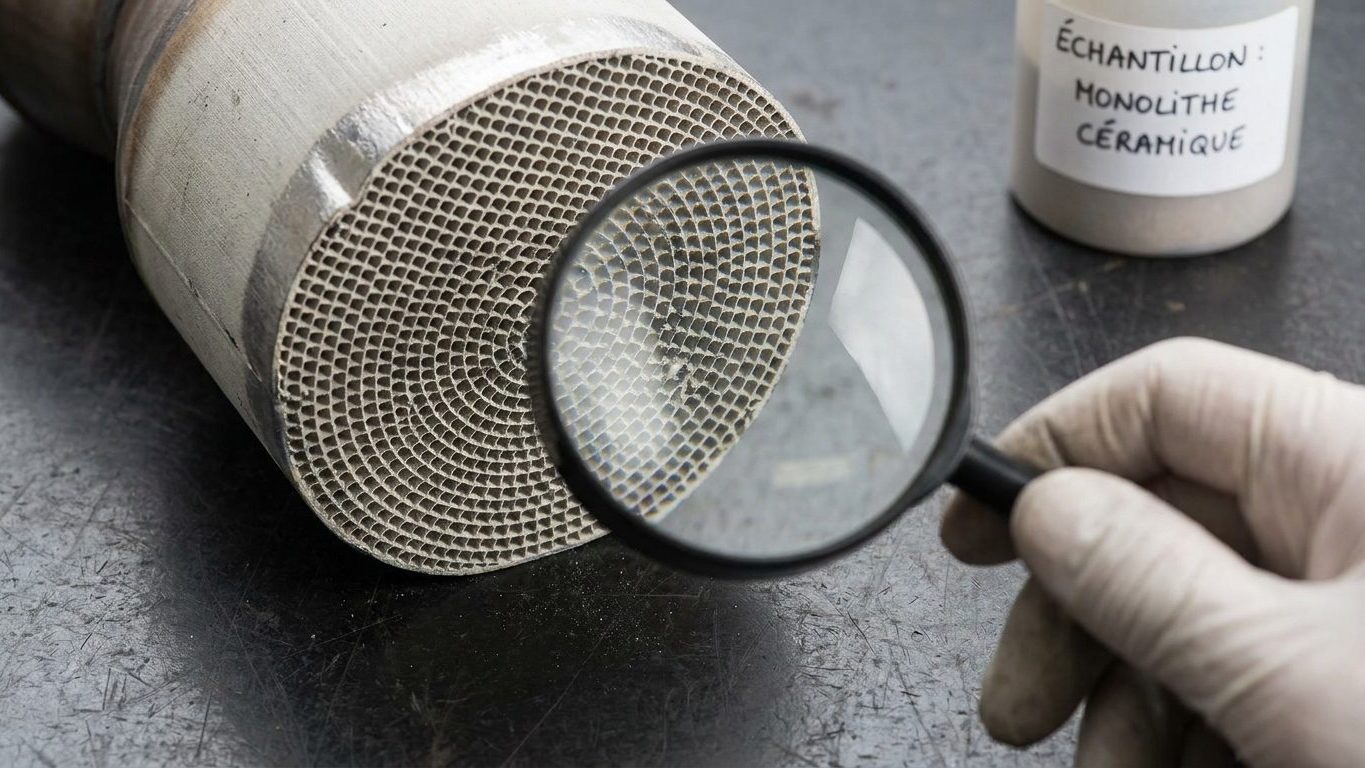
A steel exhaust pipe worth only a few euros at scrap, but whose interior attracts entire networks of professional thieves. The paradox is not one: criminals never care about the outer metal of the catalytic converter; they are drawn to the fine internal structure, a ceramic honeycomb coated with metals so rare that their value per gram far surpasses gold.
Only a few dozen tonnes of this material are mined worldwide each year: South Africa alone accounts for most of global production, according to several sources specialized in automotive recycling. South Africa is the leading producer of rhodium in particular. A tiny volume on the global scale, which explains why a simple exhaust pipe has become a target as coveted as it is discreet for organized crime.
- A catalytic converter contains 2 to 10 grams of precious metals (platinum, palladium, rhodium) worth more per gram than gold
- Catalytic converter thefts have surged by 2,200% in France since 2020, mainly targeting hybrids and SUVs
- A bolted-on protection plate turns a two-minute theft into a twenty-minute operation, often deterring thieves
The honeycomb that depollutes your journeys
The catalytic converter is far from a decorative piece. Central to the exhaust line, it stands as the vehicle’s main pollution-control device, tasked with turning the toxic gases emitted by the engine into harmless substances, a transformation achieved through a high-temperature catalytic process. Concretely, carbon monoxide and nitrogen oxides emerge as water vapor, carbon dioxide, and nitrogen.
This chemical feat relies on an internal structure called the monolith. The metals are housed within a ceramic honeycomb framework inside the catalytic converter, and the encounter between the exhaust gases and the precious metals in the monolith triggers a chemical reaction that dramatically reduces pollutants. Platinum, palladium, and rhodium line this microscopic lattice. A catalytic converter typically contains between 2 and 10 grams of precious metals, primarily palladium, platinum, and rhodium. A few grams only, but grams that carry heavy weight on the black market.
Why these metals are unavailable elsewhere
Platinum, palladium, and rhodium belong to a family known as the platinum group metals, prized for their extreme resistance to heat and corrosion. The rhodium, platinum, and palladium are exceptionally durable, and these metals can last as long as a car does. It is precisely this longevity that makes used catalytic converters as valuable as new ones: the metal hardly wears down.
Their rarity stems from geology. These elements occur in exploitable quantities only in a handful of deposits worldwide, making extraction slow, costly, and geographically concentrated. Today, rhodium is the planet’s rarest element, and it sits beneath most gasoline-powered vehicles. A chemist from Université Laval sums up the situation bluntly: these three metals are very scarce and have unique properties. No industrial substitute today can fully replace them in the majority of vehicles on the road today.
Targets chosen with method
Not all vehicles are equal in the eyes of thieves. Hybrid cars, older gasoline sedans, and SUVs are the most exposed to theft due to the abundance and accessibility of their catalytic converters. This selection follows an almost industrial logic: the higher the ground clearance, the quicker the operation.
Trucks and SUVs are easier to steal because they have greater ground clearance, which makes the theft simpler. No jack, no lifting the vehicle: the thief slides underneath directly. For hybrids, the logic differs but is just as relentless. Hybrid systems, by producing fewer polluting emissions, preserve catalytic converters longer, making them especially attractive for resale. Less worn, the hybrid catalyst retains a concentration of precious metals closer to new, a major argument for a resale network.
The act itself lasts only a few minutes. A few minutes are enough to unscrew or remove them from beneath the vehicle. A saw, a wrench, sometimes a simple cut with a grinder, and the job is done in a poorly lit parking lot. In France, the phenomenon has accelerated dramatically in recent years. Catalytic converter thefts have risen by 2,200% since 2020. A figure that, on its own, speaks to the profitability of the crime.
Protecting yourself: the actions that really make a difference
In response to this scourge, insurers and garages recommend concrete countermeasures. Preventive solutions exist to lower risk, including bolted-on protection plates, engraving the serial number, and choosing a secure parking spot. The anti-theft plate, bolted beneath the chassis, turns a two-minute operation into a twenty-minute job, often persuasive enough to deter a hurried thief. Engraving, meanwhile, makes the part identifiable and thus unusable for resale in networks that require metal anonymity.
French law also regulates the sale of these materials to limit the channels through which the trade can operate. Article L112-6 of the Monetary Code prohibits cash transactions for the sale of heavy metals, a framework that has helped clean up the field and promote genuine recycling of the rare metals derived from catalysts. On the insurance side, vigilance remains essential. In case of theft, only policies that include theft coverage provide partial reimbursement, after deducting the deductible and wear. Parking against a wall or a high curb, in a well-lit place, remains the simplest and most cost-free reflex to complicate the task for a hurried thief.
The recycling of used catalytic converters has today become a key link in the precious metals industry, on par with South African mines. Each exhaust unit carefully removed from a vehicle at the end of its life goes back into a specialized processing circuit, where the monolith is crushed, melted, and purified to extract platinum, palladium, and rhodium once again, before they ultimately end up, once more, beneath the chassis of a new car.
Sources: guideautoweb.com | orencash.fr
