
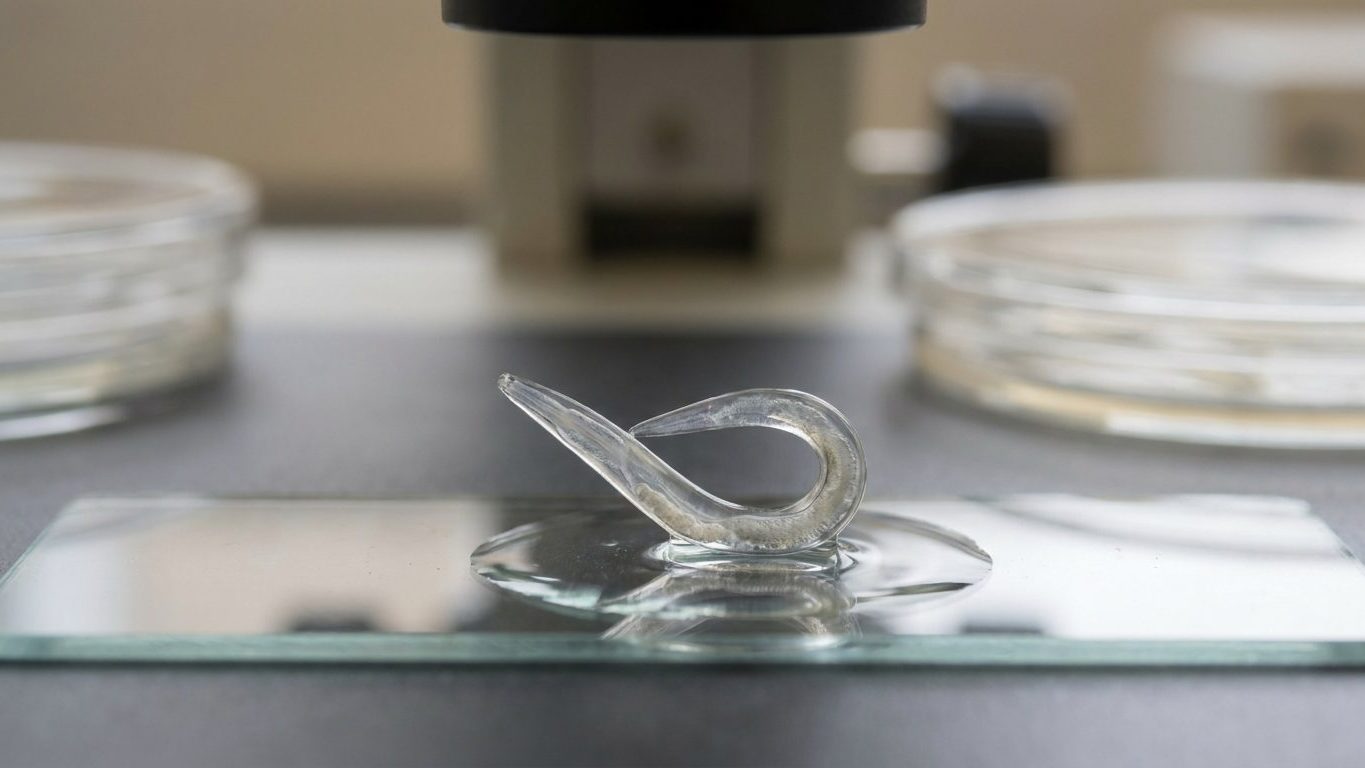
A microscopic worm extracted from the Siberian permafrost has resumed its biological activity in the lab after a frozen sojourn dating back to the late Pleistocene. Precise radiocarbon dating shows that Panagrolaimus kolymaensis remained in cryptobiosis for about 46,000 years, since the end of the Pleistocene. It ate, moved, and above all laid eggs. Its offspring, meanwhile, still live today in culture boxes.
The nematode was collected from a layer of frozen sediment in a fossil rodent burrow buried roughly 40 meters beneath the surface, near the Kolyma River. It was not the animal itself that was radiocarbon-dated, but the plant material found in the same layer. This analysis revealed that these frozen deposits, located 40 meters underground, had not thawed since the late Pleistocene, between 45,839 and 47,769 years ago. The range is broad, but the order of magnitude remains constant: forty-six millennia, nearly twenty times the age of the pyramids of Giza.
- A nematode survived 46,000 years in the Siberian permafrost before being revived in the laboratory.
- Trehalose, a sugar replacing cellular water, allowed the worm to vitrify its cells and avoid deadly ice crystals.
- The original animal had time to reproduce by parthenogenesis, and its offspring still thrives in culture today.
How an organism survives total immobilization
The phenomenon that makes this story possible is called cryptobiosis. Some organisms, such as tardigrades, rotifers, and nematodes, can endure extreme conditions by entering a dormant state known as cryptobiosis. The metabolism does not merely slow down; it halts at an undetectable level.
The key to this suspended state lies in a sugar. Once slightly dehydrated in the lab, both species boosted their production of a sugar called trehalose, which could help them survive desiccation and freezing. Put simply, the water that normally fills the cells is replaced by this compound, which vitrifies the internal environment rather than allowing it to freeze into crystals. And those ice crystals are precisely what, in a normal cell, tear membranes and kill the organism. The researchers even tested the mechanism under controlled conditions: exposing the worms to a light dehydration before freezing helped them prepare for cryptobiosis and improved their survival at -80°C. Without that preparatory step, the outcome is brutal: worms frozen at that temperature without prior dehydration died instantly, according to the study.
This mechanism is not exclusive to this Siberian worm. The same treatment benefited the dauer larvae of C. elegans, which subsequently survived 480 days at -80°C with no loss of viability or reproduction after thawing. The most studied laboratory worm in the world thus shares a good portion of the same genetic toolkit with its revived permafrost cousin.
A species we thought we knew
In 2018, researchers at the Institute of Soil Physico-Chemical Problems and Biology had already revived these nematodes. But the complete genomic analysis, published in 2023 in the journal PLOS Genetics, changed the game. Researchers from the Institute of Zoology at the University of Cologne, the Max Planck Institute of Molecular Cell Biology and Genetics, and the Center for Systems Biology Dresden used genome sequencing, assembly, and phylogenetic analysis to show that this 46,000-year-old nematode belongs to a previously undescribed species, Panagrolaimus kolymaensis. The name honors the Kolyma River, near which the specimen was unearthed.
The original animal did not survive long after awakening. But it managed to reproduce by parthenogenesis, a reproduction method that does not require a male. If the resurrected worms from the original specimen are no longer alive today, a portion of their offspring continues to thrive. A researcher involved in the study sums up the situation bluntly: “we can say they are alive because they move, eat bacteria on the culture plates, and reproduce.”
The question of contamination, however, has not been swept under the rug. Some scientists remain skeptical of the study’s results, as had been the case when the specimens were first reported in 2018; at that time, external researchers raised concerns that the nematodes analyzed might be modern contamination. A logical doubt: permafrost is not a sterile vault, and tracers of microbial contamination have already shown they can penetrate several millimeters into frozen soil cores during sampling. The precautions of handling in a clean room, combined with independent dating of the sediment and thorough genomic analysis, are the safeguards that allowed the team to defend the robustness of their conclusions.
What this worm tells us about thawing permafrost
This record far surpasses a mere biological anecdote. The study extends the longest cryptobiosis ever reported in nematodes by tens of thousands of years. Before it, the record belonged to specimens much younger, around 30,000 years, according to earlier work on the same type of permafrost.
Understanding how a cell endures such a freeze-frame moment matters beyond zoology. The research indicates that nematodes have developed ways to preserve life over geologic timescales, which could illuminate conservation strategies in the face of climate warming. An external biochemist mentioned in the study goes further, hinting at a medical line of inquiry: “perhaps we could develop molecules that achieve the same effects,” he told the Wall Street Journal, thinking about the preservation of human cells or tissues.
There remains a less uplifting question. The Siberian permafrost still covers millions of tons of frozen organic material from millennia past, and it is thawing faster than anticipated as the Arctic warms. This worm is but one signal among others of what this frozen mass may still contain, living and intact, awaiting only a gentle thaw.
Sources: journals.plos.org | scientificult.it
