
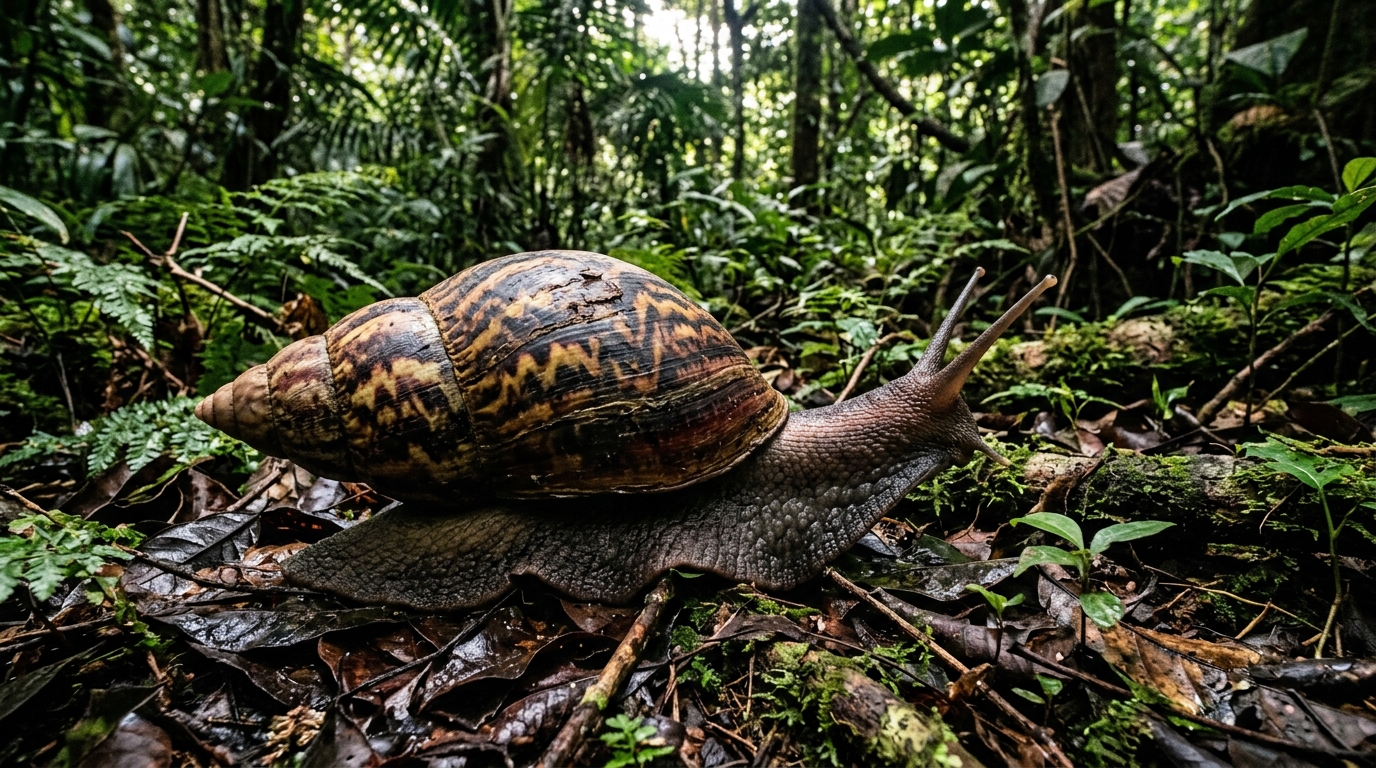
Imagine encountering, around a forest path, a creature capable of stretching to the length of a school ruler yet moving at the pace of a snail, which, let’s admit, is hardly a feat of athletic prowess. And yet, this legendary slowness has not diminished the spectacle of the animal in question. For generations, in the damp shadows of the West African undergrowth, a species has flourished that defies the usual proportions of land mollusks. Neither serpent nor small mammal, but indeed a snail, whose size alone is enough to provoke disbelief. How could such a discreet creature achieve such gigantism without ever being dethroned?
- Achatina achatina, a land snail of the humid forests of West Africa, can reach 39.3 cm in length and holds the record for the largest terrestrial snail in the world.
- Its exceptional growth is explained by the tropical climate with no hibernation, calcium-rich soils, and the absence of specialized predators.
- Introduced into other parts of the globe, this species has become invasive, devastating crops thanks to its voracious appetite and rapid reproduction.
- A snail longer than a school ruler inhabits the West African forests
- The shell-colossus: anatomy of an exceptionally oversized giant
- How this species succeeded where all others failed
- A nocturnal life clocked like a biological clock
- From natural trophy to global threat: what its success reveals
A snail longer than a school ruler inhabits the West African forests
In the forested regions of Benin, Nigeria, Ghana, and Ivory Coast, a quiet resident occupies the damp ground and the decaying foliage. It is a terrestrial snail whose shell can exceed 39.3 centimeters in length, a measurement that, when laid next to a standard school ruler, dizzyingly highlights its size. This figure is not journalistic exaggeration, but the maximum size recorded for this species, which currently holds the world record for the largest land snail.
This discreet giant lives in an environment where humidity and constant warmth provide ideal conditions for uninterrupted growth. The tropical undergrowth, with its abundant leaf litter, constitutes a perpetual pantry, allowing the animal to grow far beyond what is observed in its European or Asian cousins.
The shell-colossus: anatomy of an exceptionally oversized giant
The scientific name of this species, Achatina achatina, resonates as a clear clue when one observes its morphology. Its conical shell, streaked with brown and cream bands, is not only impressive for its length: it can also weigh several hundred grams once fully developed. This calcareous architecture, built layer by layer throughout the snail’s growth, acts as a protective armor against predators and against climatic fluctuations.
Under this shell lies a soft body capable of considerable extension during movement. The slimy texture coating its muscular foot allows it to glide across a variety of surfaces, whether tree trunks, leaves, or soft soil. This adaptation, far from trivial, is one of the secrets behind its ability to explore a relatively large territory despite its slow locomotion.
How this species succeeded where all others failed
If so many other land snails stay modest in size, it is because several factors must align to permit such gigantism. First, the tropical climate ensures year-round growth, without prolonged hibernation as seen at higher latitudes. The absence of a clearly defined cold season means the animal can feed and develop almost uninterruptedly.
Next, the calcium-rich nature of West African forest soils plays a decisive role. This element is essential for building the shell, and its abundant availability enables the snail to construct such a massive structure without exhausting itself. Finally, the lack of specialized predators capable of effectively preying on an adult of this size has likely favored, over the long term, the selection of ever-larger individuals.
A nocturnal life clocked like a biological clock
Like many terrestrial gastropods, this African giant leads a predominantly nocturnal life. Once daytime heat fades and humidity rises with the cooler evening air, the animal leaves its hiding place to seek food. This behavior helps it avoid dehydration, its greatest enemy, while taking advantage of optimal conditions to move without its skin drying out.
Its diet is essentially vegetarian: leaves, fallen fruit, tender bark, and decomposing organic matter form the core of its menu. This dietary diversity, coupled with a sizeable appetite proportional to its size, partly explains its rapid growth in the early years of life, before reaching its maximum adult size.
From natural trophy to global threat: what its success reveals
Paradoxically, this size record that fascinates naturalists has also become a source of global concern. Deliberately or accidentally introduced into other regions of the world, notably Southeast Asia and certain tropical zones of the Americas, this giant snail has proven to be a particularly invasive species. Its voracious appetite enables it to devastate entire crops, while its ability to reproduce rapidly complicates any eradication attempts.
This shift from curiosity to agricultural menace illustrates how the same traits that help a species thrive in its native environment can become problematic when that balance is disrupted elsewhere. The shell’s resilience, its dietary adaptability, and its robustness in varied climatic conditions—assets in West African forests—become real headaches for ecosystems it colonizes elsewhere.
This tale of a discreet giant reminds us that nature is full of records that stretch our imagination, often concealed away in environments we rarely associate with the exceptional. Between scientific fascination and ecological vigilance, the world’s largest snail continues to intrigue as it challenges our understanding of natural balances. It remains to be seen how many more such curiosities await discovery, incognito, in the least explored corners of our planet.
