
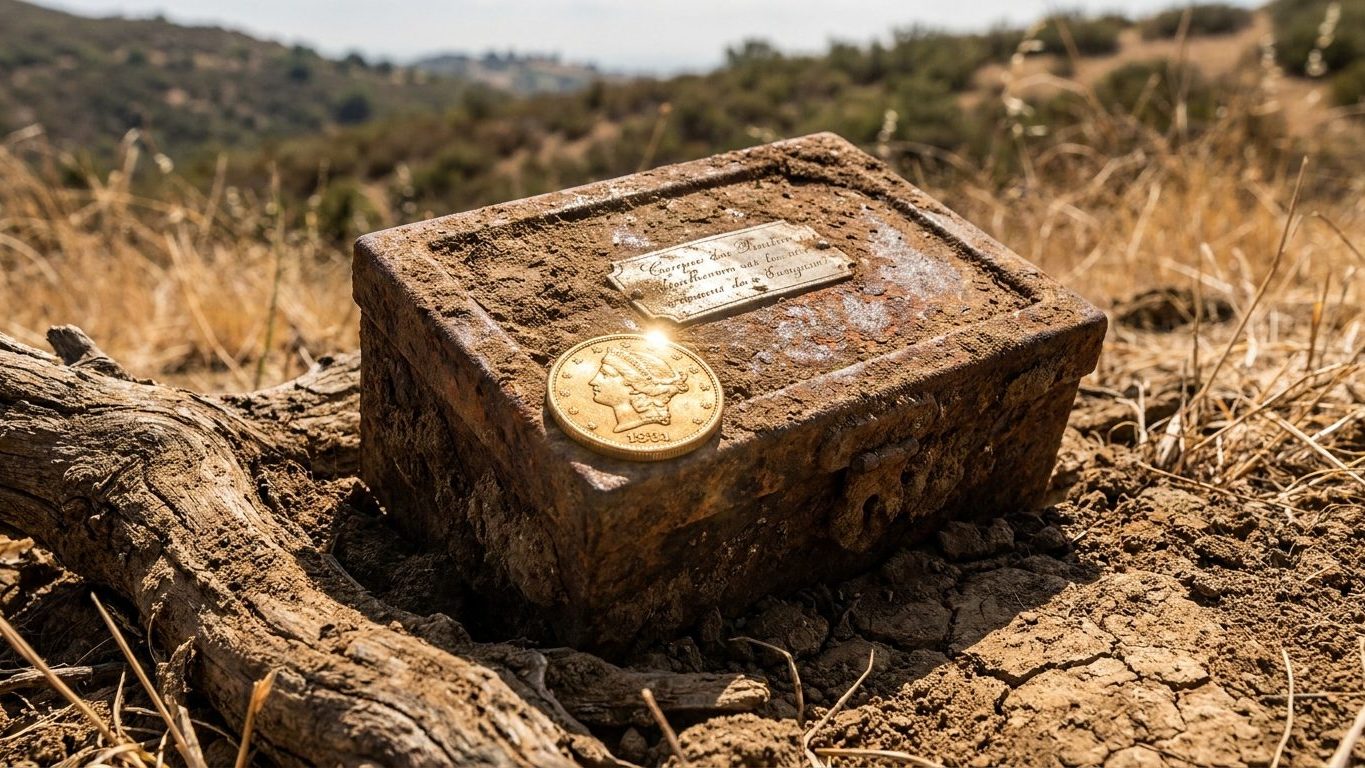
A couple settled in the heart of Gold Country, the northern California region where the 1849 gold rush began, did not expect anything out of the ordinary that day. They were strolling with their dog on their own land, along a well-worn path they had trodden hundreds of times for their daily canine walk, when they spotted the rusty top of a metal box sticking out of the weathered earth. The scene unfolded a few steps from an old tree on a property they had owned for years.
The woman spotted the box, the man bent down to pick it up but it was lodged in the soil; he finally pried it free with a piece of wood, so heavy that they initially thought it contained lead paint. On the way back, the lid split, revealing the edge of a gold coin. They headed back to the house without yet knowing what they held in their hands.
Under the rust, solid gold.
The couple returned to the site almost immediately, to a spot they would come to call Saddle Ridge, and found a second box less than a meter from the first. More metal containers appeared as they continued digging with improvised tools, then with the help of a metal detector. Quiet, discreet visits continued over several weeks, until the couple recovered all the containers scattered around the starting point. Each box contained the same kind of treasure: nineteenth-century American gold coins, buried in the ground for generations.
- A couple discovers several boxes containing nineteenth-century American gold coins on their California property.
- The coins, minted mostly at the San Francisco Mint, were in exceptional condition, as if they had never entered circulation.
- The identity of the person who buried the treasure and the reasons for burying it remain unexplained despite various theories.
Exceptional coins, never circulated
Almost all of the coins, minted between 1847 and 1894, were in pristine condition, as if they had never circulated, according to experts from the Professional Coin Grading Service who authenticated them. Such a level of preservation is extraordinary for coins of this age, which normally travel through pockets, drawers, and transactions over decades. Most came from the San Francisco Mint, minted after 1854, while a few older pieces had been minted in Georgia, which only deepens the mystery about their journey.
Certain pieces rank among the best-preserved examples ever documented by numismatists for their type and date. This detail is as intriguing as the treasure’s value itself: someone buried brand-new gold, sometimes before it ever circulated.
A move that, more than a century later, remains unexplained.
The origin of the treasure, a mystery never resolved
In hindsight, the couple realized that certain landmarks on the land—a rock with sharp edges and a line of sight toward the North Star—likely served as reference points for the person who buried the boxes. This level of preparation suggests a deliberate burying, not a hurried abandonment. The question remained: who could have possessed such a fortune in fresh coins, in a remote corner of California, without ever coming back to claim it? Despite numerous theories, the exact origin of the coins has never been established.
Several theories circulated in the American press: the loot from Jesse James’ gang, the spoils of the outlaw Black Bart, or even a portion of the 1901 San Francisco Mint heist by an employee named Walter Dimmick. This latter lead, revived by an amateur historian and reported by the San Francisco Chronicle, for a while cast doubt on the legitimacy of the find. A spokesperson for the U.S. Mint, however, never confirmed that the coins came from that theft.
None of these hypotheses has been proven to date.
What American law says, and why France would be different
In the United States, the rule is straightforward: generally, what is found on one’s own land belongs to the owner, and neither state nor federal government has a claim, except on public land or an Indigenous burial site. In California, one obligation remains: the law requires reporting any discovery with a value of $100 or more to authorities. The couple, anonymous in the press under the assumed names John and Mary, complied with this requirement before having the treasure authenticated.
Another rule, this time tax-related, states that a found treasure constitutes taxable income in the year the owner takes clear possession. In other words, the discovery had tax consequences beyond the sheer pleasure of the find.
In France, the legal framework differs markedly. The Civil Code distinguishes a treasure found on one’s own ground, which fully belongs to the finder, from treasure unearthed on another’s property, which is then shared equally between the discoverer and the landowner. The situation changes again if the object bears an archaeological character: in that case, the French state can assert a pre-emption right, a mechanism with no counterpart in California law applied to this case.
The couple chose to remain anonymous and keep the exact location of their property secret to prevent another gold rush from descending on their land. The site itself has never undergone extensive archaeological digs since the initial discovery. It remains today a privately held property closed to further investigation, which leaves, albeit faintly, a real possibility that part of the mystery still lies beneath the same earth.
Sources: thehistoryblog.com | amp.cbc.ca
