
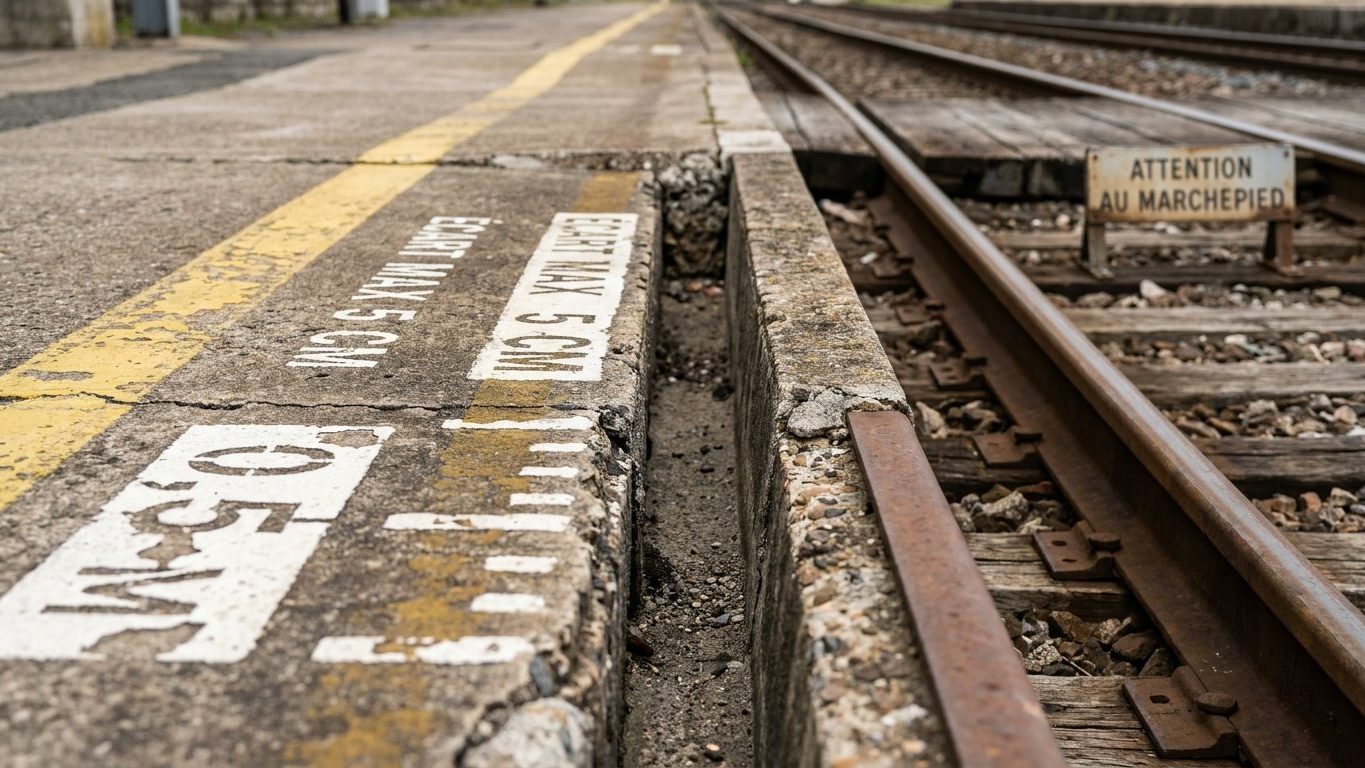
May 2014. The satirical weekly Le Canard Enchaîné published information that would poison the SNCF and its infrastructure manager for weeks: hundreds of new regional train sets, ordered to modernize the fleet, were too wide to safely run along portions of the network’s platforms. The order covered 341 TER trains, distributed between 182 Regiolis units from Alstom and 159 Regio 2N units from Bombardier, the latter manufactured at Crespin, in the Nord. The introduction of this new generation of trains, wider to meet public expectations, required the modernization of 1,300 platforms out of the 8,700 platforms on the French rail network, as confirmed by the SNCF and Réseau Ferré de France (RFF) in a press release. What had to be shaved was not the metal of the carriages nor the power of the engines: it was the edges of the platforms themselves, on a substantial portion of the territory.
Key takeaways
- Why did no one verify before ordering hundreds of trains?
- How could two public bodies be unaware of the actual width of French platforms?
- What price did this logistical error cost and who had to pay?
Two Hands That Do Not Communicate Enough
How could such a mismatch pass unnoticed until the trains were delivered? The answer begins with the organization of the French rail system, split in two since 1997. On one side, the SNCF, which operates the trains and places orders with manufacturers. On the other side, RFF, the owner and manager of the tracks and platforms. The SNCF drew up the specification document sent to the builders after consulting RFF about whether the trains could run on the tracks, basing the figures on those provided by RFF itself. The problem was that these figures were not reliable. A senior SNCF official explained that RFF realized late the adjustments to be made because its data on platform widths were neither complete nor up to date. The company ordering the trains relied on outdated infrastructure surveys, without anyone thinking to cross-check these data with a station-by-station assessment.
The other explanation lies in the very history of the network. The French railway system is not a uniform network emerged from a single master plan: it is the result of more than a century and a half of successive constructions, carried out in eras when size standards did not exist, or differed from one company to another. Lines laid during the Second Empire, others after the Liberation, others still in the 1980s, each with its own site-specific constraints and its own safety margins between the platform and the track. Designing a single train believed to be able to circulate everywhere on such a patchwork, without systematic verification station by station, was akin to tailoring a standard garment for a population with highly varied body shapes.
A Nationwide Planing Project
Of the 1,300 platforms affected, 300 had already been addressed at the moment when the issue became publicly known, evidence that the technical teams had identified the problem before the media storm. According to Réseau Ferré de France spokesperson Christophe Piednoël, the interventions could be as simple as shaving a platform by a few centimeters, or moving an electrical cabinet a bit too close to the edge. Nothing resembling a colossal nationwide project visible to the naked eye, but rather a succession of millimeter-wide adjustments across hundreds of sites, from Cagnes-sur-Mer in the Alpes-Maritimes to Hazebrouck in the Nord. The SNCF was compelled to launch a series of works spread over three years, from late 2013 to late 2016, synchronized with the delivery schedule of the train sets.
Financially, the two companies stated that the 50 million euros needed to modify these platforms were part of the 4 billion euros dedicated each year by RFF to the modernization and development of the network, effectively signaling that the bill did not represent an exceptional, isolated expense. The Regions, for their part, immediately refused to contribute. Alain Rousset, then president of the Association of Regions of France, responded by promising not to pay a single euro for this repair, arguing that local authorities should not bear the cost of a sizing error that was not theirs to rectify. The Secretary of State for Transport at the time, Frédéric Cuvillier, summarized the situation with a line that would become famous, calling the episode “comically dramatic.”
What the Episode Changed in Procedures
The controversy erupted at a pivotal moment: the rail reform project, which was to merge the current Réseau ferré de France and the SNCF into a single large public entity, was being examined by the National Assembly on June 16, 2014. The issue of platforms that were too narrow became the decisive argument for proponents of the fusion: how could two public bodies, supposed to work hand in hand, fail to share data as basic as the width of the platforms? The reform ultimately led to the creation of SNCF Réseau, the successor to RFF, tasked with smoothing the flow of information between the operator and the infrastructure manager.
The then-president of RFF, Jacques Rapoport, sought to nuance the narrative of a mere blunder. He explained that the speed and comfort of travel, especially the accommodation of people with reduced mobility, necessitated trains built to the maximum possible gauge, which in turn required corresponding infrastructure adaptations. A government reply to a parliamentary question went even further in relativizing the issue: the problem of platform dimensioning had actually been identified upstream by the various stakeholders and taken into account in the works planned to prepare for the arrival of the Regiolis trains. The spring 2014 scandal thus revealed less a sudden discovery of an error than the late exposure, by the press, of a project that had already been underway behind the scenes for several months.
Sources: france3-regions.franceinfo.fr | questions.assemblee-nationale.fr | lagazettedescommunes.com
