
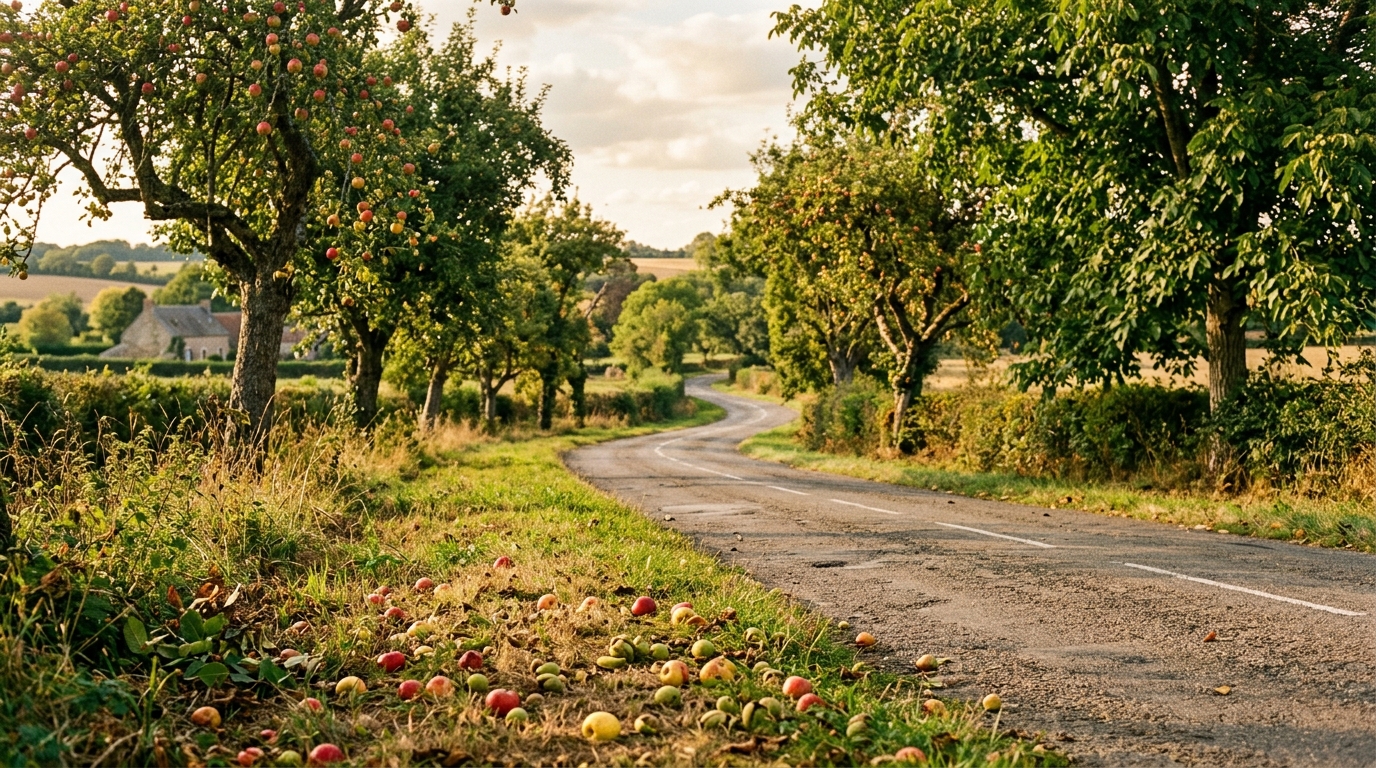
At the tail end of summer, when orchards overflow with ripe fruit, there are still long stretches of road in France where apples, walnuts, and pears fall to the ground without anyone thinking to pick them up. It is not, however, a botanical accident, but the heritage of a road regulation established more than two centuries ago and gradually revisited and transformed over time. Behind these trees that line our national routes lies an overlooked history, made of Napoleonic taxation, efforts to fight dust, and a regulation so tenacious that it has crossed eras without ever being fully repealed.
Apple and Walnut Trees Planted Along the Roads Since Napoleon
If you’ve ever noticed apple trees, walnut trees, or chestnut trees lined along a departmental road or an old royal route, know that this alignment is far from accidental. It all traces back to the law of 9 ventôse year XIII, promulgated on 28 February 1806, which regulated the planting of trees along roads and contributed to a road policy already underway under the Ancien Régime. An instruction from 1805, drafted by the director general of Bridges and Roads, went further by asking prefects to select for themselves the most advantageous species for each stretch of road, whether forest trees or fruit trees.
But this obligation did not arise from nowhere. It drew its roots from the Ancien Régime, since an order of 3 May 1720 already required landowners bordering royal roads to plant trees on their parcels. A striking administrative continuity, which shows how the management of the French road landscape has always been conceived as a matter for the State, long before discussions of spatial planning or landscape heritage.
Why French Law Still Requires Planting Fruit Trees on Public Road Property
Contrary to what one might imagine, these plantings were not initially intended for aesthetic reasons. According to the Guichet du Savoir, neighboring inhabitants were required to maintain and plant elms, hornbeams, chestnut trees, or fruit trees for strictly practical reasons, with no concern for beautifying the landscape. It was far from the pastoral postcard that these alignments evoke today.
In the 19th century, the justification evolved: the State intensified the plantings to limit the dust raised by passing vehicles on unpaved roadways. A necessity that disappeared entirely with the paving of roads at the dawn of the 20th century, but which did not prevent the regulation from persisting.
Even more surprisingly, another wave of plantings followed in the mid-20th century, this time with poplars intended to supply the wood needed for match production. The majority of these trees were ultimately never exploited by SEITA, leaving behind alignments with no real industrial use. This is where the most astonishing revelation lies. Today, the rules governing plantings along the road domain result from a patchwork of texts, both old and new, as well as local provisions. The heritage of historical regulations remains perceptible, but it would be an exaggeration to present the 1806 law as a universal obligation, always applicable in the same terms, to plant fruit trees along the roads.
These Free Fruits No One Dares to Pick Despite Their Legality
A legal detail deserves noting, because it changes everything for curious neighbors: those who planted on the State’s domain could preserve a true right of use. By seeking authorization, they acquired ownership and enjoyment of the produce from their trees, in other words the right to harvest the fruits they had themselves planted, even on land belonging to the community. A fairly clever arrangement that allowed public and private interests to be reconciled.
Yet in practice, very few pedestrians or motorists today stop to pick an apple or a walnut that has fallen beside a national road. A form of cultural caution, almost instinctive, that persists even though the law does not formally prohibit harvesting fruits fallen on public land in many situations. This paradox highlights the gap that has grown between a legal framework inherited from the 19th century and contemporary practices, where the very idea of taking fruit from the roadside seems almost incongruous, even suspect.
A Road Heritage Threatened by Modern Road Maintenance and Safety Standards
The modern regulations governing planting distances remain directly inherited from these old texts. Older regulations set minimum distances for certain roadside plantings, with possible exemptions. The six-meter rule often cited in this context should not be presented as a single national rule applicable today to all plantings and all roads.
In 1986, the Senate further confirmed that this roadside planting regulation remained contained in prefectural orders, drawn up according to a standard model specific to each department for national roads.
But this arboreal heritage, however ancient, no longer meets any functional need today. Neither the dust, nor the production of matchwood, nor even the shade for draught animals of yesteryear justifies these alignments any longer.
The tradition alone keeps these trees in place, and it becomes a problem in light of modern road-safety requirements. A trunk too close to the roadway poses a risk in the event of a vehicle leaving the road, which regularly pushes road managers to fell these centenarian trees in the name of user safety. A concrete dilemma thus pits the preservation of a unique European landscape heritage against safety imperatives that are hard to challenge, with no clear national consensus solution in sight.
Derrière ces alignements de pommiers et de noyers qui longent encore nos routes se cache donc une véritable strate archéologique du droit français, où des textes napoléoniens continuent de dialoguer avec les préoccupations très actuelles de sécurité routière. The next time you encounter a lonely fruit tree on the edge of a national road, you might view this discreet witness of an era when the State planted trees to combat dust rather than to please the eye in a different light. The question remains: how long can this singular heritage resist the demands of modern road traffic?
