
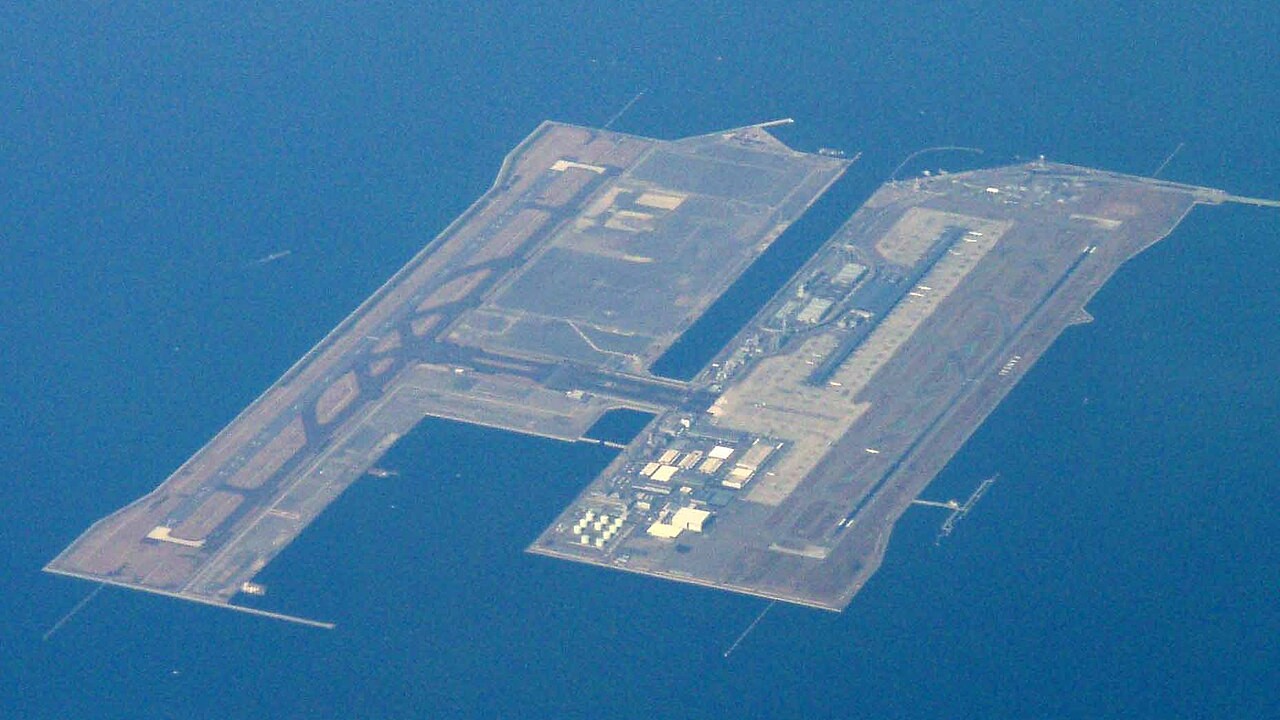
Neither the waves of Osaka Bay nor the typhoons that regularly sweep the archipelago explain why this airport keeps losing ground, year after year. The real culprit lies beneath the runways: a thick layer of soft marine sediments unable to permanently bear the weight of an island entirely built by human hands.
Key takeaways
- An airport built on an artificial island to escape neighbors’ complaints runs up against an invisible adversary
- Engineers had planned limited settlement, but the ground keeps failing to stabilize after three decades
- Hydraulic jacks continuously adjust the structures, turning maintenance into a perpetual struggle
An airport built to escape the noise, not solid ground
The story begins with a classic neighbor dispute, scaled to gigantic proportions. In the 1980s, Osaka’s Itami Airport was suffocating under residents’ complaints about the racket of aircraft. Expanding the runway would trigger a fresh legal and social fight. The chosen solution seemed elegant on paper: build a brand-new airport, but out at sea, where no resident could complain about aircraft noise. The plan called for creating an artificial island in Osaka Bay using Japan’s mass fill technique.
The result opened its doors on September 4, 1994. Kansai International Airport became an international airport built on an artificial island in Osaka Bay, south of the city of Osaka, Japan. Designed by Italian architect Renzo Piano, the terminal’s scale impressed, placing it among the longest airport terminals in the world. Just four months after its inauguration, the project faced its first real test: the Kobe earthquake, magnitude 6.7, which shook the entire region. The island held up with no major damage, seemingly confirming the technical success of the project in the moment.
A ground that stubbornly refuses to stabilise
The problem does not come from a tectonic tremor or a storm. It comes from the very subsurface. The chosen soil was not ideal: a layer of soft clay and sediments known to compress under weight. By placing millions of tons of fill on a spongey seabed, engineers created the perfect conditions for continual settlement. The airport has struggled with subsidence because it sits on soft clay that cannot properly support its immense weight, a phenomenon foreseen by geotechnical studies but greatly underestimated in extent and duration.
That is where the fault line lies: the forecasts anticipated settlement would slow and eventually stop after a few decades. In reality, the movement proved faster than expected in the early years, then continued at a slower but persistent pace, never reaching the stability plateau originally predicted. The second island built later to accompany the site’s expansion faced a slightly more delicate situation than the first, proof that even learning from the first phase, the soil still governed its own rules.
Hydraulic jacks, dikes and permanent adjustments
Facing a ground that refused to set, the airport administrators had only one option: go with the movement rather than fight it. The concessionaire added hydraulic jacks beneath the artificial island to cushion the occasional centimeters of annual sinking. In practical terms, hydraulic devices tucked under the foundations of the buildings allow the structures to be gradually raised, much like stabilizing a wobbly piece of furniture, but on the scale of an entire airport. A maintenance plan calls for adjustments every three years, along with the securing of the dikes.
This monitoring is far from incidental. A powerful system of hydraulic jacks and special sensors continuously detect the piles’ movements and adjust them to maintain the platform’s balance. The foundations rely on a colossal number of supports driven into the seabed: more than a million piles capable of withstanding earthquakes, penetrating through 80 meters of water, mud, and rock. A vertiginous technical stack designed to withstand tremors, but never able to neutralize the slow, ongoing settlement of the deeper clay.
By placing their new airport on an entirely artificial island in 1994 to escape neighbor disputes, the Japanese literally built a project that has never ceased to sink beneath its own weight. The irony is complete: the site chosen precisely because it belonged to no one and disturbed no one turned out to be the worst possible location for soil resistance. The issue is not rising seas or the ferocity of a seasonal typhoon, but the very nature of the terrain on which the entire platform rests.
An economic gamble that also failed to deliver on its promises
The subsidence of the ground was not the only forecast that aged poorly. The airport was conceived on the basis of two economic premises: continued Japanese growth through the 1980s and the promise of becoming an international hub linking Asia with other continents. Neither of these assumptions materialized, with a financial crash hitting the country in the midst of construction. Three decades later, the structure still welcomes tens of millions of passengers each year, aided by a new terminal opened at the end of 2023 and by the ambitions tied to Osaka’s World Exposition. Proof that a structure can survive its own miscalculations, so long as one is prepared to commit, indefinitely, to time and ongoing works.
Sources: shango.media | egfbtp.com
