
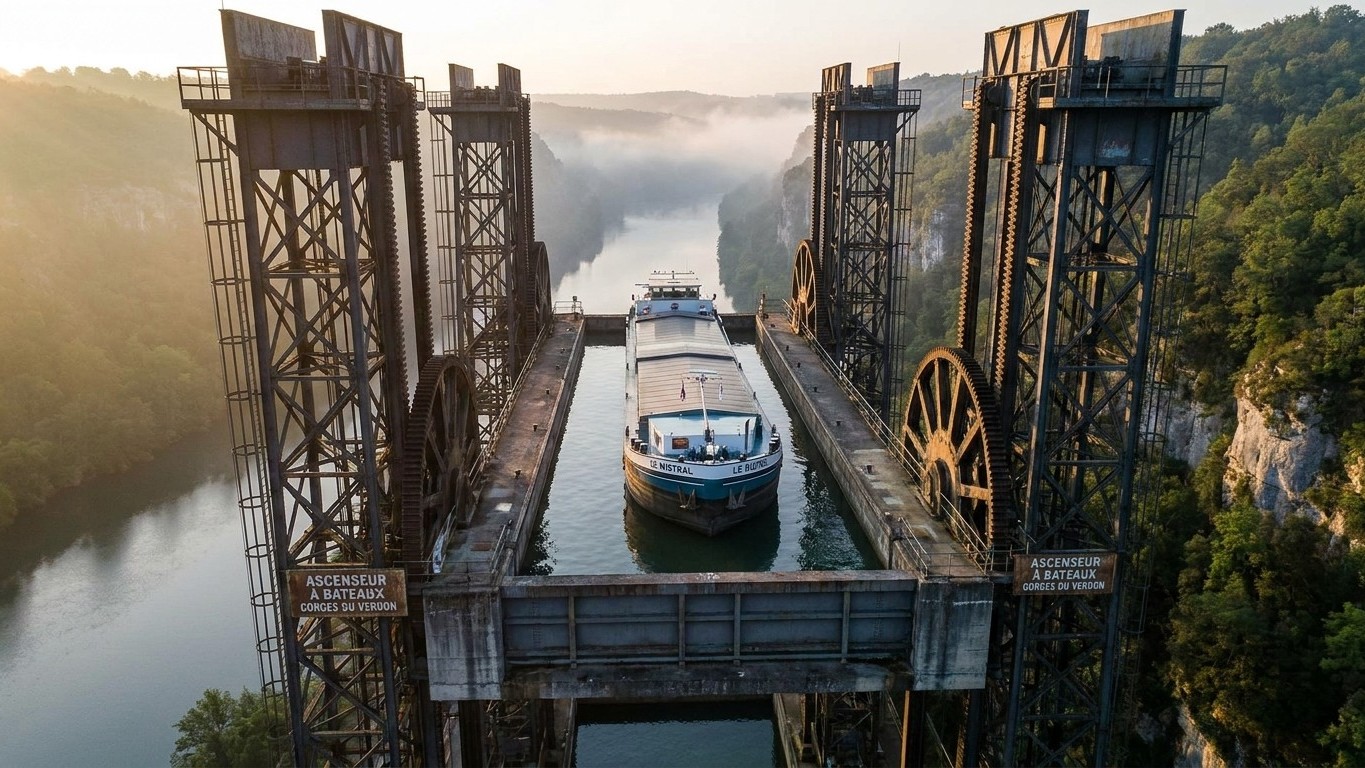
Yes, an elevator — but not for people: for entire cargo ships. On the Yangtze River, at the Three Gorges Dam, there exists a structure able to lift vessels weighing 3,000 tonnes to a height of 113 meters, and it has been in operation since 2016. Beyond this limit, there are no exceptions: heavier boats must use the older lock system, which is slower but built to accommodate far larger tonnages.
The installation is in Yichang, in Hubei Province, precisely where the river meets the world’s largest hydroelectric dam. How do you raise a 3,000-ton boat by 113 meters? A lift located in Yichang, Hubei, accomplishes this in 40 minutes. It’s a striking figure when compared with the alternative: the dam crossing time is slashed from three hours to 40 minutes. What a river cruise would take to traverse the locks in an entire afternoon, this giant freight hoist performs in the time of a lunch break.
Key takeaways
- How do you lift a 3,000-ton boat without a single steel cable?
- Why did the designers abruptly abandon their initial plan mid-route?
- What secret lies behind the precise 3,000-tonne limit?
A floating basin hoisted by rack-and-pinion gears
The principle sits almost in the realm of oversized college physics. The vessel enters a vast tank filled with water that matches its natural draft, and then the entire tank, with the ship inside, is raised mechanically. To use the lift, the captain steers into a chamber containing a water basin measuring 120 meters long, 18 meters wide, and 3.5 meters deep. The chamber, the water it contains, and the lifting mechanisms together weigh more than 15,500 tonnes. Fifteen thousand five hundred tonnes travel up and down along towers that themselves rise to a height of 169 meters.
The system does not rely on cables, contrary to what one might imagine for a conventional elevator. With four drive assemblies arranged symmetrically, employing gears and racks, the ship’s chamber is rigidly supported at four points, minimizing the risk of water sloshing or the tank tilting. This precaution is far from trivial: moving tons of water through more than a hundred meters of elevation, without any ripple destabilizing the whole setup, presents a genuine engineering challenge.
Cables abandoned along the way
The project did not always take this path. According to Lu Youmei, former general manager of the China Three Gorges Corporation, the original plan was to suspend the lifting chamber from steel cables. That approach was abandoned due to concerns that the elevator could become unstable while lifting ships. The decision cost years of delay. In 2003, the German firm Krebs und Kiefer, involved in the design, introduced gear-based mechanisms in place of cables. This revised design reassured the authorities about the system’s safety, and construction resumed in 2008.
The overall Three Gorges project began in the early 1990s, but the ship lift was the final piece to be installed. The last major component of the project, the ship lift, was completed in 2015, and entered commercial service the following year. A gestation of more than twenty years for equipment that finally came online smoothly, first in daytime tests and then in continuous operation.
Why the cap is fixed at 3,000 tonnes
Here lies the core of the matter: this ceiling is not arbitrary; it directly follows the structural constraints of the lift. The Three Gorges Dam also houses a second system, much older in concept, a five-tier lock staircase. A gigantic double set of locks, nearly 1,500 meters long, includes four locks of 280 meters and one of 350 meters, each 34 meters wide, built in each direction. This five-level lock ladder enables passage for ships of up to 10,000 tonnes.
The roles are thus clear: small and medium-sized vessels pass through the lift in 40 minutes, while the largest cargoes queue at the locks for several hours. A succinct way to describe the riverine hierarchy: locks for the big ships, lift for the smaller ones. Concretely, large ships must spend around four hours to traverse the five locks of the dam, whereas smaller and medium-tonnage vessels, with a deadweight under 3,000 tonnes, can traverse the dam via the elevator in 40 minutes. Pushing beyond the 3,000-ton threshold is not negotiable: it is a technical limit of the tank’s dimensions and the strength of the supporting mechanisms, designed to absorb a specific load without risking a loss of balance.
The contrast with other global giants of the genre underscores the Chinese achievement. Strépy-Thieu in Belgium offers 1,000 tonnes lifting capacity over 70 meters, while Lüneburg in Germany reaches 1,350 tonnes over 38 meters. The Three Gorges facility triples the load and nearly doubles the height of the best-known European references. More than a decade after entering service, the installation has surpassed one million passengers and several million tonnes of freight, confirming that beyond a technical feat, the device has found its place in the river’s daily traffic—the busiest on the Asian continent.
Sources: usinenouvelle.com | actualites-nautiques.com
