
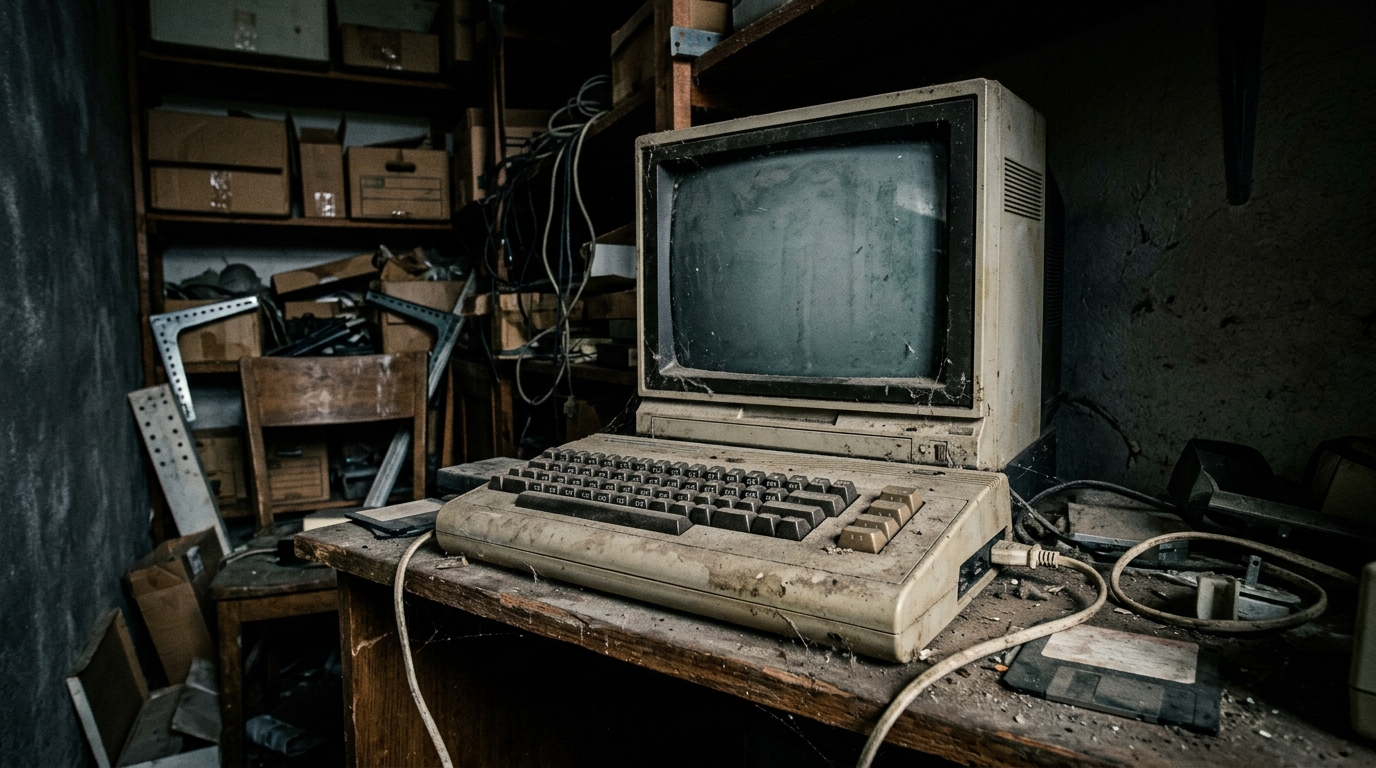
Imagine that you invest today hundreds of millions of euros in brand-new tablets, only to realize five years later that they cannot read any modern file, cannot connect to anything, and end up forgotten at the back of a cabinet. That’s exactly what happened to France in the mid-1980s, on the scale of an entire nation. As each new school year arrives with its share of digital tools, it’s both amusing and a little dizzying to recall that a precedent already exists, and that it culminated in a spectacular failure. A look back at the Informatique pour tous plan, this state ambition to turn every French pupil into a future computer scientist, and which mainly filled school storerooms with machines that became obsolete in record time.
The day France aimed to turn every pupil into a computer scientist
In 1985, the French government launched a bold bet: to massively equip schools, collèges and lycées across the country with microcomputers. The stated objective was clear, almost grandiose: to generalize computing in public education and to prepare an entire generation for a technology-driven world that was becoming unavoidable. The plan foresaw the installation of 120,000 additional microcomputers in educational establishments, an astonishing quantity for the era.
But behind this pedagogical ambition lay another motive, more industrial than educational. The hardware chosen was deliberately 100% French, with the MO5 and the TO7-70 as baseline tools. This choice was not a technical accident: it aimed first and foremost to salvage Thomson, then nationalized company on the brink of collapse in 1982. The brand was selected without a tender, a decision that shows the stakes extended far beyond the classroom. Amusingly, one of the plan’s principal initiators, Jean-Jacques Servan-Schreiber, would have preferred equipping schools with Apple II and Macintosh. Steve Jobs himself would have promised to set up a manufacturing unit in France rather than in Ireland. The industrial history could have been different, but it’s the national solution that prevailed.
Two billion francs later, machines already obsolete
The cost of the operation is dizzying in hindsight. To outfit the six classes of a single primary school, around 28 000 francs were required, nearly 10 000 euros in current terms. Multiplied across the nation, the bill rose to nearly 2 billion francs swallowed by the State in 1985—a colossal sum invested in equipment that would lose all relevance in just a few years.
Technically, the MO5, the most widespread machine in primary schools, relied on modest specifications for the era: a Motorola 6809 processor running at a mere 1 MHz, supported by 48 KB of RAM. The architecture used a proprietary local network dubbed the nanoréseau, capable of linking up to 31 student workstations to a master station, typically a Bull Micral running MS-DOS, all connected by a coaxial cable and a completely closed protocol. An ingeniously conceived system on paper, but which soon proved to be a technological dead end.
Why the MO5 ended up forgotten in the schools’ storerooms
The central problem of the Informatique pour tous plan can be boiled down to one sentence: France bet on a total incompatibility with the evolution of the global market. While the rest of the world gradually adopted the mouse, popularized by Apple and then generalized by Microsoft, French pupils learned to wield an optical pen, an ingenious accessory but quickly disqualified by the mouse’s ease of use. This detail, almost anecdotal, embodies the widening gap between Thomson’s hardware and the international standards that were taking hold elsewhere.
Worse still, even within Thomson’s own lineup, technical coherence was lacking. Nothing fit together properly, not even among the different machines of the brand, which greatly complicated maintenance and future evolutions in schools. Faced with this dead end, Thomson finally threw in the towel: in 1989, the company officially withdrew from microcomputing. The MO5 and TO7, overnight turned into technological relics, ended their careers stacked in the storerooms of French schools, transformed into dusty museum pieces before they had time to prove their durability.
An industrial fiasco that still sowed a few seeds
Should the Informatique pour tous plan be considered a total waste? The answer is more nuanced than it first appears. Certainly, the generation of pupils trained in BASIC on MO5 never really could reuse those skills once international standards were imposed in the professional world. The choice of isolated hardware, designed more to save a national flagship than to anticipate future uses, ended up costing dearly—both financially and pedagogically.
Yet the plan had the merit of familiarizing, for the first time on such a scale, hundreds of thousands of children with the very idea of a computer in the classroom. It awkwardly but concretely laid the groundwork for a discussion about the place of digital technology in schools, a debate that remains strikingly relevant today. In this sense, the Thomson episode resembles less a simple waste than a failed dress rehearsal, whose lessons continue, consciously or not, to inspire current educational policies.
Four decades later, as classrooms now feature digital boards and cutting-edge laptops, the MO5 story resonates as a quiet warning: investing heavily in technology is never enough; you must bet on the right standards. A question remains as relevant today as ever, now that artificial intelligence is making its way into schools: will we, this time, manage to avoid repeating the same mistakes?
