
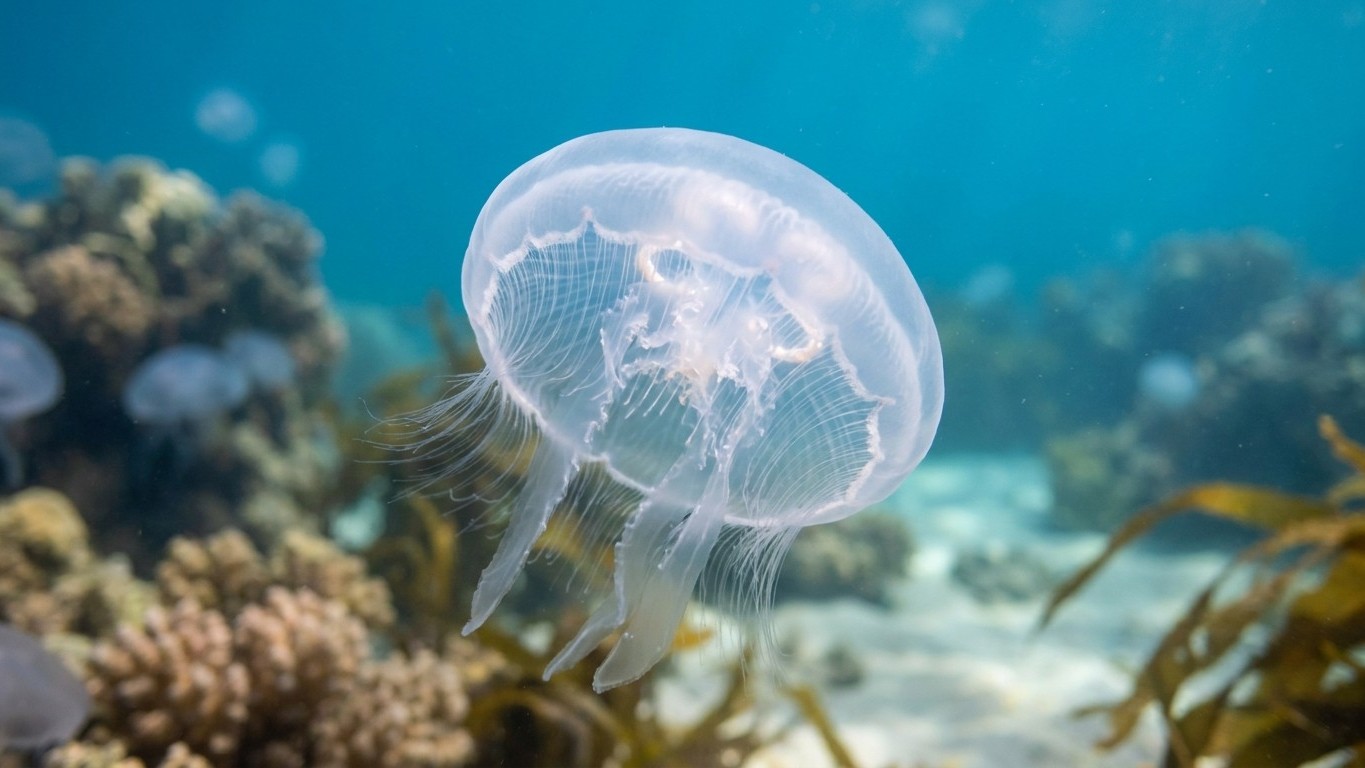
Tens of tons of jellyfish piled up in a few hours, and three reactors automatically shut down. In early August 2026, the Gravelines nuclear power plant in the Nord region was once again ensnared by these gelatinous, skeletonless creatures. A massive influx of jellyfish into the seawater pumping stations forced EDF to shut down three of its reactors, units 2, 3 and 4, while the power of reactor 1 was reduced by 50%. The site in question is far from incidental: it is the largest nuclear plant in Western Europe, whose production covers a significant share of regional electricity needs.
The paradox deserves emphasis. The continent’s most powerful installation, designed to withstand earthquakes, floods and the most sophisticated technical failures, is being neutralized by invertebrates without brains or bones. The mechanism, however, follows an inexorable logic: tens of tons of jellyfish partially blocked the intake grids and filtration drums of the pumping stations, which contribute to cooling the reactors. These filters play the role of a protective barrier on the circuit that draws its water directly from the sea.
Key takeaways
- Which animal invisible to the human eye could stop Europe’s most powerful nuclear installation?
- A troubling coincidence: the same phenomenon strikes exactly one year later, day for day
- Have other plants worldwide already suffered the same fate? Spoiler: more than you might imagine
A blockage that triggers the shutdown, not a danger to safety
The operation follows almost a mechanical logic. The animals are drawn into the pumping stations and accumulate on the filters; when the quantities become significant, the water flow can be disrupted, and the safety systems automatically command the reactor shutdown to preserve its cooling capacity. Jellyfish never penetrate the reactor core itself: they do not enter the nuclear reactor, they disrupt the water source necessary for its operation. It is precisely this cascade reaction, designed for safety, that immobilizes production.
EDF was quick to reassure on this precise point. The group stressed that the plants’ safety was in no way compromised by this episode, the automatic shutdown procedure functioning exactly as intended in response to a cooling-circuit anomaly. A safety system that performs its role, in short, even if it deprives the electrical grid of a non-negligible production capacity for several days.
A phenomenon that strikes two summers in a row, almost day for day
What is even more striking is the repetition. A year, day for day after a similar episode, the largest nuclear plant in Western Europe had to trigger its emergency procedures in the face of dense beds of cnidarians that clogged the filtration drums. The calendar coincidence even surprised the scientists themselves. Consulted by EDF during the first episode, a researcher from Ifremer, Elvire Antajan, summed up the situation with a touch of irony: “It’s really bad luck that these large arrivals occur two years in a row.”
Gravelines is not an isolated case in the coastal nuclear landscape. In 2005 and then in 2013, Sweden had to shut down the Oskarshamn site on the Baltic coast after the intrusion of a jellyfish swarm; the Torness plant in Scotland and Shimane in Japan faced the same mishap in 2011. Even California was not spared: salps clogged the filters at Diablo Canyon, just as sea grapes had done at Gravelines in the 1990s. The northern coastline thus adds nothing new; it joins a long list of nuclear sites trapped by marine life.
Why do jellyfish proliferate so much on this coastline?
Several factors combine to explain these mass arrivals, with none of them alone sufficient to explain everything. Water temperature, ocean currents, and prey availability play a decisive role in the reproduction and concentration of these organisms near the shore. The water intakes of industrial facilities, which draw in large volumes continuously, become natural convergence zones for these wandering swarms.
Overfishing adds its share to the phenomenon. By decimating fish populations, natural jellyfish predators or competitors for plankton, human activity leaves them with free rein: fewer predators, more available food, the perfect cocktail for demographic explosions. A silent imbalance that plays out far from the plant’s filters but ends up echoing directly in them.
Facing this now-identified risk, the operator has strengthened its monitoring system. Regular rounds, continuous video observation, and calibrated catching allow anticipating concentrations before they reach the filtration drums. These preventive measures, developed with the SNSM and partner fishermen, represent a cost that is far from negligible: according to EDF’s figures, 1.5 million euros are dedicated to this system over three years, to which add 30,000 euros per year for SNSM observations. Two summers in a row struck by the same skeletonless animal, and a bill that, indeed, takes shape on the energy company’s books.
Sources: franceinfo.fr | economiematin.fr | assemblee-nationale.fr
