
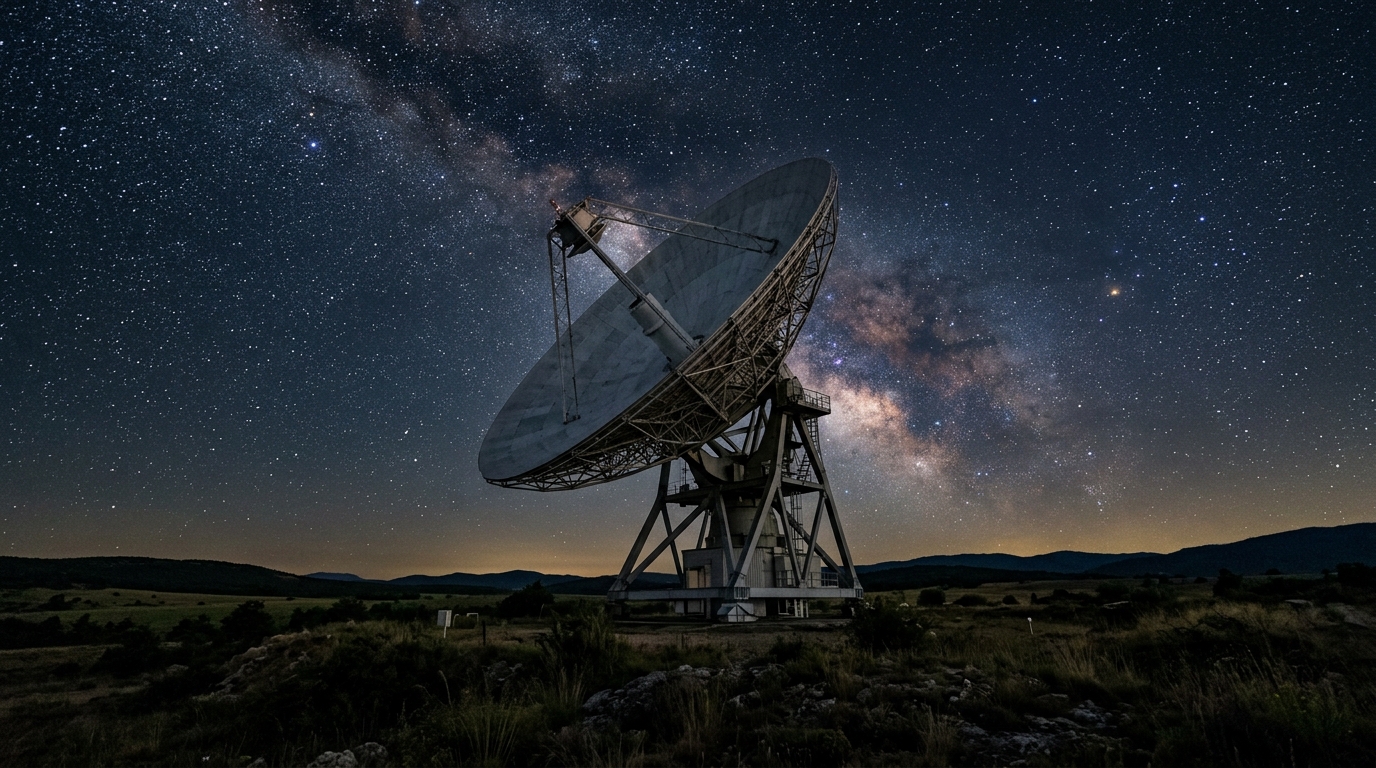
Picture a telephone call so fragile that a single misadjustment of its antenna, somewhere in Australia, could sever contact with an object launched nearly fifty years ago. That is exactly the situation of Voyager 2, the probe continuing its journey through interstellar space, more than 19 billion kilometers from home. Across the planet, only one installation can both talk to it and hear it. It isn’t the largest antenna in the world, nor the most modern. Its unique and non-negotiable geographic position makes it a link on which the mission’s very survival literally depends.
- Only the Canberra, Australia, DSS-43 antenna is far enough south to communicate with Voyager 2, which travels along the ecliptic plane
- This 70-meter-diameter antenna, built in the 1970s, had to be shut down for maintenance in the early 2020s, temporarily depriving NASA of any ability to issue commands to the probe
- Without DSS-43, NASA could still receive data from Voyager 2 but would no longer be able to pilot it, leaving the spacecraft vulnerable to the slightest technical hiccup
- Why Canberra’s geography changes everything
- DSS-43, the veteran who has never retired
- The 2020 radio silence: when Earth nearly lost Voyager 2
- Without this antenna, the mission would come to a halt
Why Canberra’s geography changes everything
Voyager 2 did not follow the same path as its twin, Voyager 1. After its Neptune flyby at the end of the 1980s, the craft dipped below the ecliptic plane, that imaginary grand disk on which the planets of the Solar System orbit. As a result, it now pursues a trajectory well south of that plane, in a direction visible directly only from the Southern Hemisphere.
Yet the Deep Space Network—the NASA deep-space antenna network—consists of only three large stations spread around the globe to ensure continuous coverage as Earth spins: one in California, one in Spain, and another in Australia. Of these three sites, only one sits far enough south to point its dish toward Voyager 2’s current position without the Earth’s horizon blocking the signal. That site is Canberra. No technical feat can compensate for this purely geometric constraint: you cannot rotate the planet to accommodate the engineers’ needs.
DSS-43, the veteran who has never retired
The antenna in question goes by a rather austere code name, DSS-43, but its scale is striking: a diameter of 70 meters, roughly the height of a 20-story building laid on its side. Built in the 1970s, it has weathered decades by undergoing successive upgrades, never replaced by a newer structure for this exact role.
What makes it irreplaceable, as noted, isn’t its age or even its size, though both contribute to its ability to pick up signals as faint as they are. The signal from Voyager 2 reaches Earth with power on the order of a billionth of a billionth of a watt. At that distance, only such a large dish can hope to discern that whisper above the cosmic background. But it is its location, and only its location, that places it in a monopolistic position for talking to the spacecraft.
The 2020 radio silence: when Earth almost lost Voyager 2
This reliance on a single antenna faced a particularly tense episode in the early 2020s. DSS-43 had to be taken offline for several months for essential maintenance, notably the replacement of gear that had aged after decades of uninterrupted service. During that period, NASA lost the ability to send commands to Voyager 2, even though the probe continued to transmit data passively via other, more modest antennas.
It was a moment when the agency realized how thin the thread holding the mission together really was. A major technical incident, a sudden failure on this antenna during its refurbishment, could have severed contact with no short-term recourse. Fortunately, the work concluded as planned and the link was restored, but the episode brutally underscored the fragility of the arrangement.
Without this antenna, the mission would come to a halt
Even today, every command sent to Voyager 2, every instruction intended to nudge its instruments or manage its diminishing power, must pass through Canberra. Without DSS-43, NASA might still receive a trickle of data from other network antennas, but it would lose the ability to command the probe. A spacecraft that can no longer be commanded is doomed to shut down at the first technical hiccup, unable to adjust its systems remotely.
That is why ground teams treat this antenna with almost obsessive caution, planning its maintenance years in advance and restricting any service interruption to the bare minimum. Voyager 2 itself, powered by a radioisotope generator whose output declines every year, no longer possesses the margin it had at launch. The slightest incapacity to communicate could become irreversible.
This story of a single antenna and unyielding geometry says something vertiginous about our space exploration: even the most iconic missions, those that shaped our view of the Solar System, remain tethered to concrete ground-based infrastructures, with their constraints, wear, and fragilities. Voyager 2 keeps racing toward the unknown, but its tenuous link to Earth still passes through that same Australian hill. How long can this dialogue endure as the probe drifts farther away day after day?
