
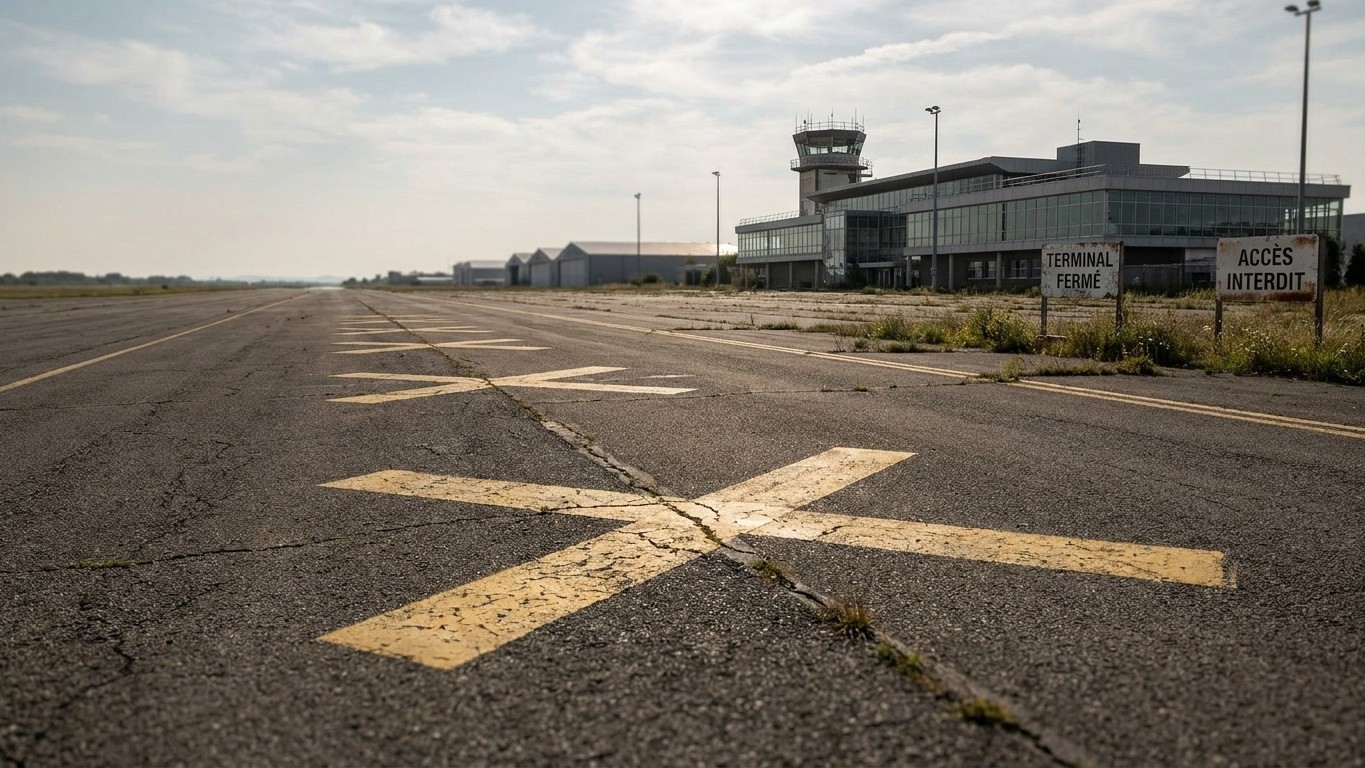
A four-kilometer runway capable of accommodating an Airbus A380, a brand-new terminal, a bill of 1.1 billion euros: this is what Spain built near Ciudad Real, about 235 kilometers south of Madrid. The airport became a symbol of Spain’s excessive spending during a construction boom that ended with the 2008 financial crisis, the very year of its opening. Four years later, the doors were already closing. A look at one of Europe’s most spectacular real estate fiascos.
Key takeaways
- An airport costing 1.1 billion euros, designed to rival major European hubs, never attracted passengers
- Closed after only four years of operation, it took years to find even a single buyer
- Today transformed into an aircraft parking lot, the site embodies the excesses of Spain’s early-2000s real estate bubble
An infrastructure cut out to rival Madrid-Barajas
The project was anything but modest in ambition. The airport was to boast a four-kilometer runway, long enough to accommodate an Airbus A380, and a 28,000-square-meter terminal capable of handling two million passengers a year, expandable up to nine million if needed. A scale of excess for a town that, in truth, numbered only tens of thousands of residents. Moreover, the construction seemed utterly disproportionate for a region so sparsely populated; Ciudad Real city itself had no more than 75,000 inhabitants and lay far from major tourist centers.
Amusing detail: before adopting its current name, the airport was first christened Don Quixote. Some argued that the literary reference, that of a dreamer detached from reality, bore a bit too close to the project’s actual situation. A nod that, in hindsight, almost sounds prophetic.
Traffic never arrived, bankruptcy followed
Built for 1.1 billion euros, the airport opened in 2008, becoming Spain’s first private international airport, but operations lasted only three years before the managing company filed for bankruptcy in April 2012. The last commercial flight, operated by the low-cost carrier Vueling, had already departed the site before this official closure. Between the inauguration and the shutdown, passenger numbers never took off: barely ten thousand travelers set foot on the grounds of this pristine, brand-new airport during its early months of operation, according to figures reported at the time.
The financial collapse proved brutal. The airport operator, CR Aeropuertos, went bankrupt in June 2012 with debts of around 300 million euros. After laying off nearly two hundred employees, the owning company now employed only about a dozen. On the now-silent tarmac, giant yellow crosses were painted to warn pilots not to land. A image that earned the site its nickname—the phantom airport—shared with another similar Spanish project, Castellón.
One hundred million euros asking price, no buyers
The Spanish judiciary attempted to recover part of the investment. In August 2013, the airport was put up for sale at auction with a starting price of 100 million euros. No one came forward. No bids were made, so sale extensions were granted over time, with the Ciudad Real Commercial Court agreeing to a seventh extension in July 2014.
It would take until July 2015 for a bidder to finally appear, with the minimum price reduced to 28 million euros. But the bid that arrived raised eyebrows: the Spanish court rejected a purchase offer of 10,000 euros submitted by a Chinese consortium named Tzaneen International, which hoped to turn the site into a European gateway for Chinese companies. The court deemed the offer too paltry to be validated, even in the absence of any other candidate.
The final sale did not occur until a year later, and at a sum far removed from the symbolic price floated in 2015. The airport was ultimately sold in 2016 to CRIA, CR International Airport, for 56.2 million euros. Yet between signing and closing, patience was required again: due to financial and bureaucratic hurdles, the sale only became effective in 2018.
Today, a giant parking lot for airplanes
The official reopening occurred in September 2019, but with no scheduled commercial flights. The airport platform reopened in September 2019 and, shortly after, the Irish company Direct Aero Services established a maintenance base there. Gone are the millions of passengers promised initially: the colossal four-kilometer runway now mainly serves to park grounded aircraft and to strip some of them for spare parts—a use that expanded particularly during the aviation crisis tied to the Covid-19 pandemic.
This reconversion even produced an almost cinematic chapter: the film I’m So Excited!, featuring Antonio Banderas and Penélope Cruz and released in 2013, was shot at this airport deserted by real travelers. A billion euros of concrete, asphalt, and steel, conceived to rival the continent’s finest hubs, today finds utility mainly in housing aircraft hulks and serving as a filming backdrop: Ciudad Real’s story remains one of the starkest examples of what can result from excessive faith in perpetual growth.
Sources : airport-technology.com | francesoir.fr | infos-75.com
