
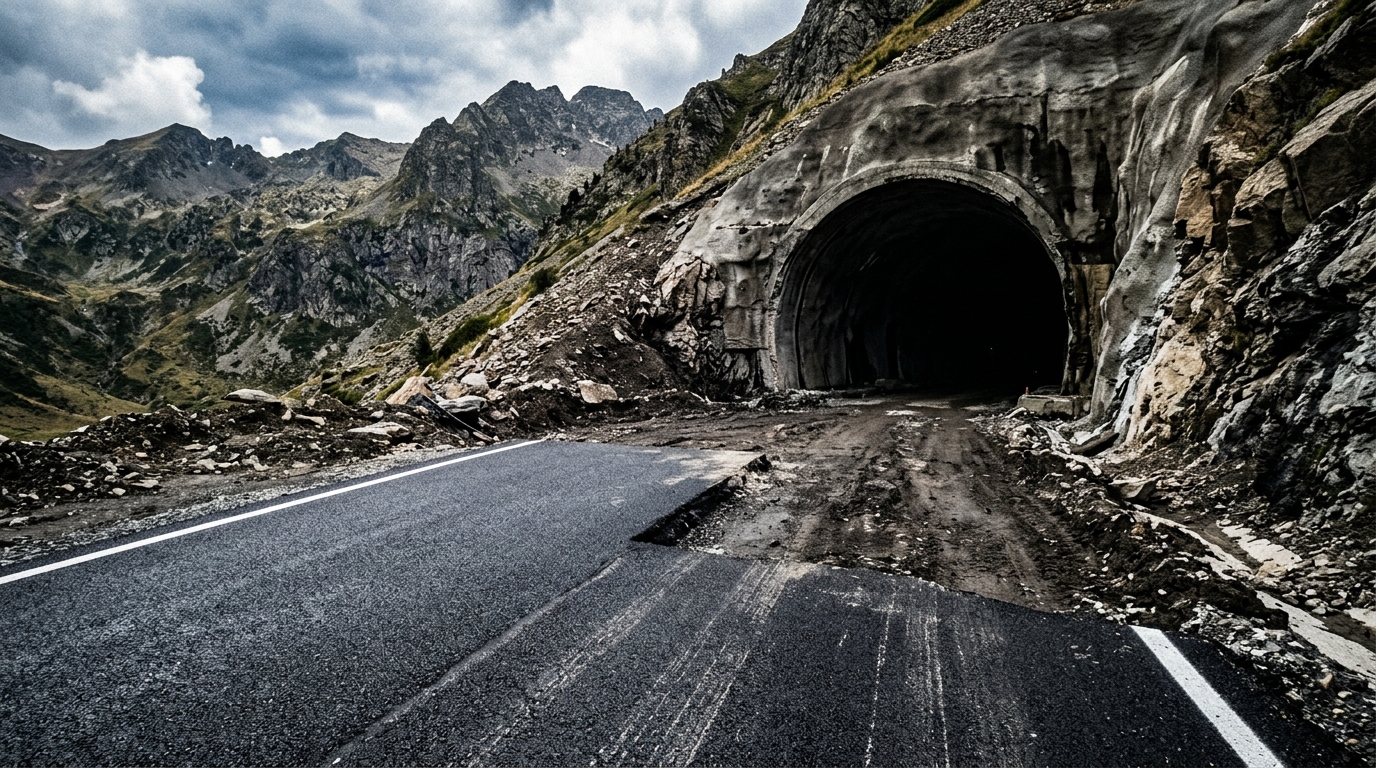
Imagine a highway that halts suddenly in the middle of nowhere, like a suspension bridge for which the second half was never built. This is basically what has been unfolding under the Pyrenees for more than twenty years, where a brand-new road tunnel cuts from one side of the mountain to the other, while the road intended to accompany it on the French side has never come to fruition. A colossal project, financed with hundreds of millions of euros, that perfectly illustrates what a cross-border initiative can become when poorly synchronized between two neighboring countries.
- The Somport tunnel (8.6 km, inaugurated in 2003) connects the Spanish Aragon region to the French Béarn, but the highway intended to extend it on the French side toward Pau has never been built.
- On the Spanish side, the road was completed up to the national motorway network, whereas on the French side motorists must use a winding departmental road.
- Environmental opposition tied to the preservation of the Aspe valley (bears and protected species) as well as budgetary decisions blocked the project, leaving the tunnel largely underutilized.
- A tunnel bored into rock, a promise built on illusion
- 254 million euros later, the road stops abruptly on the French side
- Phantom traffic: when a colossal project serves almost no purpose
- Between economic stakes and political deadlock, the Somport’s future suspended
A tunnel bored into rock, a promise built on illusion
In the heart of the Pyrenees, between Spanish Aragon and French Béarn, the Somport Tunnel has stretched since 2003—a conduit of 8.6 kilometers drilled directly through Pyrenean rock. At its inauguration, this tunnel was meant to symbolize a major step forward for cross-border exchanges, offering a fast and secure link between the two sides of the mountain range, where mountain passes had long required lengthy and sometimes winter-impractical journeys.
The ambition was clear: to create a genuine highway corridor linking Pau to Zaragoza, thereby easing the transport of goods and the travel of passengers between France and Spain. On paper, the project had everything to seduce: a strategic route, substantial funding, and the promise of unlocking a rural region too often forgotten by major transport arteries.
254 million euros later, the road stops abruptly on the French side
The total cost of this colossal undertaking rose to 254 million euros, a huge sum invested in tunneling through the mountain, strengthening structures, and installing the safety equipment indispensable for this type of infrastructure. An investment commensurate with the initial ambitions, which suggested a natural continuation on the French side once the tunnel was completed.
But here’s the twist: on the Spanish side, the road was indeed built, allowing motorists to reach the national motorway network with ease. On the French side, however, nothing materialized. The fast road intended to connect the tunnel to Pau and to the rest of the French road network was never finished, leaving drivers to cope with a winding departmental road, far from the highway standards imagined at the outset. In short, a highway was paid for to obtain, in practice, a mountain road.
Phantom traffic: when a colossal project serves almost no purpose
The immediate consequence of this lack of proper linkage is that the Somport Tunnel struggles to attract traffic. Heavy goods vehicles, which should have been the main beneficiaries of this cross-border connection, often continue to favor other routes, deemed more reliable or faster despite crossing the tunnel.
The tunnel finds itself in a paradox: designed to absorb substantial traffic, it ends up seeing only a fraction of the volume hoped for. It’s like a brand-new airport built in the countryside, with no train line or adequate access to bring travelers to it. The infrastructure exists and operates perfectly, yet it remains largely underutilized due to a lack of coherent integration with the rest of the network.
Between economic stakes and political deadlock, the Somport’s future suspended
How can such a blockage persist more than twenty years after the tunnel opened? The answer lies largely in environmental and political considerations. The Aspe valley, which the originally planned route would have crossed, is home to valuable natural heritage, including bears and other protected species, which prompted strong local opposition to the construction of a highway deemed too invasive for this Pyrenean enclave.
This opposition, coupled with successive budgetary wrangling and a persistent lack of political will across multiple mandates, ultimately buried the project on the French side, without a satisfactory alternative solution emerging. The tunnel today remains a half-useful infrastructure, a symbol of a file caught between economic ambitions and environmental preservation. Local elected officials continue to demand improvements to the existing road, yet there is no precise schedule or clearly funded plan for the future.
This dossier ultimately illustrates how large cross-border infrastructure projects can collide with complex local realities, where the economic interests of a region clash with the protection of a fragile environment. The Somport tunnel, despite its 8.6 kilometers bored into the Pyrenean rock, remains the quiet witness of an unfulfilled promise somewhere between France and Spain. It remains to be seen whether, one day, the long-awaited second half of this road will finally come to life, or if the tunnel will continue to symbolize this paradox of a modern infrastructure stuck in a very real impasse.
