
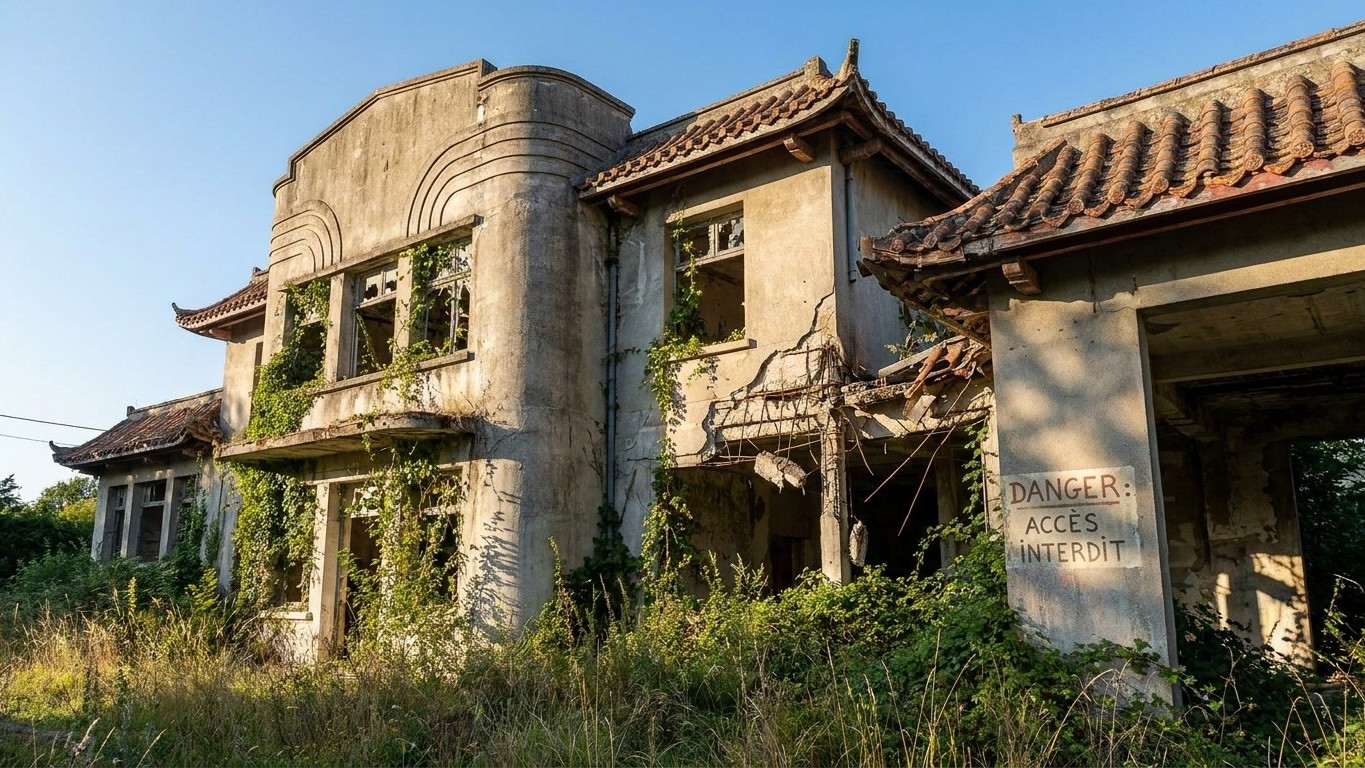
On January 8, 1962, Mario Bagno signed the deed that would erase a hamlet from the map. That day, Bagno signed an agreement with the Anghileri and Verga families to buy back the entire Consonno for 22.5 million Italian lire. A sum today trivial, but back then a fortune: the average monthly wage of a worker hovered around 50,000 lire. Bagno had just bought, for the equivalent of forty-five annual salaries of a worker, an entire village perched on the heights of Brianza, in the municipality of Olginate. What he would do with it remains one of the most delirious real estate schemes of Italy’s economic miracle.
Key takeaways
- An Italian count razes an entire village to build a hallucinatory project
- How an infrastructure entrepreneur becomes suddenly an architect of fantasies
- The day nature wiped out sixteen years of construction in a few hours
An agricultural hamlet erased from the map in a few months
Before the arrival of the count, Consonno had nothing remarkable about it. It was a mountain village whose population had fallen to sixty inhabitants by the mid-twentieth century, living off chestnut cultivation and processing from the surrounding woods, as well as celery and leek harvesting. The peasants did not own their own houses: they owned neither the dwellings they inhabited nor the lands they tilled; the whole belonged to Immobiliare Consonno Brianza, a company owned by the Verga and Anghieri families. In other words, the inhabitants had no say when the sale was signed above their heads.
The bulldozers arrived almost immediately. Bagno had the entire old constructions razed, leaving standing only the church of San Maurizio, the presbytery, and the cemetery. The man is not an ordinary developer: born in Vercelli in 1901, he had made a name for himself as a contractor specializing in road, highway and airport runway construction across Italy. An infrastructure builder who, arriving at Consonno, suddenly decided to become an architect of fantasies.
Minarets, pagodas and cannons: the construction site of a never-finished Las Vegas
The plan of Bagno rests on a single obsession: to recreate, on this lost Lombard hillside, an Italian version of Las Vegas. From 1965, six years of construction began. Out of the ground rose the Plaza Hotel, several restaurants, the Salone delle Feste ballroom, a gate to a medieval castle, a shopping gallery with its famous minaret of oriental style, and a shooting range on Mount Mario. Added to these were a Greek colonnade, Arab passages, a Chinese garden, and a minaret that rose to thirty meters. All of this in a cheerful mélange of styles that lacked any real coherence, except for the aim of dazzling visitors.
The eccentricities did not stop at architecture. The count also had a “toilet missile” installed, equipped with an artillery cannon, as well as a panoramic train that gave tourists a view of the village. To improve the sightlines from his luxury hotel, Bagno did not hesitate to mar the landscape: workers were ordered to demolish the old village. Moreover, the surrounding countryside—hills—was shifted or razed with explosives to create better panoramic vistas. A méthode that, unsurprisingly, roused the neighborhood: a group led by Lecco’s mayor, Giuseppe Fumagalli, denounced the operation, while the Lombard Association of Architects of Lecco deemed the mixed styles and the landscape alterations as a veritable abomination.
The landslide that swept it all away
For a few years, however, the gamble seemed to hold. By the late 1960s and early 1970s, Consonno became a venue for parties, weddings and weekend nights out for Milan’s enraptured bourgeoisie. But the celebration was short-lived. In October 1976, nature reclaimed its domain: a landslide, probably caused by excessive alterations to the terrain in the area, destroyed the only road leading to Consonno. A logistical disaster, since the town rested on this sole access. And the ensuing dispute sealed the project’s fate: the municipality and the count could not agree on who should pay for repairs, and the road was never truly rebuilt. Consonno, the town meant to draw crowds from Milan, found itself literally cut off from the world.
Bagno did not give up immediately. In 1981, he attempted one last stand by reopening a portion of the Grand Hotel Plaza as a retirement home, which would operate until May 2007. The count died on October 22, 1995, at the age of 94, without seeing his dream realized. Barely two months after the retirement home closed, in July 2007 the final blow arrived in the form of an illegal rave called “Summer Alliance”: the influx of more than a thousand young partygoers devastated what remained of Consonno. The count’s heirs attempted to sell the site in 2014 for twelve million euros, but found no buyers.
What strikes most about Consonno is not the ruins but the words painted on them. On a rusted banner that still stands, one can read the promotional slogan devised to sell the dream to Milanese tourists: “At Consonno, the sky is bluer.” The irony is total: the hamlet meant to offer a sky bluer than anywhere else is today a concrete skeleton with fissures, where vegetation reclaims the shells of the minaret and pagodas. The site now serves occasionally as a set, notably for advertising shoots like Levi’s and BMW, the only reconversion found for this pocket Las Vegas that ultimately drew neither casinos nor fortune, but urbex enthusiasts and curious visitors eager to photograph the failure of a man who wanted to buy the sky of an entire village.
Sources: lautrequotidien.fr | 2tout2rien.fr | for-lady.org
