
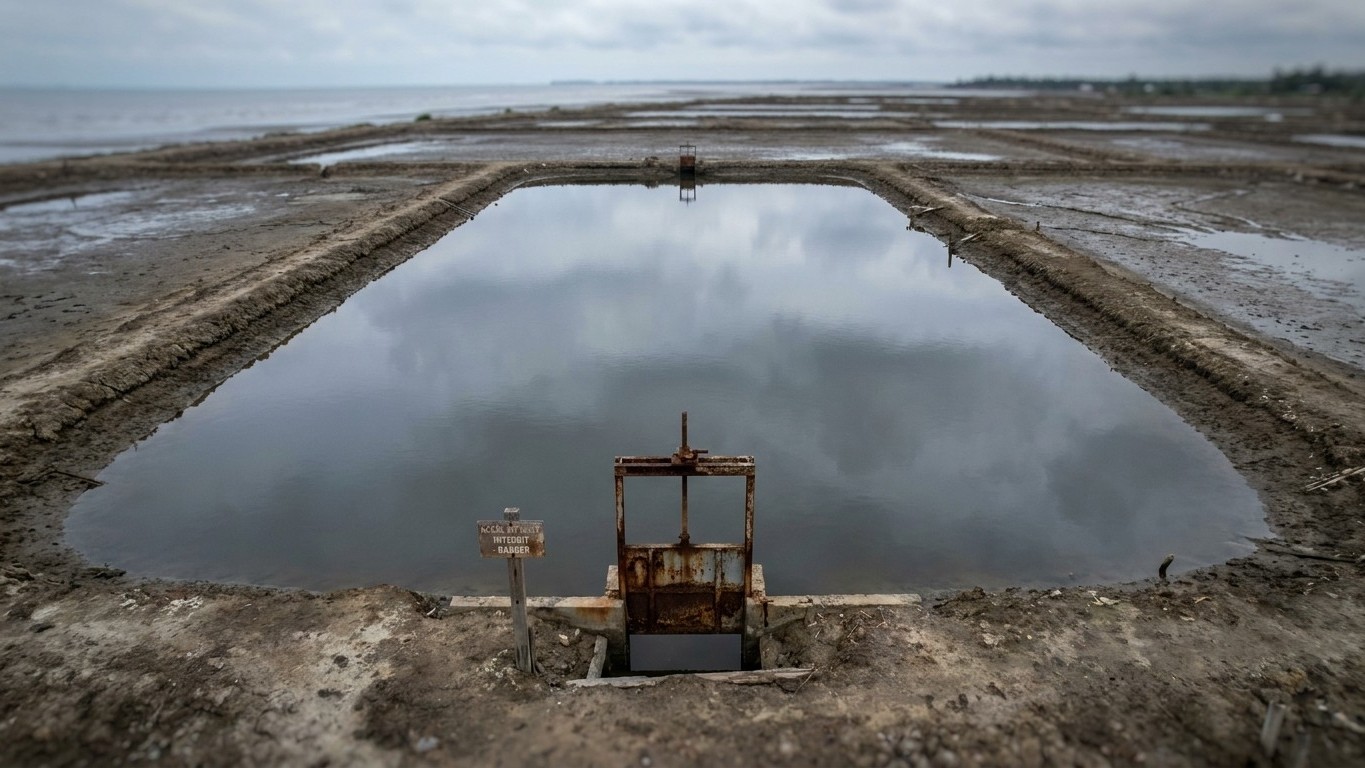
Under the tropical skies of Southeast Asia, since the mid-1990s an enormous grid of land and brackish water has lay dormant, wakeable only by the tide. The damage accumulated has left the world with about 250,000 hectares of abandoned shrimp ponds, a surface comparable to the entire area of Luxembourg, caught between two waters since the industry packed up. Levees collapsed, rusted gates, stagnant water bodies: the landscape resembles a ghostly shipyard, except here it is the sea that has been driven away, not the ships.
Key Points
- Why a simple 25-centimeter excavation multiplies mangrove regeneration by a hundredfold
- The virus that wiped out the shrimp industry in a few years, leaving giant scars
- Why nature alone cannot recover these lands without human intervention
A gold rush for pink gold that left muddy scars
The story begins with a boom. In the 1980s and 1990s, swaths of mangroves were cleared to create shrimp farms, promises of rapid foreign exchange for coastal nations chasing growth. In 1999, 350,000 hectares of mangroves were cleared across the Indonesian archipelago to make way for shrimp ponds, representing the world’s highest mangrove-deforestation rate, according to data cited by the World Bank. The dream collapsed almost everywhere else as well. A global virus, white spot syndrome, struck the industry in the mid-1990s, causing shrimp to die within days. Operators shut up shop overnight, leaving behind dikes that no municipal budget had ever anticipated maintaining.
In Indonesia, the verdict is unequivocal: more than half of mangrove-cleared shrimp farms have been abandoned or left fallow. Faced with this waste, the government eventually acted. Indonesian authorities announced plans to restore more than 300,000 hectares of inactive ponds to revive fishing and curb mangrove deforestation. The ambition is evident, but it runs into a stubborn reality: these lands do not heal by themselves.
Why nature does not reclaim its rights on its own
One might suppose that an abandoned basin would gradually revert to mangrove, slowly, over the seasons. That is rarely the case. Field studies show that abandoned basins preserve their original structure, yet remain open to tidal flux to varying degrees due to erosion or the withdrawal of sluice gates. Not completely closed, nor truly open. The water stagnates, brackish, without the regular rhythm of tides that normally nourishes mangrove roots.
Vietnamese researchers observed the same blockage in Ben Tre province, where several abandoned basins continue to disrupt the natural hydrological regime of the coastline. The problem is not merely aesthetic. A study published in PLOS One is unequivocal on the course to take: restoring the hydrology of a shrimp pond is not limited to removing the gates; the dikes must also be removed. Without this step, freshwater and seawater never mix in the right proportions, and mangrove propagules simply do not receive the inundation they need to germinate.
Reopen the dike, let the sea in
The working method bears a somewhat austere name—mangrove ecological restoration—but its principle rests on a simple image: break through the earthen wall so that saltwater can return to caress the soil at its own pace. In the field, this translates to breaking the basin walls, manually constructing tidal channels, and the assisted dispersal of mangrove propagules. Nothing sophisticated, just patient labor.
The results, when the method is applied, are spectacular. A study conducted in Ben Tre, Vietnam, showed that excavating a mere 25 centimeters increased the time of tidal inundation from 463 to 7,597 hours per year, strongly boosting survival and growth rates of planted mangroves. Over ten years, the difference becomes striking: the excavated zone accumulated 98.7 tonnes of biomass per hectare for one species, compared with only 1.04 tonnes in the unexcavated, still-closed area. A hundred times more wood, roots, and life, for the same waiting period.
In Singapore, on the island of Pulau Ubin, a specific site illustrates this timing well. The site was planted with mangroves before being converted into aquaculture ponds in the 1990s, and abandoned in 2001. It took more than twenty years for a structured restoration project, involving the national parks authority and a local bank, to finally tackle the dikes and reintroduce seawater circulation. In Indonesia, at the Perancak estuary in Bali, the reconversion of aquaculture ponds into mangroves began in the early 2000s, led by a local research institute that transformed former experimental ponds into open-air observation stations.
Yet the soil of these basins retains a precious memory beneath the mud. Researchers measured, in some ponds abandoned for ten to twenty-two years, carbon stocks exceeding 865 tonnes of carbon per hectare in the deeper soil layers, compared with an average of about 1,030 tonnes for a reference intact mangrove. This suggests that the restoration potential already exists, buried, waiting for someone to dare turn the valve. And yet, on a global scale, the areas returned to mangroves remain small relative to the 250,000 hectares recorded: up to 13,000 hectares restored in Thailand and a few thousand hectares in Vietnam, according to surveys compiled by sector specialists.
Sources: sciencedirect.com | mothership.sg
