
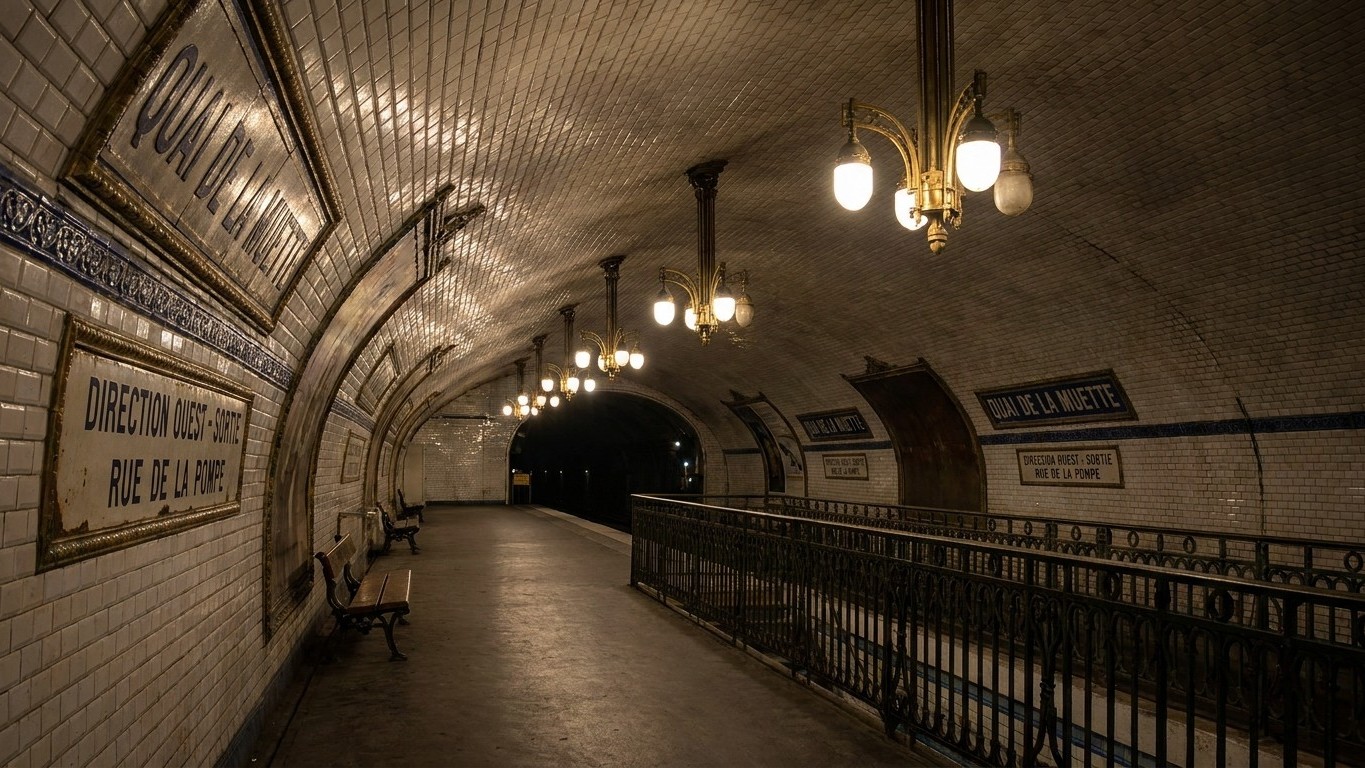
Under Simon Bolivar Avenue, in Paris’s 19th arrondissement, there lies since 1921 a metro station entirely tiled, a place no one has ever used. Its name is Haxo. Its construction was nearly complete in the 1920s, yet it was never opened to the public. The trains of line 3 bis have passed its platforms for a century, without ever stopping.
Key takeaways
- A Parisian station built a century ago has NEVER seen a single traveler
- In Berlin, the Cold War transformed dozens of stations into forbidden zones monitored by soldiers
- These forgotten places today serve as cinema sets perfectly preserved by time
Haxo, the cinema backdrop that has never welcomed a traveler
What first strikes is the illusion of normalcy. The station looks exactly like the others with its platforms, tiled vaults, and signage, but it has no public access. No stairs, no corridor to the street: its staircases simply do not exist. The station was meant to connect the current lines 3 and 7 via a single track nicknamed the “Fêtes line,” but the shuttle service set up between Pré-Saint-Gervais and Porte des Lilas was a flop. Given the low ridership, only a shuttle service was implemented, dismissed by the public and withdrawn in 1939. Haxo has never seen a single traveler pass through, and its exterior access has never been built.
The place has not, however, remained completely inert. The station is frequently used by filmmakers, with about five films shot there each year, including Amélie. In 1993, it even served a very specific purpose: the press preview of the new MF 88 rolling stock. A century-old tile, never trodden by the public, but perfectly maintained for the cameras.
Porte Molitor, Arsenal, Croix-Rouge: the underground museum of missed opportunities
Haxo is not an isolated case. At the other end of the capital, in the 16th arrondissement, the Porte Molitor station meets a destin y almost symmetrical. Built on a spur linking lines 9 and 10 called the “Murat line,” it has a central platform flanked by two tracks, designed to serve Parc des Princes on match nights. The project collapsed for a prosaic reason: in 1932, Parc des Princes capacity was doubled, and the station could not handle the expected passenger flow, so it never opened, its two tracks today serving as a garage.
Other Paris stations extend this discreet list. One can mention Arsenal on line 5, Champ de Mars on line 8, or Porte Molitor between lines 9 and 10. A little further north, Croix-Rouge station, closed in 1939 like several other stops of the era, never reopened to the public but now serves as a filming location for movies and series, its authentic period setting making it a sought-after spot for Parisian producers. As for Porte des Lilas-Cinéma station, built in 1921 to host the terminus of line 7 bis, a project that never came to fruition, it today marks the starting point of the Fêtes line. A whole network of finished, tiled, lit corridors, yet empty for a century beneath the Parisian feet.
In Berlin, stations transformed into forbidden zones during the Cold War
The phenomenon takes on a completely different dimension in Berlin, where geopolitics moved underground. Thirteen years after the wall’s construction, in 1961, dozens of metro and urban rail stations in West Berlin had become empty underground tombs, lit only to a minimum, watched by armed East German soldiers. Rather than demolish these sections or reroute the lines, East German authorities chose a radical solution: simply close the stations on the East side, without altering the track layout.
As a result, a surreal underground ballet unfolded for nearly thirty years. Trains slowed down, but never stopped at these deserted stations. They were called Geisterbahnhöfe, literally ghost stations, and they remained frozen in that state until 1990. One exception to this regime was Friedrichstraße station, with its border crossing, which served as the official crossing point between the two Berlins. Everywhere else, Western passengers would pass these abandoned platforms, glimpsing through the windows soldiers frozen in the shadows.
Today, one of these former ghost stations, Nordbahnhof, retains a tangible trace of that interlude. The platforms of some old ghost stations still bear original tiles, never renovated between the construction of the Wall and reunification. A Berlin tiling frozen in the 1960s, just as Haxo has remained since the 1920s: two cities, two histories, one shared reflex to let the tiling speak for the absent travelers.
Sources: parissecret.com | berlin.de
