
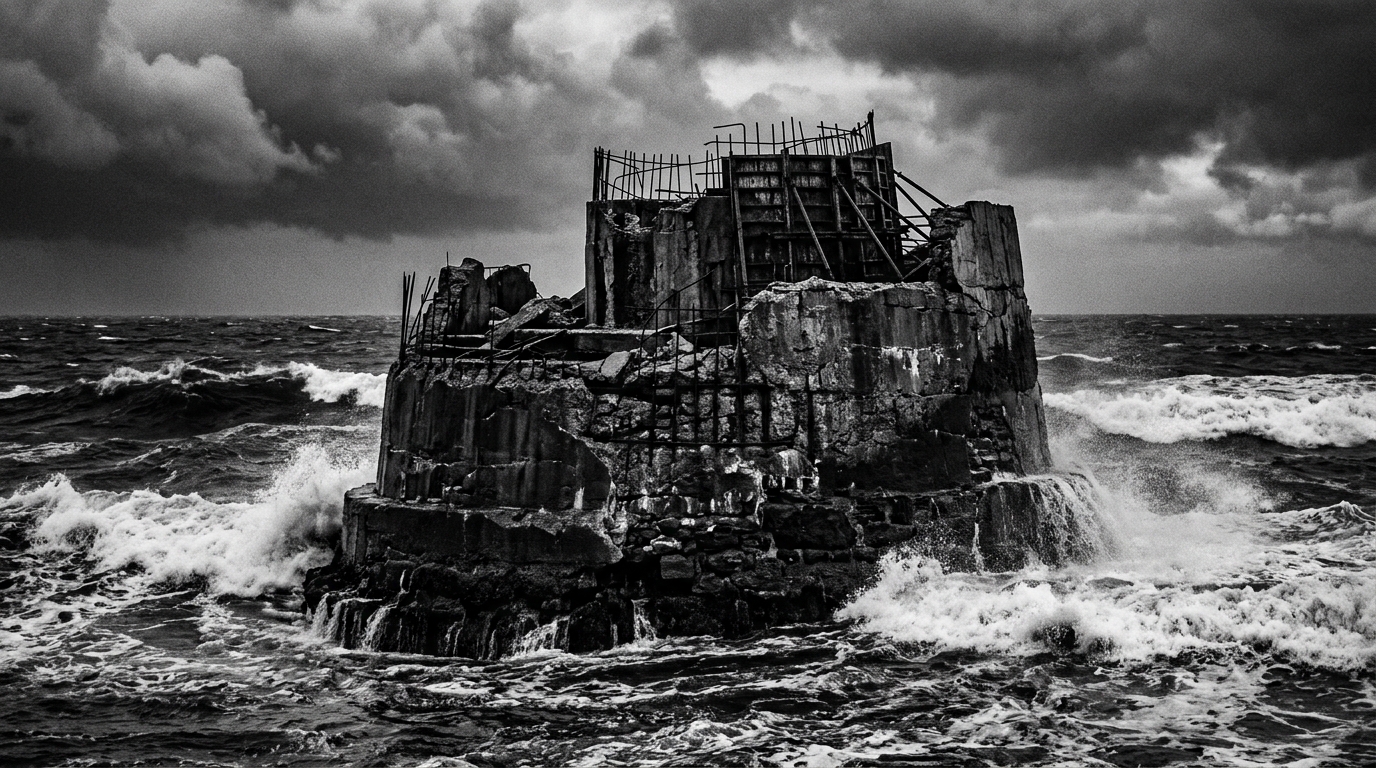
There is, off Ouessant, a position in the Iroise Sea where no lighthouse has ever risen, and yet tens of millions of francs were swallowed up there before a single stone was laid. It wasn’t a legendary storm nor a spectacular bankruptcy that doomed this pharaonic project: it was a far subtler foe, lurking beneath the seabed, that the engineers of the time never managed to master. Here is a little-known tale, that of a phantom lighthouse that cost the French state dearly without ever guiding a single ship.
- The contract signed in December 1984 with SPIE-Batignolles envisioned a steel-concrete tripod lighthouse, to be commissioned in the summer of 1987.
- The risk of sand liquefaction under wave action made the foundations unstable and stalled the project as early as 1984-1985.
- The contract was terminated in May 1986 after 160 million francs had been spent, against an estimated total cost of 500 million.
- A lighthouse intended to dominate the Iroise Sea
- Soil liquefaction, the invisible enemy that halted everything
- 160 million francs vanished: the salty bill of a phantom project
- What the Ouessant project’s failure reveals about the limits of civil engineering
A lighthouse intended to dominate the Iroise Sea
In the 1980s, France sought to strengthen maritime safety around the Ouessant archipelago, a zone renowned for its fierce currents and heavy shipping traffic, where routes between the Channel and the Atlantic intersect. After several failed attempts, the call for bids for this major aid to navigation was relaunched in June 1983. It was the SPIE-Batignolles group that ultimately won the contract, proposing an audacious project for its time: a mixed steel-concrete structure, of the tripod type, designed to rest on the seabed by mere gravity.
That technical choice was not incidental. It marked the French first lighthouse conceived to be placed so far offshore, a feat of engineering intended to push the boundaries of what was deemed possible at sea. The contract was signed in December 1984, with a clear objective: to be commissioned in the summer of 1987. Everything seemed aligned to equip the Iroise Sea with a structure commensurate with its dangers.
Soil liquefaction, the invisible enemy that halted everything
Between 1984 and 1985, as the supplementary studies intensified, the project began to crack even before the first concrete block touched the water. Engineers uncovered a major risk: the liquefaction of the sands that formed the site’s foundations. This phenomenon, hard for the general public to visualize, can be likened to what happens when one shakes a bucket of water-saturated sand: the ground suddenly loses all cohesion and behaves like a liquid, unable to support any load.
Under the action of the waves and currents of the Iroise Sea, this risk became a real sword of Damocles hanging over the construction site. Such settlement, or a complete collapse of the tripod structure, would pose substantial human and financial dangers. Added to these purely technical difficulties were legal changes that further complicated the progress of works. The construction, expected to advance rapidly, literally ground to a halt, in both senses of the word.
160 million francs vanished: the salty bill of a phantom project
Lacking a reliable assessment of the cost of mitigations against this liquefaction risk, the authorities eventually threw in the towel. The contract was officially terminated in May 1986, bringing a definitive end to a project that had begun with ambition a few years earlier. The affair might have remained confidential if a ministerial answer, provided in 1988 to a written question in the National Assembly, had not revealed the scale of funds already spent.
The figure is striking: 160 million francs had already been spent, including technical studies and compensation paid to companies for the stoppage of the works. A sum definitively lost to public finances, while the complete project’s cost, had it been pursued to completion, was estimated at around 500 million francs. The country ended up with a third of the bill paid, and no lighthouse in return, a phantom monument that never came to light but indeed cost money.
What the Ouessant project’s failure reveals about the limits of civil engineering
This episode, today largely forgotten by the general public, nonetheless sits within the long and turbulent history of Ouessant’s lighthouses. This Breton-tip archipelago has always been associated with exceptionally hostile construction conditions, where the sea imposes its law on even the most seasoned engineers. But abandoning this tripod lighthouse illustrates a phenomenon different from the shipwrecks or storms that marked other structures in the field: here, scientific uncertainty had the final say.
This dossier recalls an uncomfortable truth: even with substantial financial means and a resolute political will, certain marine soils hold secrets that technology cannot always pierce in time. The liquefaction of sands, a phenomenon still studied today in offshore civil engineering, notably for offshore wind turbines, could have turned this lighthouse into an expensive trap if the project had continued despite the warnings. In that sense, the 1986 halt, though financially frustrating, may have prevented an even costlier technical disaster.
From this aborted project, there is today no visible trace in the Iroise Sea, only administrative documents and a budget line that testifies to an ambition broken by geology. This little-known story invites reflection on how risk is assessed before embarking on large-scale infrastructure works: how many projects, even today, advance without fully measuring what the substratum may hold in store?
