
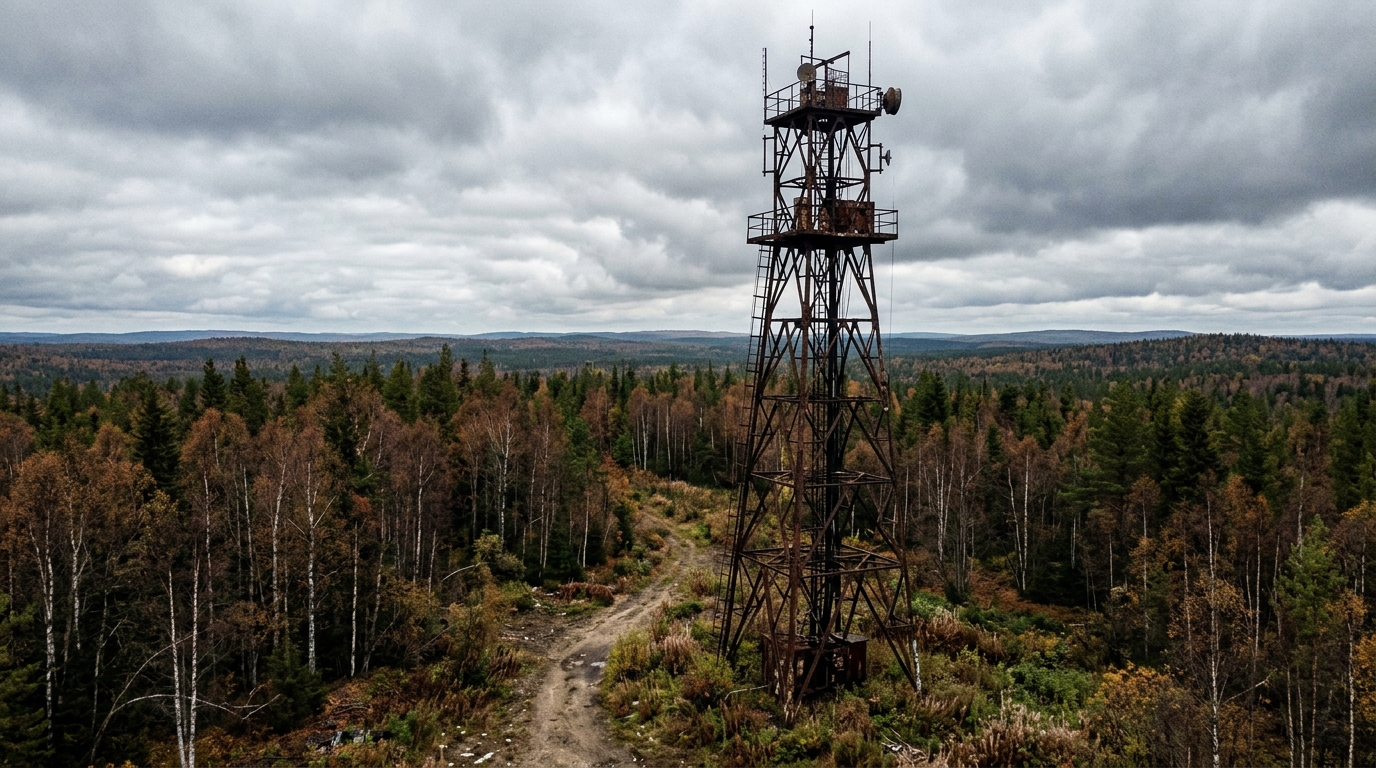
4625 kHz. Remember this frequency, because for almost fifty years it has housed one of the greatest enigmas of world radio. Night after night, somewhere within the vast expanse of Russian territory, a stubborn signal continues to emit a dull, repetitive hum, with no official explanation ever offered. Neither the Russian government, nor the military, nor anyone else has ever lifted the veil on this radiophonic anomaly that fascinates both mystery enthusiasts and telecommunications specialists. As the new school year settles in and many people dive back into a studious routine, there exists a corner of the globe where time seems to have frozen since 1976 on a single electronic note.
- Since 1976, the UVB-76 station, nicknamed The Buzzer, has been transmitting a continuous hum on 4625 kHz that authorities in Russia have never officially explained.
- The signal is occasionally interrupted by male voices speaking in Russian, reciting sequences of words or numbers, often during periods of international tension.
- The transmitter’s location has shifted over time, suggesting a military device that is actively maintained rather than a forgotten test.
- Since 1976, a phantom signal haunts Russian shortwave
- An endless hum that crossed the Cold War
- Mysterious voices that occasionally break the radio silence
- Why the Kremlin stays silent about this frequency
- What the Buzzer really reveals about Russian military secrets
Since 1976, a phantom signal haunts Russian shortwave bands
Every few seconds, a monotonous hum traverses the shortwave spectrum, a pattern that has persisted for nearly half a century. This station, radio amateurs have named UVB-76 or, more familiarly, The Buzzer, broadcasts continuously on the 4625 kHz frequency. The sound resembles a mechanical tone, repeated relentlessly, day and night, like a metronome frozen since the Cold War. No Russian authority has ever officially confirmed its existence or provided any public explanation of its actual function.
That institutional silence has only fueled the curiosity of a growing community. Thousands of enthusiasts, equipped with simple shortwave receivers, listen to this stream night after night, watching for the slightest change in rhythm or pitch of the signal. Entire forums have formed to archive every variation, no matter how minor, as the idea that something might be hidden behind this buzz continues to feed speculation.
An endless hum that traversed the Cold War
What makes UVB-76 so remarkable is its longevity. The station began broadcasting in the midst of the Cold War, at a time when tensions between the USSR and Western powers made every radio signal suspect. It has since survived the collapse of the Soviet Union, the chaotic economic transitions of the 1990s, and the geopolitical shifts of subsequent decades, without ever interrupting its transmission for a sustained period.
This persistence is all the more intriguing because the transmitter’s location has changed over time. Enthusiasts have identified several sites located in different regions of Russia, suggesting that the network behind this signal has been moved or duplicated. Such a level of continuity, despite political and technological upheavals, implies that it is not a forgotten test, but a device actively maintained, with an objective still unclear to the general public.
Mysterious voices that break the radio silence
The most troubling aspect is not so much the buzzing itself as its occasional interruptions. At irregular intervals, often several months apart, the monotone signal abruptly stops to give way to a voice, usually male, that pronounces in Russian sequences of words or numbers that appear unrelated. These messages, short and cryptic, are immediately transcribed and shared by the listener community tracking every clue.
These vocal interventions have often coincided, observers note, with periods of international tension, reinforcing the hypothesis of a link to sensitive military or diplomatic operations. But without official confirmation, these coincidences remain speculation. They are nevertheless enough to sustain a cinematic-like mood of suspense around this obscure frequency.
Why the Kremlin remains silent about this frequency
The mute stance of the Russian authorities is not insignificant in a country where military communications infrastructure has historically been classified. Officially acknowledging UVB-76’s existence would likely entail revealing its exact use, which could expose transmission methods still employed today. Silence thus becomes a strategy in itself, almost more revealing than any public statement.
This total lack of communication contrasts with the relative transparency that some other nations show regarding their obsolete former military networks. In Russia, the blur surrounding this frequency suggests that the device still holds a strategically significant utility today, justifying such a prolonged silence, nearly fifty years after its first transmission.
What the Buzzer really reveals about Russian military secrets
Beyond the mystery that fascinates the curious, UVB-76 mainly illustrates the persistence of communication methods inherited from another era. In a world saturated with satellites, fiber optics, and digitally encrypted networks, the fact that a military power still maintains a radio channel as archaic as this prompts questions about the robustness and reliability of these older technologies in the event of a major crisis. An analog signal, difficult to jam completely and independent of modern digital infrastructures, could serve as a safety net if ordinary communications fail.
This hypothesis, widely shared among observers, does not, however, resolve all the gaps. Why this continuous buzz rather than classic radio silence? Why these coded messages so rare and so strange? The Buzzer remains above all the symbol of a carefully guarded state secret, where every attempt to explain meets the total absence of confirmation.
Today, UVB-76 continues to buzz, indifferent to the speculations it has generated for nearly half a century. This small signal, at once banal and elusive, reminds us that some secrets resist time better than any technology. So should we view it as a relic of the Cold War or as a still-active device with real, tangible stakes? The answer, for now, continues to be lost in the crackles of frequency 4625 kHz.
