
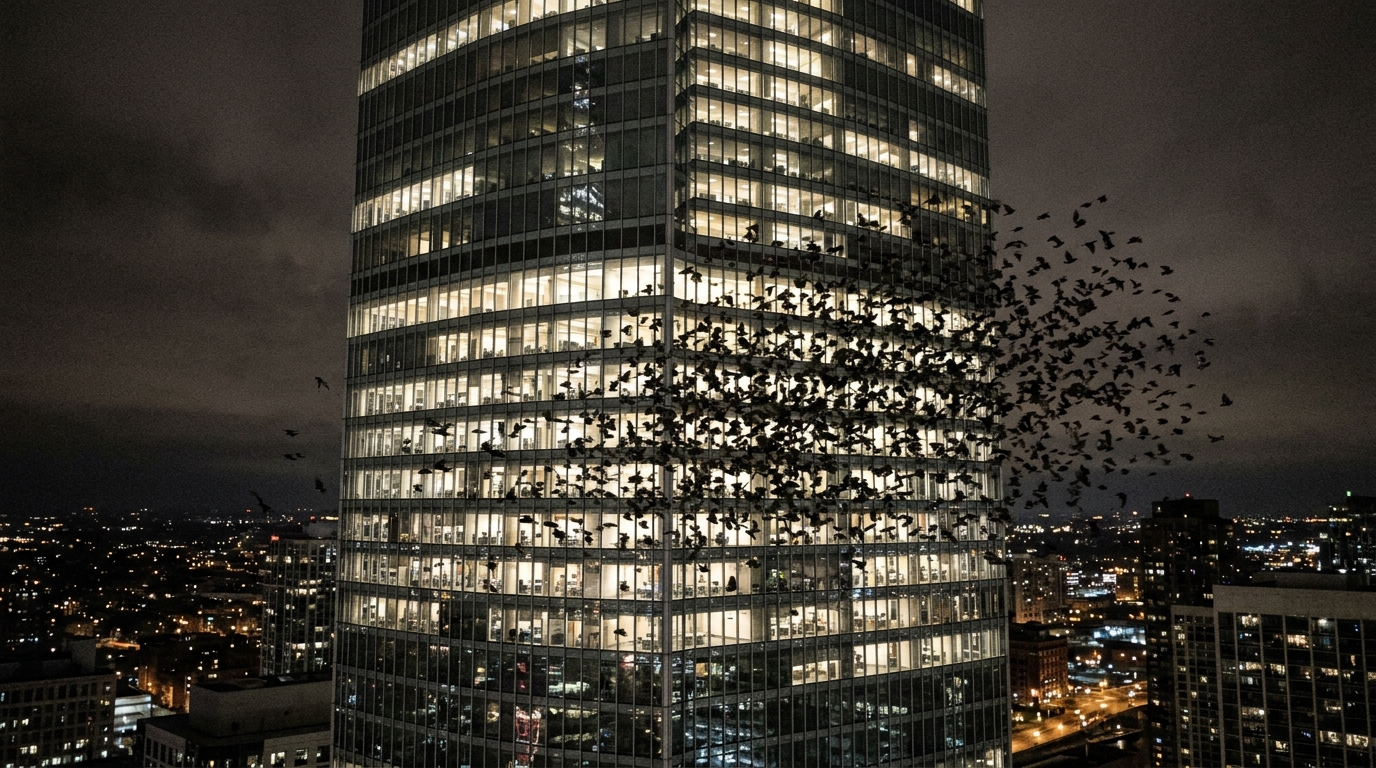
There are numbers that hit you like an obvious truth, and others that leave you speechless. Imagine a single glass facade in a large American city, strewn at dawn with nearly a thousand lifeless little bodies. This isn’t a disaster-film scene, but a real event that occurred in Chicago on an October night in 2023. This kind of tragedy, as jaw-dropping as it may seem, is actually only the visible part of a massive and largely unknown phenomenon to the general public. Because behind this carnage lies a mechanism as simple as it is cruel, linked to our most ordinary urban habits.
- Night-migratory birds navigate by the stars and the Earth’s magnetic field, a system disrupted by city light pollution that disorients them and causes them to fly at low altitudes.
- Glassy facades, reflecting the sky or rendered transparent by interior lighting, trigger mass collisions, causing up to a billion birds to die each year in the United States.
- Several North American cities are now reducing nighttime building lighting during migration peaks, a simple measure that already shows promising results.
- The invisible trap that misleads millions of migratory brains
- Why a lit window becomes a deadly trap
- Cities that switch off the lights to save entire species
- What this urban carnage reveals about our relationship with life
The Invisible Trap That Misleads Millions of Migratory Brains
Every autumn, billions of birds cross the North American continent at night, using the darkness to dodge predators and conserve energy. These winged travelers, often tiny, navigate with an extraordinary sense: they read the starry sky like a map, relying on the Earth’s magnetic field and the positions of the constellations. This navigation system, honed by millions of years of evolution, works perfectly in a natural environment, far from any light pollution.
The problem is that modern cities bear little resemblance to the night in which these species evolved. Illuminated skyscrapers create real light halos that rival the stars, and for a brain calibrated for millennia to follow celestial cues, this confusion becomes fatal. The birds, disoriented, start circling around lit buildings, exhausting their energy reserves and losing their migratory bearings altogether.
Why a Lit Window Becomes a Deadly Trap
Once caught in this artificial light, the birds often fly at low altitude, exactly where the glass façades of buildings lie. Glass has a notorious trait: it reflects the sky and the surrounding vegetation, or becomes completely transparent when lit from inside. For a bird in flight, it is impossible to distinguish a glass wall from an open space. The collision is then almost inevitable, and often happens at full speed.
That is precisely what happened on that tragic night in Chicago: weather conditions had driven an exceptional number of migratory birds to fly low, just as a particularly bright building loomed in their path. The result was a silent carnage, discovered early in the morning by astonished passersby. It is estimated that in the United States, up to a billion birds die each year in similar circumstances, a figure that dizzyingly dwarfs when viewed against the already worrying decline of many bird populations.
Cities That Turn Off the Lights to Save Entire Species
In response to this finding, several North American metropolises have started rethinking their nighttime lighting practices, especially during periods of intense migration that mark spring and autumn. Programs now encourage building managers to turn off or reduce lighting on upper floors during the night, particularly during migration peaks detected by weather radars. These measures, as simple as they may seem, are already showing encouraging results in the number of collisions recorded.
Other more technical solutions are also developing, such as applying patterns on glass to make them visible to birds, or installing less aggressive lighting systems. These initiatives remain, however, minority in scale against the vast extent of the existing building stock, and many still rely on the goodwill of property owners rather than strict regulatory mandates. The path toward cities truly designed to coexist with wildlife still seems long.
What This Urban Carnage Reveals About Our Relationship With Life
Beyond the immediate tragedy, this Chicago episode highlights a broader truth: our urban infrastructure has been designed without ever considering the needs of other species sharing our environment. Light, which we regard as a simple comfort or a symbol of modernity, becomes an existential threat to creatures that have not had the evolutionary time to adapt to such abrupt and radical changes.
This realization calls into question our ability to rethink our cities in a more inclusive way toward living beings. As autumn returns and major migrations resume across continents, the question of nocturnal building lighting remains acutely relevant. Could a simple light switch truly make the difference between life and death for millions of birds each year?
This Chicago tragedy, as spectacular as it may have seemed, is ultimately only the visible symptom of a much larger and more diffuse problem. Between runaway urbanization and the vital needs of wildlife, a balance remains to be found, and it might well begin with a simple gesture as turning off the lights at night.
