
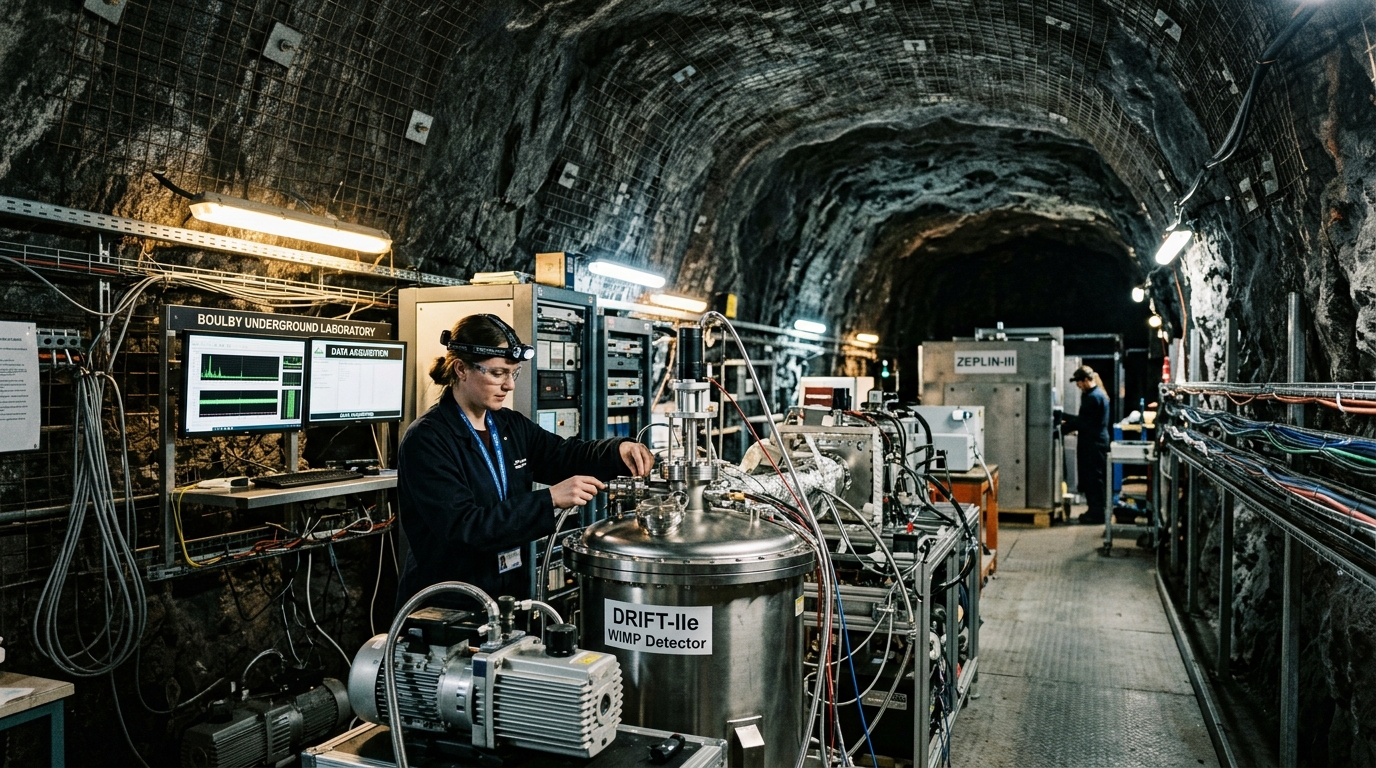
Void and silence are concepts we often confuse. Yet outer space, that infamous cosmic vacuum, is far from a tranquil place: it is continually traversed by a flood of high-energy particles, the cosmic rays, that strike our planet without end. At the Earth’s surface, this invisible din is everywhere, and it presents a formidable problem to anyone trying to detect a signal that is tiny, almost imperceptible. Because in order to hope to capture the trace of a dark matter particle, that mysterious substance thought to comprise the bulk of the universe’s mass, one must first quiet this noisy environment. That is precisely the mission undertaken by a laboratory tucked inside an active British mine, somewhere between the cliffs of North Yorkshire and the windswept moors of the North Sea.
- The Boulby laboratory, shielded by more than 1,100 meters of rock, reduces the cosmic-ray rate by about a factor of one million compared with the surface.
- A consortium of British universities is developing a giant detector containing up to 100 tonnes of liquid xenon, funded to the tune of 8 million pounds by UK Research and Innovation.
- Boulby is also slated to host a future installation for the international XLZD experiment, whose final location remains to be determined.
- The rock as a shield: why the surface is hell for physicists
- A particle per year: the most patient hunt in modern physics
- Absolute calm, a technical challenge before being a scientific one
- What these mines teach us about the invisible that surrounds us
More than a kilometer of rock above it, in the bowels of the Boulby mine, relentlessly mined since the late 1960s to extract polyhalite, an instrument must stay calm that is greater than the vacuum itself in order to hope, one day, to detect the passage of a single particle per year. An objective that might seem almost trivial, until one understands the scale of the technical and scientific challenge hidden behind it.
The rock as a shield: why the surface is hell for physicists
In open air, escaping the ongoing bombardment of cosmic rays is impossible. These particles, born of violent astrophysical events, pierce the atmosphere and strike everything at the surface, including the most sensitive scientific instruments. For a detector aiming to spot a tiny signal, this persistent background noise is a nightmare: it literally drowns the sought-after information beneath an avalanche of false signals.
That is where geology becomes a valuable ally. The underground laboratory site at Boulby, located between the towns of Saltburn and Whitby on England’s northeast coast, benefits from an exceptional natural shield. More than 1,100 meters of rock lie above the facility, reducing the cosmic-ray rate by roughly a millionfold compared with the surface. In other words, the salt and polyhalite mountain acts as a giant screen, filtering out the bulk of the disruptive radiation before it reaches the instruments. As an added bonus, the surrounding salt rock is itself very low in natural radioactivity, making it an ideal ground for any scientific project requiring the lowest possible background noise.
A particle per year: the most patient hunt in modern physics
Here lies one of the most fascinating paradoxes of contemporary physics: building instruments of extreme sophistication in order to… detect nothing most of the time. If dark matter exists in the form of particles that can interact, even very weakly, with ordinary matter, theorists estimate these interactions would be extraordinarily rare. We’re talking perhaps a handful of events per year, or even fewer, in the scale of a detector.
That is precisely why a consortium of British universities is developing a new giant detector at the Boulby site. The project will take the form of an enormous underground thermos containing up to 100 tonnes of liquid xenon, a material especially sensitive to the interactions being sought. This program benefits from public funding of 8 million pounds sterling from UK Research and Innovation, and brings together researchers from several institutions, including the University of Sheffield. The ambition does not stop at this detector alone: Boulby is also in the running to host the foundations of a future facility for the international XLZD experiment, even though its final location has yet to be decided.
Absolute calm, a technical challenge before being a scientific one
Going down a detector to more than a kilometer underground does not by itself guarantee the silence sought. It is also necessary to build, maintain, and operate a device of astonishing precision in an industrial environment, right in the middle of an active mine. The network of tunnels at Boulby, operated by ICL UK since 1968, stretches over more than 1,000 kilometers of passages, a labyrinth where mining and cutting-edge research coexist.
Each component of the future detector must be chosen, tested, and assembled with extreme care, because even the slightest amount of radioactivity in a material—even in tiny quantities—would contaminate the measurements and mask the signal being sought. It is a bit like trying to hear a whisper from someone at the far end of a quiet room: the slightest stray noise, no matter how small, can ruin everything. This requirement explains why Boulby has hosted underground scientific experiments since the 1990s, with teams gradually refining their methods to reach this level of almost complete calm.
What these mines teach us about the invisible that surrounds us
Boulby is no stranger to dark-matter exploration. For more than a decade, the UK Dark Matter Collaboration conducted a research program at a depth equivalent to 2,800 meters of water, a way of measuring the insulating power of rock by comparison with a water depth producing the same shielding effect. This historic experiment laid the scientific and technical foundations on which today’s new projects at the site build.
The laboratory director, Sean Paling, sums up the challenge clearly: “To discover, or even to be able to rule out the existence of dark matter, would represent a major leap forward for science and would transform our understanding of the cosmos.” A sentence that reminds us that even an absence of results in this field would constitute a major advance, allowing hypotheses to be eliminated and guiding future research toward more promising directions.
Ultimately, what strikes about this quest carried out beneath the Yorkshire moors is the contrast between the scale of the question being asked—the very nature of the matter that makes up the universe—and the extreme restraint of the device designed to answer it. No rumble, no bustle: just a silent chamber buried under a mountain of salt, where scientists wait patiently for an invisible particle to reveal itself. A waiting that, should it one day bear fruit, could well reorder the fundamentals of our understanding of the cosmos.
