
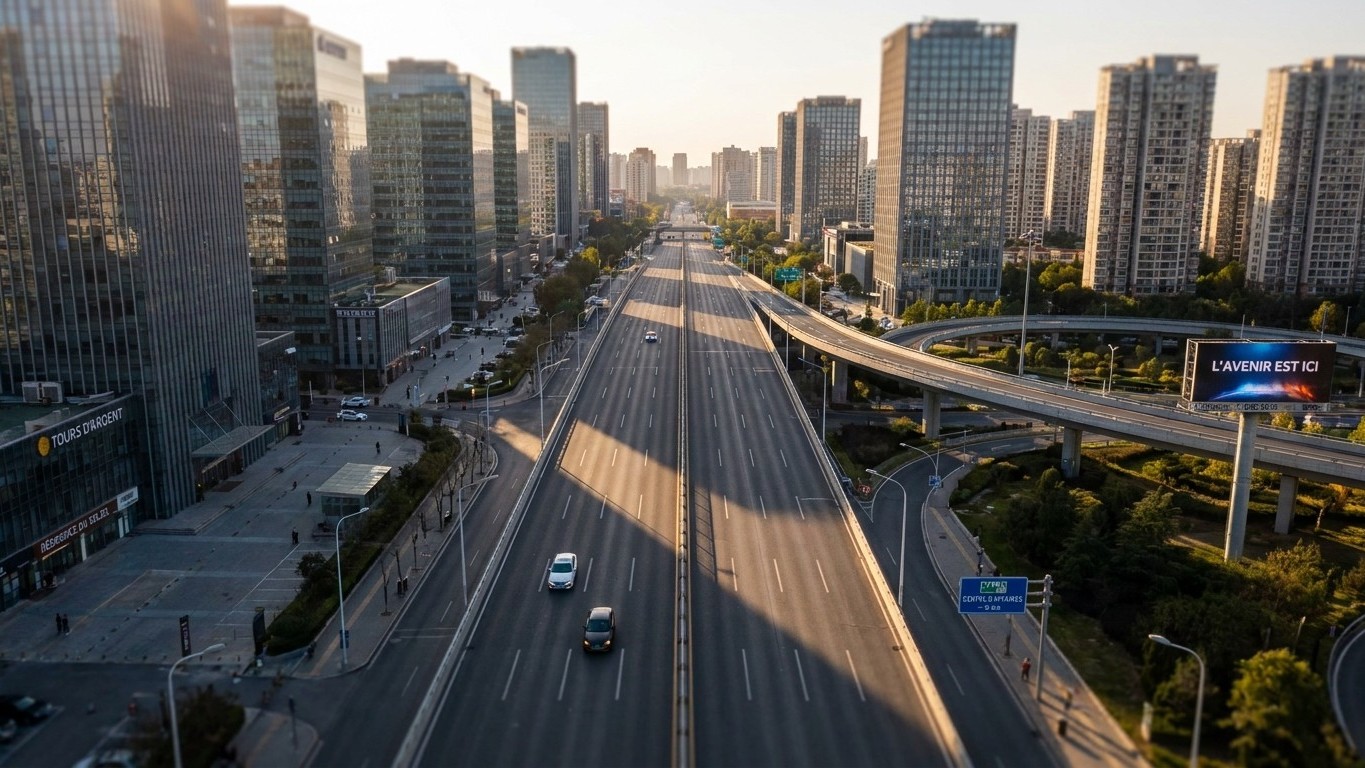
Ordos, in Inner Mongolia, has housed since the mid-2000s a district named Kangbashi, conceived to house one million people. Two decades on, the official population tops out at roughly 120,000 to 130,000 residents according to the latest censuses, barely more than one tenth of the initial target. The gulf between the scale of the project and the emptiness of its avenues has made it, in the international press, the archetype of the ghost Chinese city.
Key takeaways
- A concrete district intended for a million residents, yet only about 130,000 residents after 20 years
- Reports from Al Jazeera and Time transformed Kangbashi into a symbol of Chinese urban excess
- Despite growth, the district remains barely at 13% of its originally planned capacity
The coal bet transformed into a new city
Everything begins with underground wealth. Ordos owes its prosperity to its energy and mineral reserves: one sixth of the country’s coal reserves, proven natural gas reserves equal to about a third of the national total. This windfall enabled the city to boast one of the highest GDPs per capita in China, with around 145,000 yuan per person, already above the average for the continental mainland. Yet the old Dongsheng district was severely water-short. Faced with desert expansion and shrinking water supplies, authorities chose to relocate the seat of the municipal government, and most of its residents, to Kangbashi, a district then occupied by two villages near three reservoirs.
The project unfolded in three clearly identified phases. The new district’s development officially began and progressed in three steps: infrastructure from 2004 to 2007, surface construction from 2007 to 2011, and finalization from 2011 to 2015. The local government moved quickly: in 2006, the urban plan for the new sector was approved by regional authorities, and by July of that year the municipal government had moved there in full. On paper, the ambition was immense. As early as 2003, Ordos authorities launched the creation of a new district designed to host one million inhabitants, spanning 355 square kilometers, about thirty kilometers from the old center.
Eight-lane avenues for no one
Yet the scenery is unmistakable. The district is filled with office towers, administrative centres, government buildings, museums, theatres, and sports facilities, not to mention entire subdivisions of duplexes and mid-to-upper-tier villas. The problem, highlighted as early as 2009 by international reports, was that the district had been designed to house, support, and entertain one million people, while hardly anyone lived there.
It was an Al Jazeera report, followed by a photo feature in Time magazine, that brought Kangbashi to the world’s attention. The first reports describing the district as a “ghost town” appeared in 2009; an Al Jazeera correspondent and a Time photographer recounted the absence of residents in the new city. At the time, the numbers were dizzying when weighed against the ambition: estimates placed the population between 20,000 and 30,000 inhabitants. Yet some researchers tempered the comparison with the classic ghost towns. A recent Atlas Obscura piece bluntly states: Kangbashi does not have phantoms; it is not Pripyat in the Chernobyl exclusion zone, nor anything like Centralia; you won’t find signs of lives abandoned, only concrete shells of a life that never occurred.
Real growth, but far from the mark
The original void did not endure indefinitely. In the following years, the demographic curve gradually reversed. In 2017, a Forbes article by Wade Shepard reported that the population had climbed to 153,000 residents, up from 30,000 in 2009, making the ghost-town label increasingly difficult to sustain, in his view. Official census data confirm the trend without validating the most optimistic numbers: Kangbashi’s new district counted 118,796 inhabitants in the 2020 census, a figure close to the roughly 120,000 reached in 2021 according to other estimates.
Scholars examining the issue remain divided on the real size of the rebound. A researcher who visited in 2025 spoke of an official population of around 130,000 in 2024, still increasing, while another publication the same year placed the estimate at about 25,000 people, i.e., barely 2.5% of the planned capacity. Part of this discrepancy stems from counting methods: permanent resident population, daytime population including commuters from Dongsheng, or the district’s administrative boundary. A Tongji University urbanism researcher, who chose Kangbashi as a field study to compare real estate booms in Spain, Angola, and China, notes that this phenomenon is not unique to China on a global scale.
What is not disputed, however, is the gap with the original promises. An article published in 2010 already recalled that Kangbashi was supposed to house 300,000 residents by that date, an intermediate goal well short of the eventual one million, and yet never achieved within the timelines announced. The district formally changed its administrative status in 2016, moving from a construction zone to a fully fledged district, marking the official end of a project that stretched over more than a decade.
Coal that is already funding the post-coal era
Ordos no longer relies solely on its vacant boulevards to project the future. The prefecture continues to invest heavily in new industrial endeavors, while beginning a shift toward renewable energy, including an industrial park touted as the first of its kind to aim for total carbon neutrality. Kangbashi, for its part, continues to attract residents in small numbers, buoyed by housing prices that remain far more affordable than in coastal megacities. Yet even in the most generous estimates, the district designed for a million souls still hosts only a handful of tens of thousands, its broad avenues continuing, more than twenty years after the first spade was struck, to present a striking contrast between the grandness of the urban plan and the modest life that unfolds there.
Sources: borgenproject.org | time.com
