
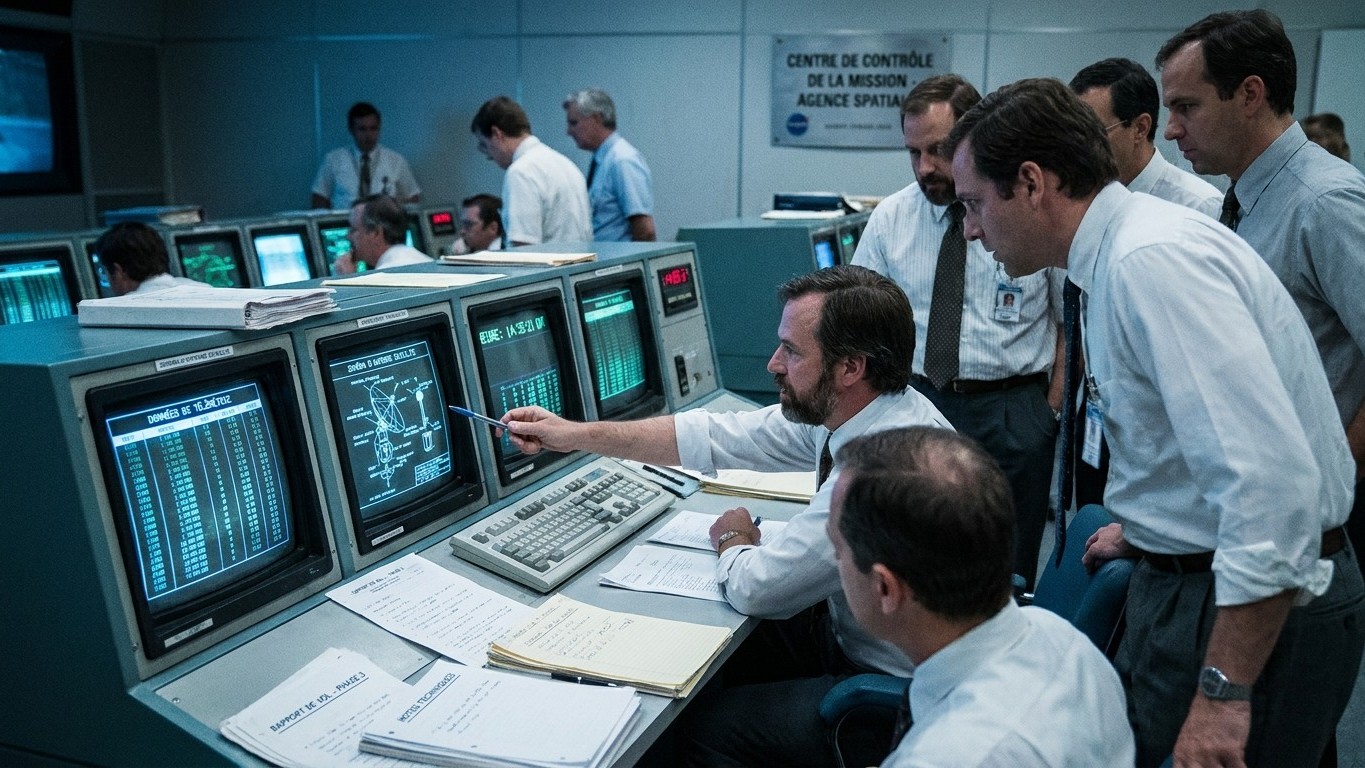
On April 11, 1991, hundreds of millions of kilometers from Earth, a simple command issued from NASA’s mission control: deploy Galileo’s large high-gain antenna, a 4.8-meter disk designed to function like an umbrella. Nothing went as planned. Of the eighteen metallic ribs that were meant to unfold into a fan, three stubbornly clung to their central mast. The consequence: the spacecraft that was supposed to beam Jupiter images at a comfortable rate found itself whispering through the vacuum of space.
The story begins well before that infamous April month. After the Challenger disaster, Galileo and its antenna had to be sent back to JPL at the end of 1986, then shipped again to Cape Canaveral for integration and launch in 1989. The loss of lubricant was blamed on the jolts endured by the antenna during truck journeys across the country. A logistical detail, nearly trivial at first glance, that would nonetheless jeopardize one of the most ambitious missions ever sent to the giant planets.
Takeaways
- A giant umbrella-like antenna remained stuck in distant orbit
- A tiny chemical detail compromised one of history’s greatest space missions
- How engineers saved the impossible by giving up on repairing the metal
An Umbrella That Refused to Open
On April 11, 1991, once Galileo was sufficiently far from the Sun’s heat, the probe executed the stored commands intended to deploy its large antenna. But telemetry received a few minutes later at JPL showed that something had gone wrong: the motors stalled and the antenna opened only partially. A team of more than a hundred technical experts, from JPL and the industry, sprang into urgent action. Within weeks, they analyzed Galileo’s telemetry and conducted ground tests on a spare, identical antenna. They concluded that the problem probably arose from the blockage of a few ribs, caused by friction between their pins and sleeves.
The culprit identified came down to one word: lubricant. The excessive friction between pins and sleeves was attributed to wear on surfaces that occurred after the loss of a dry lubricant applied to the pins during the antenna’s Florida manufacturing. A coating intended to guarantee smooth sliding had simply worn away, victim of the jolts accumulated during years of storage and transport before launch. A subsequent investigation confirmed this hypothesis: the most probable locking mechanism was friction at the pin-sleeve interface, at the mid-span restraint of the ribs; the rib pre-stress during factory storage had damaged the ceramic coating on the pin, designed to retain the molybdenum disulfide lubricant.
Ten Thousand Times Slower, Literally
The figure is dizzying. Without this steerable antenna, data transmission had to go through the low-gain antenna, whose rate was 10 to 40 bits per second, versus 134,000 bits per second for the main antenna. Do the math: that’s a ratio approaching ten thousand. To give a concrete sense, transmitting a single high-resolution image of Jupiter, which would have taken a few minutes with the main antenna, now required several hours, or even days, with the backup antennas.
Attempts to free the ribs stretched over nearly two years. These strategies were pursued from May 1991 to January 1993: the antenna would be folded and redeployed; for months the antenna was repeatedly exposed to the Sun and then moved into the shadow so that the pins would loosen under the cycle of expansion and contraction; the two electric motors used for deployment were driven in short bursts to create, by resonance, a torque 40% stronger than the original. None of it worked. The stubborn ribs remained as if welded cold by the vacuum of space itself.
Saving the Mission with Software, Not with Metal
Facing the impossibility of a mechanical repair, the Galileo team changed tack. Rather than forcing the antenna, they reinvented how the probe communicates. From 1993 to 1996, a new flight and ground software suite was developed, and NASA’s Deep Space Network stations were enhanced to carry the mission forward with the spacecraft’s low-gain antennas. Compression algorithms allowed packing maximum scientific data into an absurdly narrow data stream, while the large ground-based antennas in the network were made more sensitive to capture even the faintest whisper from Jupiter.
The gamble, nearly audacious, paid off. Despite the malfunction, it is estimated that about 70% of the original scientific objectives were eventually achieved. Galileo also marked several world firsts: a flyby of the asteroid Gaspra in October 1991 and Ida in August 1993, with the unexpected discovery of a tiny moon, Dactyl, orbiting Ida. The spacecraft also witnessed, up close, the spectacular collision of Comet Shoemaker–Levy 9 with Jupiter in July 1994, before finally placing itself into orbit around the gas giant on December 7, 1995.
The blocked antenna, therefore, did not kill the mission; it merely forced it to improvise. There is a certain irony in watching a space agency capable of sending a probe billions of kilometers away be tripped up by friction of just a few microns on a titanium pin. Twenty-eight years after that fateful April 11, the lesson has been formally integrated into NASA’s technical archives: the official dossier now calls for stricter lubricant selection and a design more tolerant of failures for single-use, non-redundant deployment mechanisms of this kind. Galileo completed its mission by deliberately plunging into Jupiter’s atmosphere in September 2003 to avoid any chance of contaminating Europa’s subsurface ocean that it had helped reveal beneath its icy crust.
Sources: 19fortyfive.com | clubic.com
