
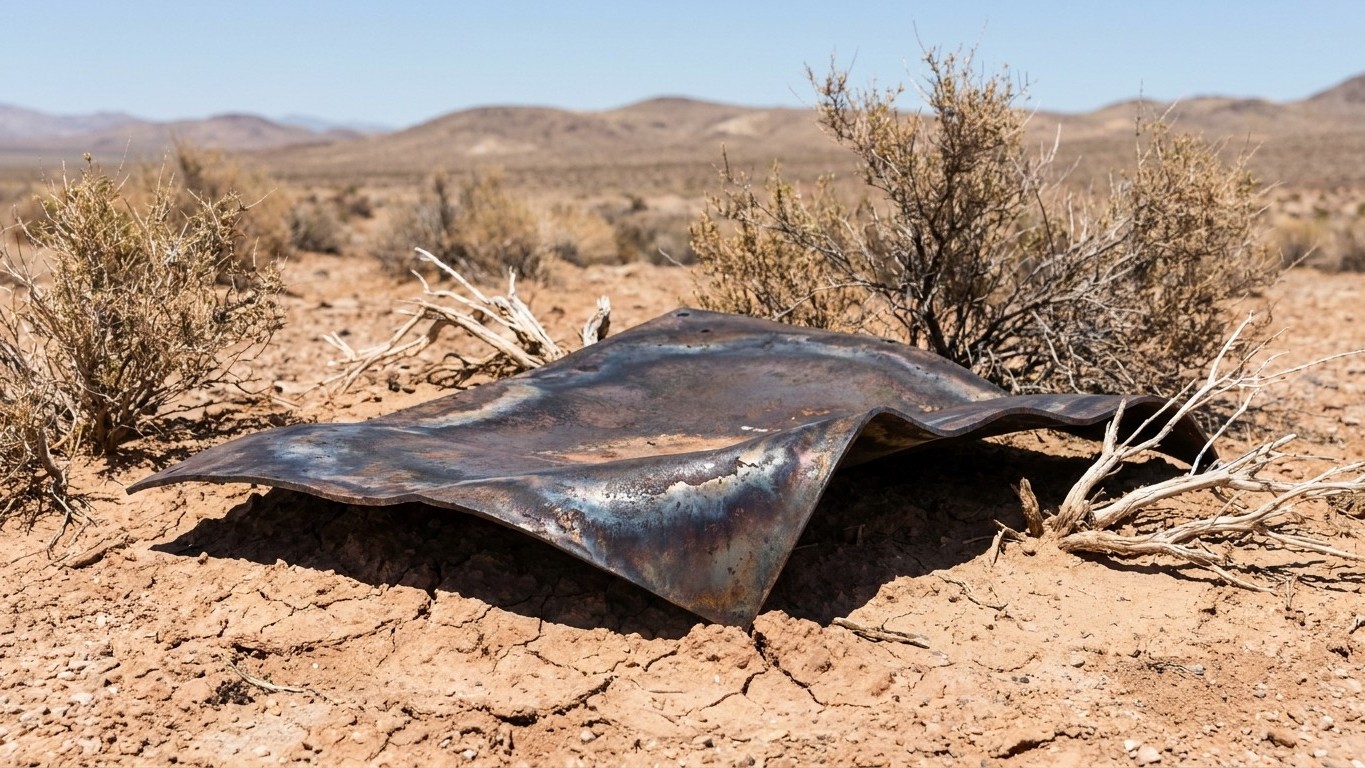
A 900-kilogram steel plate welded onto a nuclear test shaft, launched at a speed that surpasses anything humanity has ever sent from the surface of the Earth. This is what happened on August 27, 1957 at the Nevada Test Site, during the Pascal-B underground nuclear test, as part of Operation Plumbbob. An improvised giant cannon, and an enigma that still has no definitive answer.
À retenir
- A 900 kg steel plate welded onto a nuclear test shaft vanished in a few milliseconds
- Physicists estimate its speed at six times the velocity needed to escape Earth
- Its fate remains a mystery: vaporized in the atmosphere or lost forever in space?
A cap meant to contain the explosion
The objective of physicist Robert Brownlee, a researcher at Los Alamos Laboratory, was not dramatic on paper: figure out how to confine the radioactive fallout of an underground nuclear explosion. Brownlee was tasked with determining methods to contain underground blasts, starting from a detonation at the bottom of an open shaft and then progressively adding “plugs” of concrete to cushion the blast. Pascal-A, the first test, had already set the tone: the blast’s yield was far higher than predicted, estimated at about 55 tons, which caused quite a stir at the test site.
For Pascal-B, the team wanted to push further. The device was placed at the bottom of a roughly 150-meter-deep hollow column, and a 900-kilogram iron cap, 10 centimeters thick, was welded to the top. On paper, this cap was supposed to stay in place and smother the blast. Brownlee, however, doubted it—he believed the cap might not endure the ordeal, and his doubt would prove justified.
The shaft turned into a cannon
At 3:35 p.m. local time on August 27, 1957, the setup fired. Pascal-B detonated with a yield of 300 tons, and the fireball leaped into the Nevada sky, propelling the cap as intended. But “as intended” is an understatement here. Immediately upon detonation, the blast surged up the shaft and launched the cap into the atmosphere, prompting some to speculate that it had become the first human-made object to enter Earth’s orbit.
The shaft, with its rigid walls and narrow diameter, functioned exactly like a firearm barrel: an explosive charge at the bottom, a precisely calibrated projectile atop, and a tube to guide the thrust. The comparison isn’t far-fetched. When the bomb exploded, it didn’t merely explode; it created a pressurized column of nuclear fire within the shaft, effectively turning it into a giant cannon, with the steel plate acting as the “bullet.” A striking image for a test that, at its core, aimed to study how to confine radiation.
A single camera image, and 66 kilometers per second
To gauge the plate’s exit velocity, Brownlee had arranged a high-speed camera focused on the shaft’s opening. This camera, capturing one frame per millisecond, was aimed at the aperture to study the plate’s speed; after detonation, the plate appeared in only a single frame. In the blink of a scientific eye, it had already vanished from view.
Direct measurement was impossible under these conditions. Yet a single image was enough to establish a lower bound. In a conversation with Bill Ogle, Brownlee estimated the speed to be “six times the Earth’s escape velocity,” roughly 67.2 km/s. Other analyses arrive at a similar order of magnitude: the 900 kg cap was ripped from the top of the test shaft at speeds exceeding 66 km/s. To put that figure in perspective, Earth’s escape velocity, the speed required to permanently break free from the planet’s gravity, is about 11.2 km/s. The plate thus streaked away at a pace six times faster than necessary to never return to Earth. By comparison, a rifle bullet typically travels at around a kilometer per second or less.
Brownlee, not given to grandiloquence, summarized the situation with a line that became a cult quote in physics circles. He calculated a lower bound based on the time between frames and quipped that the best estimate was that the plate sped away “like a bat out of hell” at incredible speed. A subtly irreverent expression, yet it captures the team’s disbelief at what they had just measured.
Vaporized or lost in space? The debate persists
The question that still fuels forums of enthusiasts and science-popularization articles nearly seven decades later is this: what became of the plate? It was never found on the ground or anywhere else. The most solid and widely accepted trail among physicists points to a complete destruction in the atmosphere. Scientists believe that the heating and compression during the extreme velocity would vaporize the cap as it traversed the atmosphere. At 66 km/s in the lower, denser layers, the friction would generate enough heat to turn steel into plasma in a fraction of a second.
Brownlee himself consistently avoided endorsing the “first human-made space object” legend, which has circulated for decades. He said he never witnessed, nor did he ever claim to have seen the plate shoot into space. What he did see was a camera image, and nothing more. The scientific skepticism in the face of populist hype remains almost a textbook case in itself.
One telling detail makes the tale even tastier: if the plate had miraculously survived its atmospheric journey, it would have outpaced Sputnik 1 by weeks in the space race. Sputnik was launched on October 4, 1957, a little over five weeks after Pascal-B. Yet no official body has ever validated this hypothesis, and the purely vertical trajectory of the shot makes orbit physically impossible: a objects launched straight upward cannot reach orbit; they rise and then fall unless they disintegrate beforehand. The Pascal-B plate will likely remain forever what it is now: a steel fragment somewhere above Nevada’s desert, a testament that a containment test gone wrong can, by accident, yield the fastest object humanity has ever propelled.
Source : plane-encyclopedia.com
