
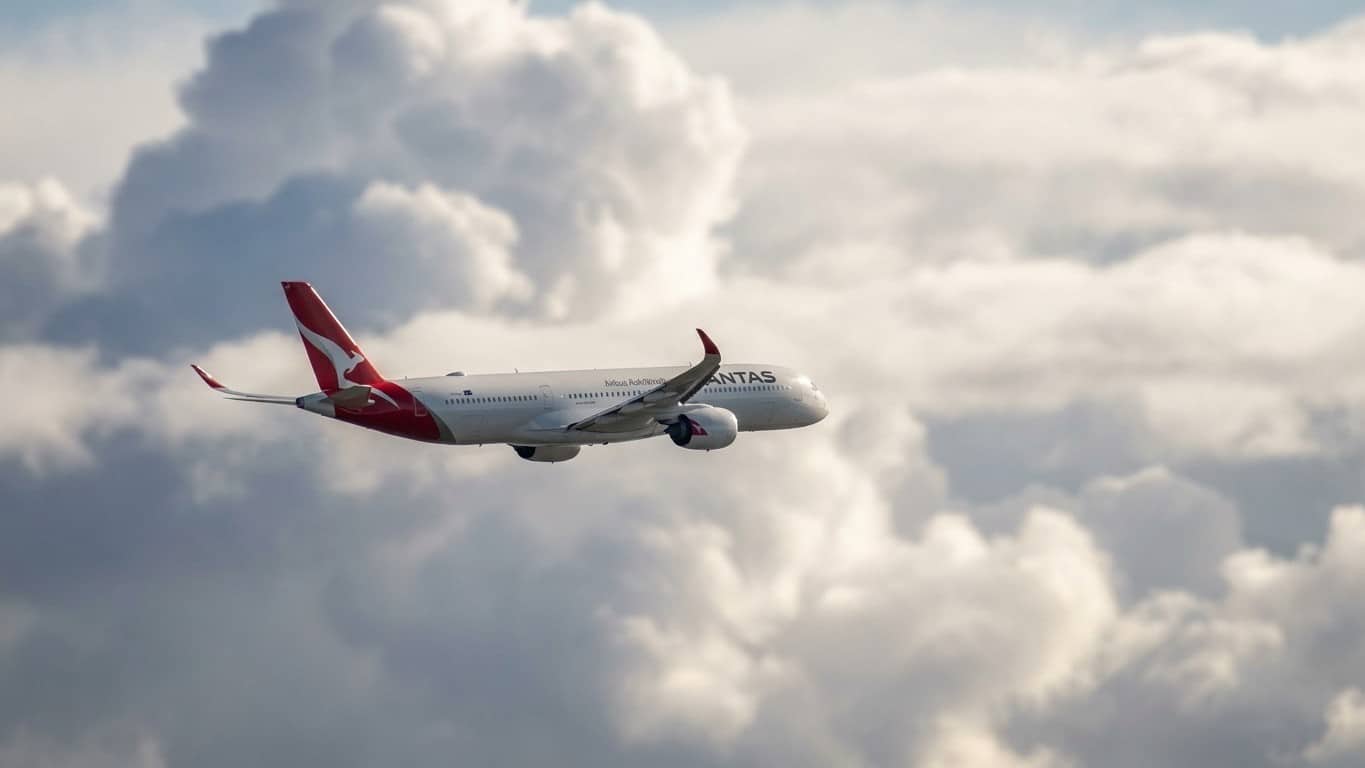
Twenty-four hours and ten minutes. That is how long it took a Qantas-branded Airbus A350-1000ULR to fly from Melbourne to Toulouse non-stop, a test flight that quietly shattered a record two decades in the making. The previous Guinness World Record stood at 22 hours and 42 minutes, set by a Boeing 777-200LR that connected Hong Kong to London in November 2005. This time, the aircraft crossed the Pacific, then the United States from west to east, before crossing the Atlantic to land in France, according to data from Flightradar24, which recorded durations that varied slightly among trackers, ranging from 24h10 to 24h25.
To note
- Which Guinness record did Qantas smash after twenty years of waiting?
- Why did the Melbourne–Toulouse return trip take a completely different route than the outbound?
- How feasible is it to endure 22 hours in a pressurized cabin without health risks?
A return flight that is far from symmetrical
This journey represented the second half of a test program conducted from Toulouse. The previous week, Airbus had made waves by performing a nonstop test flight from its Toulouse Blagnac facilities to Melbourne, a flight that lasted 19 hours and 13 minutes and was the most-watched flight of the day. Logically, one might have expected the aircraft to repeat the same path on the way back. But instead of simply retracing its steps toward the northwest, the jet chose to complete the return by veering northeast.
This route, seemingly absurd on a flat map, actually follows an inexorable logic. The flight demonstrated that the eastward transpacific route, taking advantage of the jet stream’s tailwinds over the Pacific rather than headwinds on a westbound return, presents a viable operational profile for the future Sydney–London commercial service. According to CNN, which tracked the journey day by day, the aircraft was set to redo the route on Monday, after a Toulouse–Melbourne flight of more than 19 hours, on planned paths that could reach 22 hours and more than 10,000 miles.
Why the East pays and the West costs
The first key to understanding lies in geometry. On a globe, the shortest path between two points is never the straight line drawn on a flat map (the loxodromic route with a constant heading), but a great-circle arc, known as an orthodrome, that follows the curvature of the Earth. Melbourne and Toulouse are nearly antipodal. For this kind of journey, the shortest route can pass over the pole or via the equator depending on the winds, and the difference between the two tracks can amount to thousands of kilometers.
The second key, even more decisive, is meteorology. At mid-latitudes, jet streams blow from west to east, propelled by the rotation of the Earth and the temperature differences between polar and tropical air. An aircraft flying east benefits from this tailwind and can gain several hours of flight time; attempting the same journey westward means fighting headwinds, consuming more fuel for the same distance. That is precisely the calculation Qantas made when choosing to head northeast for the return rather than retracing the direct route. Qantas has already indicated that transpacific crossings, leveraging wind conditions, are an option for the future nonstop Sydney–London route, to be launched as part of Project Sunrise in October 2027.
There remains a constant trade-off between fuel and payload. Each ton of kerosene carried must itself be transported, so it is burned to move the aircraft: beyond a certain threshold, adding fuel merely increases weight without truly expanding usable range. This is the core technical challenge of the A350-1000ULR. The aircraft was designed with a central aft fuel tank, boosting its range by about 1,000 nautical miles compared with the standard version, a compromise that allows transporting passengers and freight over extreme distances without fully sacrificing commercial capacity.
Twenty-two hours in a pressurized tube
Going farther is one thing. Keeping a human body comfortable for twenty-two hours inside a cabin is another matter. The pressurization of airliners never replicates sea-level conditions: it maintains a cabin pressure equivalent to roughly 1,800 to 2,400 meters in altitude, which can provoke mild hypoxia in most passengers, with possible symptoms such as headaches, fatigue, or difficulty concentrating. The cabin air, drawn from high altitude and recycled, is also considerably drier than ambient air, drying mucous membranes and increasing fatigue.
Added to that is prolonged immobility, a known risk factor for blood circulation, and jet lag, which disrupts the body clock well after landing. This is precisely what Qantas aims to document with this test program. Airbus engineers and analysts used these two test flights to examine a wide range of systems and collect enormous amounts of data on every aspect of the journey, with Qantas particularly eager to understand how this long-haul flight will affect passengers. Two pilots from the Australian carrier even joined Airbus’s test crew for the return leg, also to test the human factor from an operational perspective.
An test run ahead of October 2027
This aircraft will never carry paying passengers: it is a test prototype, registered F-WULR and nicknamed Vega, dedicated to certification. It is the first of twelve A350-1000ULRs ordered by Qantas for Project Sunrise, the program intended to launch nonstop connections from eastern Australia to destinations such as London and New York, with the first deliveries expected in 2027. Vanessa Hudson, Qantas Group CEO, confirmed in June 2026 that the first Sydney–London commercial flights would go on sale in February 2027 for a launch in October 2027.
There remains one question that this test flight does not fully answer: how will an economy passenger, without the training of a test pilot or the opportunity to stretch their legs every couple of hours, endure these twenty-two hours in real life? The commercial answer will come in stages: first London in late 2027, then Sydney–New York, confirmed as the second route of the program after London. The prototype, for its part, will have already spoken to the feasibility of the technical side. On human comfort, real-world experimentation is only just beginning.
Sources: hype.aero | simpleflying.com
